
Ten Things Not to Say When Disciplining

Effectively Handling Classroom Discipline
 

The words a teacher uses when disciplining sends a message to children, and not always a good one. If you want to effectively handle classroom discipline, here are ten things not to say when you discipline.
  1. "Because I said so."
    Problem:
     
    God is the ultimate authority, not you. Also, expecting blind obedience does little to help children understand issues. Obedience should always be expected but you should have a valid reason for your expectations.
     
  2. "You're such a bad girl/boy."
    Problem:
     
    This is an attack on the person rather than the behavior. Yes, we are all depraved but we are also created in the image of God. Children should be treated with dignity and respect, not demeaned.
     
  3. "I'm sick and tired of you acting this way. I can't take any more."
    Problem:
     
    For children, this kind of statement can be perceived as rejection. God doesn't give up on us. He is patient, kind, loving, and merciful. Discipline shouldn't be about how you feel but about helping the child.
     
  4. "When I was a boy/girl . . ."
    Problem:
     
    Comparisons to the past take you out of the present moment, getting attention off the problem at hand. Besides, times have changed. Empathizing with a child can be helpful but often this approach is more about chiding than empathy.
     
  5. "If you .... then I'll give you ..."
    Problem:
     
    Bribing children to behave focuses on outward conformity rather than getting to the root problem and developing inner change and intrinsic motivation. You are focusing on short-term results rather than long term change.
     
  6. "I've had enough."
    Problem:
     
    Students have been allowed to push you to your limit. When a teacher gets to this point, he/she often reacts out of anger or frustration rather than love and concern.
     
  7. "If you don't behave, I'm going to tell your parents."
    Problem:
     
    Too often this is an empty threat, a control tactic to intimidate the child into behaving. When parental involvement is needed, a mere statement of fact should be made and not a threat. A statement of fact will be followed through whereas a threat often is not.
     
  8. "Now you're going to be punished."
    Problem:
     
    The biblical word used for discipline indicates that disciplining is more like a tutorage program, not punishment. It looks ahead to what your children can become not simply what they did wrong.
     
  9. "Don't do this .... don't do that ..."
    Problem:
     
    While rules are needed, they should be positively stated. The idea is to build up, not condemn. Surrounding children with a wall of no's does little to motivate them.
     
  10. "I know you can't help it. It's okay."
    Problem:
     
    Permissive teachers who let children slide on misbehavior fail to hold them accountable. It is not okay. They will not learn if you do not deal with it. Too often this kind of statement is more a matter of inconvenience or laziness on the part of the teacher or perhaps a misguided belief that he/she will be liked better with this kind of reaction. Failing to train a child by disciplining is not the loving thing to do.


Use These Resources to Become More Effective with Classroom Discipline
 

Effectively Handling Classroom Discipline Workbook
 
more info about the Classroom Discipline Workbook

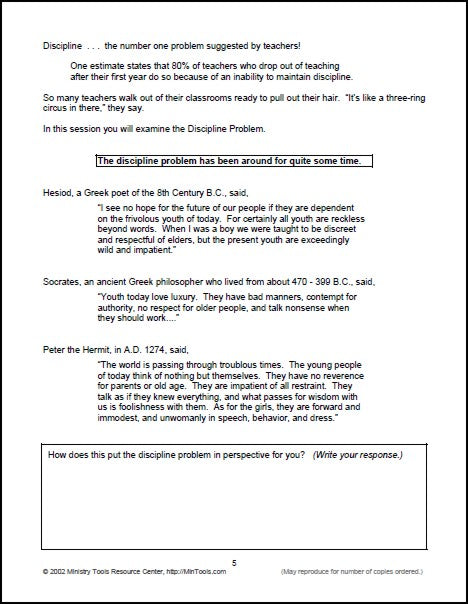
"Effectively Handling Classroom Discipline" is a 97 page self-study guide that will lay the groundwork for going beyond mere crowd control to making a difference in the lives of your students even in the process of disciplining. It takes you beyond the adoption of an arsenal of tactics to the development of a comprehensive style of disciplining that uses God as a standard.


Handbook on Classroom Discipline
 
more info about the Handbook on Discipline

Use this handbook as a reference providing tips for effectively handling classroom discipline problems. Along with general tips, you will find help in dealing with some specific behavioral issues.


Discipline Issues
 
more info about the Classroom Discipline Workbook

In the 'Discipline Issues: What to Do About Specific Challenges' you will find one page sheets for each of 56 different classroom discipline issues, looking at the challenge these discipline issues bring, possible causes, and ways to correct and better yet circumvent (prevent) problems.


Biblical Authority versus the Authoritarian and Permissive Teachers Worksheet
 
more info about the Biblical Authority versus the Authoritarian and Permissive Teachers Worksheet

How teachers manage the classroom teaches. In this 3 page worksheet you will compare Biblical Authority to permissive and authoritative styles to understand the message each of these approaches communicates.


Click Here for other teacher training materials from Ministry Tools Resource Center.
 
 
Click Here for online teacher training.


Share:


More Training on Disciplining:

     5 Key Elements in an Approach to Classroom Discipline
     An Umbrella for Classroom Discipline
     Classroom Discipline Must Get Beyond
     Dealing with Discipline Problems
     Hidden Messages in Disciplining
     Discipline Tip (changes monthly)


Home Page  :  Search Site  :  Site Map  :  Privacy Policy  :  Training  :  Resources  :  Our Store  :  Contact Us
 
Follow on: Follow MinTools on Twitter Twitter    Find MinTools on Facebook Facebook    Google+    Find MinTools on FriendFeed friendfeed     Follow on Pinterest Pinterest     Help MinTools.com thru: Help support MinTools thru iGive iGive