But It Hurts!

Share:

Have you ever noticed how we as Christians makes excuses for ourselves for having bad attitudes, negative thinking, and ungodly reactions?

I don’t feel good.
I’m under a lot of stress.
I’ve been hurt real bad.
I’m tired.

Yes. We feel pain and disappointment. We face struggles and obstacles in our way. We don’t always get treated the way we should. While we shouldn’t deny the reality of how we feel and what we have experienced, does that excuse us from demonstrating God’s love to those around us by lashing out at them or making their lives miserable? Does that excuse us from walking the walk?

No Loopholes in Scripture for When It Hurts

Read through Scripture and you’ll find verses like the following:

And the Lord’s servant must not quarrel; instead, he must be kind to everyone, able to teach, not resentful. (2 Tim. 2:24)

Rejoice in the Lord always. I will say it again: Rejoice! Let your gentleness be evident to all. (Phil. 4:4-5)

Be completely humble and gentle; be patient, bearing with one another in love. (Eph. 4:2)

Love is patient, love is kind. It does not envy, it does not boast, it is not proud. It is not rude, it is not self-seeking, it is not easily angered, it keeps no record of wrongs. Love does not delight in evil but rather rejoices with the truth. It always protects, always trusts, always hopes, always perseveres. (1 Cor. 13:4-7)

Somehow we think we are the exception, that our situation is different. Scripture, however, makes no distinctions. We are to walk the walk even when it hurts because we have help for when it hurts. God knows what we’ll face in life and provides what we need to rise above.

  • God knows we’ll have situations in life causing us to hurt and grieve so He provides comfort.
  • God knows we’ll have stressful and anxiety-producing circumstances so He provides peace.
  • God knows we’ll have sorrow and sadness in life so He provides joy.
  • God knows we’ll have plenty of temptations so He provides grace to overcome.
  • God knows we’ll have troubles of various sorts so He provides hope of a better day.

A Biblical Example of Walking the Walk Even When It Hurts

King David of the Old Testament was no stranger to suffering. Read through the Psalms and you’ll notice his candor in talking about his feelings but then it’s like as though he would catch himself and say “Why so downcast, O my soul? Why so disturbed within me? Put your hope in God, for I will yet praise him, my Savior and my God” (Ps. 42:11). He had a keen awareness of what God offers to those who hurt.

Walk the Walk Even When It HurtsDavid penned the words,

“Even though I walk through the valley of the shadow of death, I will fear no evil, for you are with me.” (Ps. 23:4)

The entire Psalm 23 forms the basis for the devotional Bible study guide titled, Walk the Walk Even When It Hurts. As you work through the devotions, you’ll encounter a realistic view of struggles and hardships, the valleys of life, yet encouragement that it is possible to rise above.

Share:

Ministry Resources

Share:

Learning from what others have written about ministry in their books, articles, and video presentations can be quite helpful, keeping you from having to always learn the hard way. Using curriculum and other ministry tools already developed saves time so you can focus your attention elsewhere. For this reason, Ministry Tools Resource Center provides pages devoted to listing ideas and resources to enhance your learning and better equip you for ministry. Check out the List of Ministry Resources Pages pointing you to resource pages for church life (i.e., body life, fellowship, spiritual gifts), doctrine, equipping & ideas for ministry, holidays & seasons, and people groups — currently near 90 different topics.

While all of those pages may contain beneficial resources, we’d be remiss to think it’s all we need for effective ministry. And, we’d be unwise to view those resources as our starting point.

Begin with God When Looking for Ministry Resources

God does encourage us to consult with and learn from others (Prov. 15:22) but He also says “the fear of the Lord is THE BEGINNING of knowledge” (Prov. 1:7) and “the fear of the Lord is THE BEGINNING of wisdom” (Ps. 111:10). The more we know and love the Lord our God in the fullness of who He is, the more we’ll trust Him to be our all in all, leading to a realization of His power at work in and through us. That’s where we begin!

Ministry Resources from His Divine Power


His divine power has granted to us everything pertaining to life and godliness, through the true knowledge of Him who called us by His own glory and excellence. (2 Pet. 1:3, NASB)

Only the unchanging character of our glorious God gives us a firm foundation upon which to stand (Ps. 40:2) as well as a shield and fortress to shelter and protect (Ps. 18:2; 94:22; Prov. 18:10).

When we start with God, we’ll be in a better position to discern and filter what we read from other resources so we apply what is not only doctrinally sound but also a good fit for our situation. God promises to direct our paths when we trust in Him with all our heart rather than lean on our own understanding (Prov. 3:5-6).

When we begin with God, we’ll be better able to withstand the pressures and stressors of ministry, knowing that He not only has the best answers but also the ability to calm the soul just as Jesus calmed the raging sea (Mk. 4:35-41).

Be Sure to Check Out: The Ministry Worker’s Devotional: A Mighty Fortress Is Our God

Share:

Help Keep Ministry Online Using iGive & Affiliate Links

Share:

Do you shop online? Do you appreciate this ministry?  You can help keep God’s work through Ministry Tools Resource Center online without any extra cost to you. Simply search for one of the over 2300 online stores in the iGive network after clicking on our iGive link and a portion of the money you spend benefits Ministry Tools Resource Center.  You pay the same price at the store you normally would, perhaps even less if you find a coupon or deal on iGive.  It won’t take long setting up an iGive account, making Ministry Tools Resource Center as your cause.

iGive.com

Ministry Tools Resources is also an affiliate with a number of retail stores. When you purchase through the links on the following page, a small commission from your order goes to this ministry:

Check out: Complete List of Affiliate Stores

The following pages provide links to the same stores but give you targeted resources:

Any purchases you make through links on those pages will help keep this ministry online. You’ll have a part in equipping believers around the world. And, it is greatly appreciated.

Share:

Train Small Group Leaders

Share:

Due to the potential of life change that can come through small groups, it’s always been important to have leaders who are trained, not only to facilitate discussion, but also to shepherd members of their group. Take some time to examine what you’re doing to train small group leaders in your church. What kind of training do you provide? How encompassing is your support and encouragement?

Train Small Group Leaders to Meet the Challenges of the Days in Which We Live

Small groups form for various reasons and so training always needs to be specific to the focus and primary agenda for their meeting. But, in addition, training needs to prepare small group leaders for challenges relevant to the days in which we live.

  1. Since a question for small groups may no longer be about the “place” where they should meet but rather the online “platform” they should use, additional training may be required.

Some groups may meet online temporarily with others meeting that way for the long haul. Some may use a combination of online and in-person. Small group leaders need to be effectively trained to not only know how to use technology but also how to use it in ways that are safe and productive for their small group.

You’ll first need to determine the best platform for your small group needs (based on number of participants, length of meeting time, cost, group member’s ability to access it, etc.). Some common platforms include:

Church Online Platform
FaceTime
Google Meet (was Google Duo)
Google Chat (was Google Hangouts)
GoToMeeting
Microsoft Teams
Skype
Zoom

Also be sure to train small group leaders about the differences of leading a group online versus in-person. Here are some articles on other sites that can be of help:

  1. Though support groups used to be the main type of group for helping people work through addictions and mental health issues, more and more people are experiencing anxiety and depression today. Almost any type of group will consist of people with these kinds of needs more and more. Are your small group leaders prepared?

Small group leaders need to be trained on how to respond both within the group meeting and one-on-one. How can they and the group be a support system to one another? When is it time to guide the person in finding help outside of the group?

As relates to the days in which we live, perhaps providing leaders with coping skills suggestions to pass on would be helpful. Also remember that leaders too need support and comfort. Here are some articles on other sites that may be of help:

Maybe a study on dealing with anxiety and depression would be beneficial. The following links will take you to one of our affiliate stores:

If meeting online, people may find it easy to hide their feelings behind the screen. Small group leaders need to learn how to observe, connect, and engage with people in ways that get below the surface.

Share:

3 Tips for Any Kind of Ministry Online

Share:

Online ministry has become a way of life these days. Some of it will continue on for years to come so it is important we remember key factors that relate to how God wants us to do ministry.

Tips That Serve as Reminders for Any Kind of Ministry Online

1) Remember that love “always protects” (1 Cor. 13:7).

Any kind of online ministry needs to be done safely, with cyber security in mind. In addition we must always guard people’s privacy, time, contact preferences, etc. so as to respect and protect. We need to build parameters into the kind of interactions allowed so as to minimize negative and destructive commenting, etc. which tends to happen more freely when hidden behind screens.

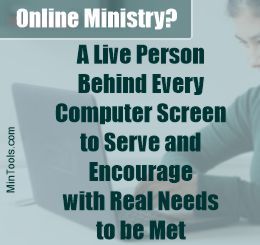
Online Ministry2) Remember that behind every screen is a live person.

  • Meeting their needs matter. Sometimes it’s easier for people to mask what’s really happening in their lives through online platforms. How will you discern needs? If we rely on people to take the first step, many needs will undoubtedly go unmet.
  • Relationships matter. We cannot rely solely on streaming a worship service to follow God’s design for Body life. That takes relationships. Even if you have a platform wherein people can interact, how much relationship building really happens? What are you doing to follow up with people who attend digitally? How are relationships fostered?
  • Encouraging matters. We meet with the purpose of “encouraging one another” according to Hebrews 10:25. Is that happening through your online ministry? How do you know?

(Be aware that churches can fall short on the above even when meeting in person. We must always strategically work at meeting needs, building relationships, and encouraging one another but it becomes even more challenging with online ministry.)

3) Remember that it isn’t the same as meeting in person.

While meeting online might be considered connecting with other believers, the full intent of God’s command to meet together (Heb. 10:25) is that we physically gather. There are benefits of in-person that cannot happen as easily, as unencumbered, and sometimes never online. Ministry online can bridge some gaps and provide a temporary means of connecting but should not completely and permanently substitute for in-person meeting with one another.

Share:

3 Tips for Ministry & Church Newsletters

Share:

Many churches and ministries rely on newsletters of some sort to communicate.

Tips for Ministry & Church Newsletters

While there are many suggestions that could be given about using newsletters, here are three tips to give some broad perspective. The MinTools.com newsletter will be used as an example.

  1. Have a purpose for your newsletter.

Develop a newsletter for a good reason, not just because other churches or ministries do it. When you have an overall, broad objective you’ll have clearer direction for what content to include in it.

Ministry Newsletter
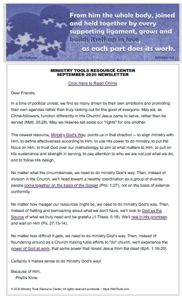
Click image to read the current month’s MinTools.com Newsletter.

MinTools.com Example:

At the start of every new month at MinTools.com an e-mail newsletter is sent to those who sign up for it. I praise God for the many people from around the world who have subscribed to it. These newsletters have multiple purposes:

  • They provide an update of new material on this site, as well as the sites devoted to training for Bible teachers and Church leaders.
  • They address a spiritual issue or ministry need relevant to believers in the Church.
  • They seek to encourage or challenge us to think about how well we are lining up with the character of God and principles from His Word, the Bible, in that area.

Please take time to read this month’s newsletter. You can subscribe to it on that same page. Please know that your e-mail address is used for no other purpose.

  1. Strategically determine the newsletter’s format and means of distribution.

If you have a primarily online ministry, a digital format of some sort may be the way to go for you too. But, if a church or ministry is not primarily online or worldwide, postal mail may be more of the way to go. If you decide to hand them out in person (i.e., at the doors on their way out, in their church mailboxes, etc.) to save money, you’ll need to accept the reality that many newsletters may not actually make it home and get read. You’ll also need to be aware that very likely not everyone will have attended the meeting during which you distributed them.

Remember, budget alone should not be the determining factor for the format you use. Always consider your readers. What will the people you minister to/with be most likely to read? A combination of e-mail/online and hardcopy might be necessary if you want to increase the number of people who read it.

MinTools.com Example:

Since Ministry Tools Resource Center targets believers around the world, the best format to date has been to use e-mail as the medium. Not only would the cost be prohibitive to send a hardcopy newsletters through the postal service, but it also would not be as conducive to directing people to updates on the site, one of the key purposes for doing the newsletter. In an e-mail newsletter, people can easily click on links to new posts and/or new resources. The newsletter can also be found online as well. You can freely sign up to receive these e-mail newsletter updates generally sent once a month.

  1. Don’t assume everyone will read it.

One thing you quickly learn in ministry is that no matter how purposeful and strategic you might be in using a newsletter update, not everyone will read it. And, while some may thoroughly read it, others will merely glance over the highlights.

If you’re using a newsletter to communicate something you don’t want people to miss, be sure to use other formats of communication. Also, figure out a way to highlight that information in the newsletter so it will less likely be missed.

MinTools.com Example:

In looking at the statistics about the MinTools.com newsletter, I realize that not everyone reads it — very common with e-mail newsletters. Sometimes the e-mail goes into people’s junk/spam folder. Sometimes the e-mail may not even get to people’s e-mail account at all. And, sometimes when it makes it, it still doesn’t get read, in large part because people are just so busy and/or they get so much e-mail they can’t look at it all. But, I also note that enough people do receive it and read it to make the newsletters worth the time and effort. At times people respond with positive feedback about how God used it to encourage and spur them on.

Of course, there are many other factors to consider (how often, who will develop it, layout, name, etc.). Rather than just do a newsletter the way you’ve always done it, seek God’s wisdom on how you can be more purposeful and strategic, increasing the potential of more people actually reading it.

Share: