Father’s Day Is …

Share:

On Father’s Day we honor the fathers among us. Scripture clearly teaches that the role of fathers goes beyond mere providers and protectors. Notice how Ephesians 6:2-4 reminds us of their responsibility beginning with how not to do it. — Fathers, do not exasperate your children; instead, bring them up in the training and instruction of the Lord.

Three Points About What Father’s Day Is …

Holiday Reflections Includes Father's Day
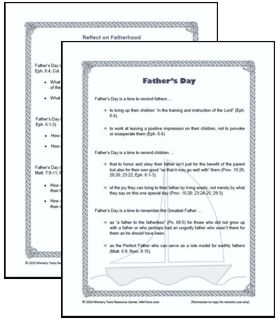
You’ll find the following three key reminders for Father’s Day in the Holiday Reflections Discipleship Guides resource, along with additional subpoints, Scripture, and some questions to reflect on. Father’s Day is one of fourteen holidays covered in this resource which can be used for personal benefit, in a small group, or distributed to your entire church.

  1. Father’s Day is a time to remind fathers to bring up their children “in the training and instruction of the Lord” (Eph. 6:4).
  1. It’s a time to remind children that to honor and obey their fathers isn’t just for the benefit of the parent but also for their own good “so that it may go well with” them (Eph. 6:1-3).
  1. And, Father’s Day is a time to remember God as the Greatest Father, “a father to the fatherless” (Ps. 68:5) which would include those whose father is no longer alive and those whose father wasn’t there for them as they should have been. Check out this post: God as Our Father
Share:

But My Mother (Father) Abused Me

Share:

Sometimes the people who are supposed to love and care for us the most are the ones who abandon, neglect, or abuse us. The question is asked, “How do I get to the point of being able to forgive those who abused me?”

3 Suggestions for Those Abused by a Parents

I am going to make three suggestions for those abused by a parent. I trust it won’t sound too trite because it’s anything but that. Getting to the point of being able to do these suggestions is monumental when you have suffered at the hand of a parent.

1) Gain a biblical perspective.

God’s command to “honor” our parents comes without qualification. And, His Word specifically warns against scorning them (Prov. 20:20; 28:24; 30:11,17), letting us know that it is destructive for us to do so. Yet, the Bible nowhere tells us to accept abandonment, neglect, or abuse as normal or acceptable. We can “honor” them as our parents without agreeing with them or condoning what they do. Likewise, forgiving someone does not mean we agree with, condone, or even forget what they’ve done. Rather, we are not holding it against them. We are unlikely to honor them if we do not forgive them and vice versa.

2) Transfer your dependence onto the Lord.

Part of the anger and resentment we hold over these kinds of parents comes because we feel betrayed by them, the ones who were supposed to love, care for, and protect us. Accept that your parent may never be what you want or need him/her to be. Rely on the Lord to be there for you, to be the One who will meet your innermost needs. — “Though my father and mother forsake me, the LORD will receive me.” (Ps. 27:10) We will not forgive until we let go of our anger. We will not let go of our anger until we let go of our expectations.

3) Relinquish control to the Lord.

When a parent or other significant adult in our lives has harmed us in some way (physical or emotional), we tend to become self-protective. We are going to do whatever is within our power to shield ourselves. To forgive may seem like you are letting that person win, like you are relinquishing control or power to them. However, by forgiving, you are actually helping yourself become whole. You will not truly heal until you forgive. To be able to choose to forgive, you will need to turn over that control to the Lord who has promised to be there for you. That does not mean you will never need to put boundaries in place to protect yourself from the dysfunction. But, you will be doing it for healing purposes, not simply to protect yourself.
Forgive as the Lord forgave you, even parents who abusedScripture makes no exceptions on whom we are to forgive (Eph. 4:32; Col. 3:13). When we don’t forgive, it not only keeps a wedge between us and the other person but also hinders fellowship with the Lord (Matt. 6:12-15). Maybe your parent doesn’t deserve your forgiveness. Neither do any of us merit God’s forgiveness yet He went so far as to send Jesus to die for us so we could be forgiven. For the sake of the Lord and your relationship with Him, as well as your own inner healing, ask God to help you let go of your anger, bitterness, and resentment and forgive as He has forgiven you.

Share:

Mother’s Day Is …

Share:

Before getting into what Mother’s Day is, we should look at what this holiday is not.

This Holiday Celebrating Motherhood is Not in the Bible.

We can find verses where mothers are recognized. Proverbs 31 states that the children of a godly woman will “arise and call her blessed.” The Apostle Paul called attention to the contribution of Timothy’s mother and grandmother in his life (2 Tim. 1:5). And, we can find verses in the Bible about honoring our parents which goes beyond verbal recognition and certainly extends beyond what is done on one special day (Ex. 20:12; Matt. 15:4-6; Eph. 6:1-3).

But, Scripture does not command us, or even suggest, that we set aside a special day, like Mother’s Day, to do so. Consequently, this is a holiday about which we must develop personal convictions for celebrating it and we must also respect others for their opinions about it. Let’s apply Romans 14:5-8 to Mother’s Day.

What Mother’s Day is . . .

We can look at this holiday in the following ways:

Mother’s Day is a day to celebrate motherhood.

 It’s a time to make moms feel special.

Mother’s Day is merely one day to honor our mothers.

It’s a day to remember mothers who are no longer with us.

And, Mother’s Day is also a time to be sensitive toward those who want to be moms but can’t, those whose mom is no longer alive, and those who didn’t have a good mother.

While we might want to use this holiday to celebrate motherhood in the church, let’s do it in a way that is respectful and encouraging to all.

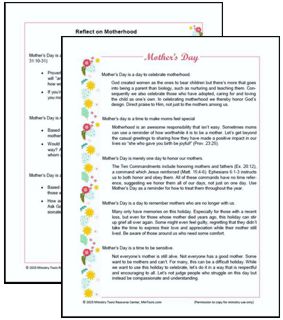
Holiday Reflections Discipleship Guides Includes Mother's Day
You can use the discipleship guide in the Holiday Reflections resource to help people think through the above points. It includes brief input on each of the points along with Scripture and some questions. (Mother’s Day is one of fourteen guides included in this resource.)

Also See: Mother’s Day Resources

Share:

Let’s Be Sensitive on Mother’s and Father’s Day

Share:

Mothers & FathersThe scene repeats itself at churches across the land.  It’s Mother’s Day or Father’s Day and the service revolves around this parent.  Certainly we do well to honor or celebrate mothers and fathers but let’s be sensitive.

Sitting among your congregation will be men and women who:

never had children

can’t have children and ache because of it

lost a child to death

hope to yet have children

Sitting among your congregation will be people, young and old, who grieve or struggle because they:

lost their mother or father to death, some even recently

never knew their mother or father

were abused or neglected by a mother or father

are estranged from a mother or father

I know of many people who stay home on Mother’s Day or Father’s Day because of the way the church handles this holiday.  It’s too painful.  It isn’t relevant.  — How sad that they don’t feel like they’ll get anything out of gathering with the Body that day.  How sad that they don’t trust us to be sensitive enough to their situations.  How sad that they don’t seek comfort on this hurtful day among the Body of Christ but rather feel the need to retreat.

How to be Sensitive on Mother’s and Father’s Day

We can start by thinking through:

  1. how much emphasis is placed on it
  2. how things are worded
  3. how we single out people … careful not to make one look superior to the other
  4. how gifts are distributed
  5. how obvious we make it that some in your midst are not mothers or fathers

We need to be careful at the same time that we are not being fake in our representation or obvious in our inclusion of people in these different situations.

The way to avoid that is to have a year-round environment … 

where people in all statuses and situations of life feel accepted and like they belong. 

where individuals’ life stages are acknowledged and needs are met but yet they are not segregated from the whole. 

It’s called body life … unity  … true fellowship … where we can meet with all of our differences and be better because of it.

In this kind of environment you will have more of a tendency to simply be sensitive and not have to guard yourself on holidays like Mother’s and Father’s Day.  You will come across genuine because you are.  If this kind of environment isn’t built throughout the year, special emphasis on certain segments can make others feel like they aren’t important or that their pain will be ignored.

———-
Resource that Includes Thoughts on Mother’s Day and Father’s Day:
(This resource includes guides on a total of 14 different holidays.)
———-
Share:

The Greatest Gift a Father Can Give His Children

Share:
Father's Day Gifts
Click image to check out Gifts for Fathers at one of our affiliate stores.


When updating the Father’s Day Resources Page, I came across a couple quotes I’d like to pass along that leads to the greatest gift a father can give his children.

Quotes for Fathers Leading to the Greatest Gift a Father Can Give His Children

A Father’s Day bulletin and bookmark with the same message quotes Oswald Chambers:

“The destiny of every human being depends on his relationship to Jesus Christ. It is not on his relationship to life, or to his service or his usefulness, but simply and solely on his relationship to Jesus Christ.”

So often men tend to find their worth in achievements and how well they fulfill their roles or positions in life  … like fatherhood.  This quote emphasizes that what matters most is that you know Christ.  That leads me to the next message I came across on another bulletin and bookmark which only makes sense if the father has that relationship with Jesus.

“The greatest gift a father can give his children is to walk in the footsteps of God.”

The father’s example will leave a much greater impact on his children than words alone could ever do.  A Pass It On Card provides an acronym for what it will take:

D.A.D. – Dedicated And Devoted

When fathers are first and foremost dedicated and devoted to the Lord Jesus Christ they will be to their children what they should be.  What greater gift could a father give than to be an example of someone who knows and loves the Lord?

Share: