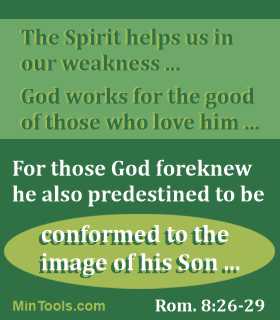
Conformed to the Image of Christ

Share:

Conformed to the Image of Christ, God's Son
God intends for us to be conformed to the image of Christ (Rom.8:29). It takes more than outward conformity of simply following His example. The change into His likeness begins on the inside, which then manifests itself outwardly in all we do. That requires power outside of ourselves. Only as we walk in the Spirit will we truly emulate Jesus from the inside out (Gal.5:13-26). Christlikeness will then affect all we do.

Conformity to Christ Affects Our Relationship with God

We read of Jesus praying to the Father. His example so impacted His disciples that they asked Him to teach them how to pray (Lk. 11:1-4). From Him we learn that teaching prayer by example requires … (Click on links to read posts.)

If Jesus found prayer to be vital to His relationship with the Father, certainly those who are conformed to the image of Christ should find praying vital to their walk with God.

Christlikeness Affects Our Relationships with Others

Scripture specifically exhorts us, “In your relationships with one another, have the same mindset as Christ Jesus” (Phil. 2:5). It goes on to describe an attitude of humility and servanthood. Read: Jesus’ Example of Servanthood

When conformed to the image of Christ, it spills over into how we speak and react. Click on the following links to read more:

Being Conformed to the Image of Christ Affects How We Do Ministry

All we do, “whether in word or deed”, is to be done “in the name of the Lord Jesus” (Col. 3:17). That means we pull on His power and authority as we align with Him in the way we serve. Take time to read: Ministry Methodology All in the Name of the Lord

Alignment with Him provides a broad covering for how we do ministry. We can also learn how to do specific ministries from His example. Consider teaching: Jesus, the Master Teacher, shows us how to teach others. Read the following posts to learn ways to conform your teaching with His:

When conformed to the image of Christ, we’ll also be concerned with helping others in their ministries. Jesus actively discipled and equipped people in His earthly ministry.

  • Let’s rely on and yield to the Holy Spirit to make us more like Christ in all we do!
Share:

How Do Your Co-Workers View You?

Share:

Daniel Thrown into Lion's Den Due to Jealousy of Co-workers
God miraculously delivered Daniel from the lions’ den, but why did they throw him in with the lions? True, Daniel continued to pray to God after the king’s decree forbidding everyone from praying to any god or human except the king for thirty days. The real reason, however, goes back further to what led to the king’s decree — to what was taking place in Daniel’s “workplace” with his co-workers.

How Daniel’s Co-Workers Viewed Him

Excelling in his job, Daniel received recognition, which made his co-workers jealous. To sabotage his success they wanted to bring an accusation against him “but they could find no ground of accusation or evidence of corruption, inasmuch as he was faithful, and no negligence or corruption was to be found in him” (Dan. 6:1-4).

Notice that they found “NO” negligence or corruption in him. That undoubtedly meant he didn’t justify even little breaks in integrity saying,

“It doesn’t hurt anything.”
“Nobody will notice.”
“Everybody’s doing it.”

Daniel’s co-workers concluded, “We will never find any basis for charges against this man Daniel unless it has something to do with the law of his God” (Dan. 6:5). Since his character flowed from Daniel’s walk with God, his co-workers would have to manipulate the king into making a decree they knew Daniel wouldn’t keep because of his unwavering devotion to his God.

What Kind of Testimony Do You Have in the Workplace?

Think about how your co-workers view you. Would they characterize you similar to Daniel (Dan. 6:4)?

Faithful?

Can people depend on you do do your job and do it well? Do the words trustworthy, consistent, and dependable describe you in the workplace?

No Negligence?

Do you avoid making mistakes due to carelessness? Are you careful not to cut corners or gloss over errors but rather aim for excellence? Do the words conscientious, attentive, and careful describe you in the workplace?

No Corruption?

Do you maintain moral integrity, not even getting caught up in little white lies? Do the words honest and good describe you in the workplace?

Result of Such a Testimony

We probably won’t get thrown into a lions’ den because of jealous co-workers. We might, however, get ridiculed, even fired if we fail to comply with an immoral demand. Are you willing to suffer for righteousness’ sake? God may not “shut the mouths of the lions” (Dan. 6:22) as He did with Daniel. Sometimes He allows suffering to bring about a greater purpose, though we may not see it at the time

The approval of God way supersedes the approval of other people, so “even if you should suffer for what is right, you are blessed” (1 Pet. 3:14). Jesus said, “Blessed are those who are persecuted because of righteousness, for theirs is the kingdom of heaven. Blessed are you when people insult you, persecute you and falsely say all kinds of evil against you because of me. Rejoice and be glad, because great is your reward in heaven, for in the same way they persecuted the prophets who were before you.” (Matt. 5:10-12)

More on the Workplace

Share:

Identifying and Keeping the Top Priorities?

Share:

We all have priorities, that which we deem as most important. We tend to invest most of our time, energy, and resources into what truly matters to us. As followers of Jesus, we need to ask if what we value most is what He views as the greatest priorities in life. Do we have the right priorities in our lives? How do keep His priorities at the top of our list?

Identifying What’s Most Important

Certainly it makes sense that if Jesus identified two commandments as the greatest, those commands should be our top priorities. In short, He said that loving God with all of who we are should come first. Love for people comes next. See Matthew 22:36-40.

Jesus Identified Love for God and People as the Greatest Commandments, Making It Our Top Priorities

Reflect on these priorities by clicking on the following links:

Keeping the Our Top Priorities

In the busyness of life, we can easily lose sight of what’s most important. We get caught up on all we have to do to the point that we neglect our relationship with God and often important people in our lives. Further, our old sin nature pushes us to self-fulfillment and self-gratification, making ourselves most important rather than God and others. How do we keep the right priorities?

It’s easy to say we love God and people, but another thing to live it out. Maintaining these priorities, however, is possible regardless of our life circumstances if we begin with the right perspective and continue by pulling on a power outside of ourselves. Take time to reflect on these realities by clicking on the links listed below:

Share:

Teaching About Prayer

Share:

Perhaps you want to teach on praying but aren’t sure where to begin. Maybe you taught about it in the past but it didn’t seem to have much impact. Incorporate the following elements when teaching about prayer and see if it makes a difference. (Click on the links within the post for added input.)

Begin by Getting to the Real Essence of Praying

Though a spiritual discipline we “ought to” do, praying is so much more. Through prayer we connect with the Almighty God, an outgrowth of our relationship with Him. While we could list a number of good reasons to pray, communion with the Lord ranks at the top. Help people develop the right purposes for praying.

Instruct People on What the Bible Says about Prayer

When teaching about prayer, help people learn to pray in a way that reflects who God is because who God is affects how He answers prayer. God’s Word provides valuable instruction, not just about the importance of praying but also what’s important when we pray. Jesus Himself gave pointers on how to pray.

Start teaching about prayer when people are young. The Children Learn to Pray Curriculum by Ministry Tools Resource Center uses the Lord’s Prayer as a starting point. For Bible lessons on prayer for all ages, go to: Teaching about Praying

Remember the Power of Your Example in Teaching about Prayer

Teaching about Prayer Came as a Result of Seeing Jesus Pray
(Click image to enlarge in Pinterest & repin.)

Look at Jesus for an example of the power of one’s own prayer life. — “One day Jesus was praying in a certain place. When he finished, one of his disciples said to him, ‘”Lord, teach us to pray …'” (Lk. 11:1-4) — Imagine your students, disciplees, or congregants coming to you and ASKING YOU to teach them to pray.

Teaching prayer by examples requires the following on our part …

Authenticity
Consistency
Availability

When praying becomes part of our church culture, people notice. We don’t just talk about praying. We pray.

When we pray like we truly believe, people notice. We don’t just go through the motions of praying. We actually believe God hears us and cares.

Share:

Learning to Cope in Times of Crisis

Share:

We will all inevitably face times of crisis, whether personal or as a nation. We find examples of how to cope in Scripture.

Learn How to Cope in Crisis from the Old Testament Prophet Habakkuk

Habakkuk provides an example of dealing with crisis that has a more global, or national, reach. He wrote of destruction, violence, strife, conflict, injustice, and more (Hab. 1:3-4).

From Habakkuk we learn how to …

(Click on the links for more on each of the above lessons.)

Habakkuk’s conclusion:

Habakkuk’s Example of Coping in Times of Crisis

“Though the fig tree does not bud and there are no grapes on the vines, though the olive crop fails and the fields produce no food, though there are no sheep in the pen and no cattle in the stalls, yet I will rejoice in the Lord, I will be joyful in God my Savior. The Sovereign Lord is my strength; he makes my feet like the feet of a deer, he enables me to tread on the heights.” (Hab. 3:17-19)

Learn about Coping in Times of Crisis from the Apostle Paul

Paul provides an example of dealing with crisis on the personal level. He sometimes experienced hunger, thirst, and want of other basics. He faced persecution, shipwreck, and other dangers. (2 Cor. 11:23-28; Phil. 4:12)

From Paul’s life we learn how to …

find purpose even in negative circumstances and wrongs done by others by keeping the focus on Christ.

Now I want you to know, brothers and sisters, that what has happened to me has actually served to advance the gospel. … For to me, to live is Christ and to die is gain. … It is true that some preach Christ out of envy and rivalry … out of selfish ambition, not sincerely, supposing that they can stir up trouble for me while I am in chains. But what does it matter? The important thing is that in every way, whether from false motives or true, Christ is preached. And because of this I rejoice. (Phil. 1:12-26)

keep perspective by remembering that hardships and suffering provide opportunity to get to know the Lord better.

What is more, I consider everything a loss because of the surpassing worth of knowing Christ Jesus my Lord, for whose sake I have lost all things. I consider them garbage, that I may gain Christ. … I want to know Christ – yes, to know the power of his resurrection and participation in his sufferings … (Phil. 3:7-11)

be content no matter the circumstances by finding strength in the Lord.

I know what it is to be in need, and I know what it is to have plenty. I have learned the secret of being content in any and every situation, whether well fed or hungry, whether living in plenty or in want. I can do all this through him who gives me strength. (Phil. 4:12-13)

Paul’s conclusion: “To our God and Father be glory for ever and ever. Amen.” (Phil. 4:20)

Share:

4 Biblical Truths about Freedom

Share:

True Freedom Where the Spirit Is
Freedom. True freedom. We can’t use personal experience to fully describe it. Free countries celebrate their independence, but not everyone, however, experiences physical freedom. To truly understand what freedom means, we must look beyond ourselves to a higher standard. God’s Word describes true freedom so take time to reflect on biblical truths and consider how it should affect you no matter what your physical situation might be.

What We Learn About Freedom in God’s Word

We find the following truths about freedom in Scripture. Click on the link(s) under each point for more about that truth.

  1. True freedom goes beyond physical freedom.

But now that you have been set free from sin and have become slaves of God, the benefit you reap leads to holiness, and the result is eternal life. (Rom. 6:22)

  1. Everyone can be free in the way that matters the most.

Then you will know the truth, and the truth will set you free. (Jn. 8:32)

  1. Jesus is the source of true freedom.

So if the Son sets you free, you will be free indeed. (Jn. 8:36)
To him who loves us and has freed us from our sins by his blood … (Rev. 1:5)

  1. Being free doesn’t mean we live however we want.

Live as free people, but do not use your freedom as a cover-up for evil; live as God’s slaves. (1 Pet. 2:16)

How These Biblical Truths Should Affect Us

Whether celebrating your country’s freedom or simply reflecting on what it means to be free, remember the above truths. When you do, you should find yourself …

contented in whatever your situation.

clinging to what matters most.

celebrating the One who died to make true freedom possible.

considering how to express that freedom in ways that align with God’s reason for setting us free.

Share: