Check Your Motives

Share:

In doing a personal ministry check-up, it isn’t enough to make sure we have the right message. We also need to check our motives, to make sure we’re coming alongside of people for the right reasons. We can learn from the Apostle Paul’s example.

Check Your Motives When Doing a Personal Ministry Check-upFor the appeal we make does not spring from error or impure motives, nor are we trying to trick you. On the contrary, we speak as men approved by God to be entrusted with the gospel. We are not trying to please men but God, who tests our hearts. You know we never used flattery, nor did we put on a mask to cover up greed – God is our witness. We were not looking for praise from men, not from you or anyone else. (1 Thess. 2:3-6a)

Check Your Motivation to Make Sure It’s Pure

We have pure motives in ministry when we do what we do because we love the Lord with ALL of our heart, soul, mind, and strength which spills over into loving people (Lk. 10:27). Impure motives come when we put anything or anyone, including ourselves, above the Lord. When, however, we put our “all” into loving God, there’s no room for selfish ambition. He’s the One who gets the glory, not us (Ps. 115:1). It’s His agenda we seek, not our own. It’s His approval that matters, not people’s (Gal. 1:10).

Think about it: We serve the Almighty God, the One of whom there is none greater. Shouldn’t everything be centered around Him. Who are we to claim that which belongs to Him? Who are we that we would seek to draw attention to ourselves rather than the One who can truly make a difference in people’s lives? — “So neither the one who plants nor the one who waters is anything, but only God, who makes things grow.” (1 Cor. 3:7)

How to Safeguard Your Motives

Paul kept his motives pure by looking at ministry as a heart issue, not merely tasks to be accomplished. He knew God “tests our hearts” (1 Thess. 2:4b) for “the Lord does not look at the things people look at. People look at the outward appearance, but the Lord looks at the heart.” (1 Sam. 16:7).

So, “above all else, guard your heart, for everything you do flows from it” (Prov. 4:23). Remember, “the mouth speaks what the heart is full of” (Lk. 6:45). Take great care to sow good into your heart.

For more about the role of the heart in ministry, read the following:

Share:

Check Your Message

Share:

In 1 Thessalonians 2:3-6, Paul did a personal assessment of sorts in defense of the message he shared with this church. Therein we learn of the need to check our message as well.

Consider Your Message When Doing a Personal Ministry Check-upFor the appeal we make does not spring from error or impure motives, nor are we trying to trick you. On the contrary, we speak as men approved by God to be entrusted with the gospel. We are not trying to please men but God, who tests our hearts. You know we never used flattery, nor did we put on a mask to cover up greed – God is our witness. We were not looking for praise from men, not from you or anyone else.

Check Your Message to Make Sure It’s True

Notice how Paul said, “the appeal we make does not spring from error” (1 Thess. 2:3). We mustn’t wander from what’s true to make the message seem more appealing. People need to hear truth, not what makes them feel good. Jesus said, “If you hold to my teaching, you are really my disciples. Then you will know the truth, and the truth will set you free.” (Jn. 8:31-32)

While we mustn’t stray from the truth, we must make sure we’re presenting it rightly. The Greek word for “appeal”, paraklesis, suggests that Paul came alongside of the Thessalonians with truth. He came alongside with encouragement, entreating them, rather than with an iron fist as an authoritarian. He didn’t, however, merely say what he thought they wanted to hear, but rather what God wanted them to hear. He didn’t stray from what was true but rather aligned with God’s message. In coming alongside of people in this way, he was speaking the truth in love (Eph. 4:15).

Paul’s words to Timothy further explain that we’re to communicate truth “with great patience and careful instruction. For the time will come when people will not put up with sound doctrine. Instead, to suit their own desires, they will gather around them a great number of teachers to say what their itching ears want to hear. They will turn their ears away from the truth and turn aside to myths. But you, keep your head in all situations …” (2 Tim. 4:2-5)

How to Safeguard the Message

Paul kept true because he looked at the message he had been given as an entrustment for which he’d be held accountable. He wrote, “we speak as men approved by God to be entrusted with the gospel” (1 Thess. 2:4a). No wonder Paul exhorted Timothy, “Do your best to present yourself to God as one approved, a workman who does not need to be ashamed and who correctly handles the word of truth” (2 Tim. 2:15). If we’re not investing sufficient prayer, time, and study into God’s Word, we may find ourselves failing to accurately communicate God’s truth.

Think about it: The message we proclaim comes from the Almighty God, the One of whom there is none greater. Shouldn’t we handle it carefully? Who are we to make adjustments to it? Who are we to pick and choose what’s true when He says “all Scripture is God-breathed and is useful” (2 Tim. 3:16-17)?

Read the following articles for more thoughts about accurately presenting the message. These articles target Bible teachers, but anyone communicating God’s Word, in any capacity, can benefit.

Share:

Value of a Personal Ministry Check-Up

Share:

When was the last time you did a personal ministry check-up? The Apostle Paul made this kind of assessment of his ministry in light of criticism levied at him. False accusations that could have stirred up doubts within the Thessalonian church required Paul to defend his ministry. In order to do that, he had to step back and look at himself, to do a check-up of sorts. We can learn much from his conclusions.

What to Consider When Doing a Personal Ministry Check-upFor the appeal we make does not spring from error or impure motives, nor are we trying to trick you. On the contrary, we speak as men approved by God to be entrusted with the gospel. We are not trying to please men but God, who tests our hearts. You know we never used flattery, nor did we put on a mask to cover up greed – God is our witness. We were not looking for praise from men, not from you or anyone else. (1 Thess. 2:3-6a)

Value of Personal Assessments

For Paul, doing a ministry check-up became essential for the purpose of defending his ministry to reassure others of the validity of his message. We might not be in the same position as Paul so we might not need to broadcast conclusions. We do however need to be ready should the need arise.

Like Paul, we need to know before God, with Him as “our witness”, that we’re doing ministry as He would have us do it. Whatever we do, we do it to the glory of God (1 Cor. 10:31). We ultimately stand accountable before God to be good stewards of that with which we’ve been entrusted. Two times in just a few verses, Paul stated the perspective that kept him from failing the check-up. He wasn’t trying to please people, to gain their praise, but rather cared most about what God thought, for he realized that God was the One who tested his heart. He knew he could fool other people, but not God.

What to Consider When Doing a Personal Ministry Check-Up

Look back at Paul’s words to the Thessalonians. There we find three different areas for us to assess.

  1. Our message – Make sure it’s true.
  2. Our motives – Make sure they’re pure.
  3. Our methods – Make sure they’re upright, filled with integrity.

Be sure to click on the above links for more on each area.

Share:

Prayer That Reflects Who God Is

Share:

Prayer That Reflects Our Great God
Think about when you pray. Are your prayers truly reflecting the kind of God we have? If so, they’ll demonstrate a wholehearted trust in Him. You’ll approach Him with a sense of awe, yet also intimacy.

An Acrostic Showing Prayer That Acknowledges Who God Really Is

For each word in this acrostic, think about what qualifies God to be the One to whom we turn in prayer in these ways.

P – Pleading – trusting in God

We can “approach God’s throne of grace with confidence” because He is merciful and gracious, ready to help in our time of need. (Ps. 121:3; Prov. 3:5-6; Rom. 8:28; Phil. 4:19; Heb. 4:16)

R – Relating – communing with God

We can talk with God as a Friend because in His love He reconciled us to Himself through Jesus’ death on our behalf. (Ps. 66:20; Jn. 15:13-15; Rom. 5:8-10; Col. 1:20)

A – Aligning – cooperating with God

We can seek His counsel and will for what to do since He is holy, all-knowing, and all-wise, making His ways higher and best. (Isa. 55:8-9; 1 Jn. 5:14)

Y – Yearning – seeking after God above all else

We can look to God to satisfy our deepest need as He is totally sufficient, unlike anything or anyone else. (Ps. 42:1-2)

E – Exalting – worshiping God

We can express His worth as the Lord God of whom there is none greater. (Ps. 34:1-4; 46:10; 57:11)

R – Revering – honoring God

We can defer to Him even when we don’t understand because we know He is sovereign. (Ps. 33:6-11, 16-20; 50:15; 111:10; Prov. 3:7-10)

Resources to Help with Praying

For more on prayer, visit the Prayer Ministry Training section of this site.

Also consider these resources:

Share:

Want Something More Than Mere Religion?

Share:

Biblical Christianity Has Jesus at the Center and Throughout ScriptureA lot of different religions exist in this world. What makes biblical Christianity so different is the Person of Jesus Christ at the center of it. Even the Old Testament of the Bible, not just the New Testament, points to Jesus throughout its pages (Lk. 24:27, 44; Jn. 5:39; 1 Pet. 1:10-13). He makes Christianity so much more than a mere religion. What He offers goes way beyond a religious experience.

Jesus is So Much More Than Mere Religion

If everything revolves around Jesus, then He must be someone great enough to truly make a difference in people’s lives.

  1. Jesus is more than a religious figure like a prophet. He is God come in the flesh (Matt. 1:23; Jn. 1:1-5; Phil. 2:6-7; Heb. 1:3), — a divine Person.
  1. He did more than come and live on this earth once upon a time. He died and rose again and is now seated at the right hand of the Father in the heavenly realms (Eph. 1:19-21; Col. 3:1), — a living Person.
  1. Following Jesus is more than adhering to a creed, certain moral principles or ideals. We follow a Person, Jesus Christ, whom we can get to know and love (Jn. 1:10-13; 17:3; 1 Jn. 4:13-19;  Rev. 3:20), — a Person with whom we can relate.
  1. Jesus is more than a good example to pattern our lives after. He is a Savior, the One who died on the cross to take our sin upon Himself so we can be made right with God (Isa. 53:5; Jn. 14:6). He is the Sovereign Lord who ascended back to heaven after His resurrection from the dead, the One to whom every knee will one day bow (Phil. 2:10), — making Him a Supreme Being to whom we owe not only our eternal destiny but also our love, service, obedience, and worship now.

Jesus Offers So Much More Than a Religious Experience

While Jesus does give eternal life to those who believe in Him (Jn. 3:16; 1 Jn. 5:13), He offers so much more. Jesus IS eternal life (Jn. 14:6), not just something He promises we will one day possess. He extends Himself to us, not just a promise or possession so we can be in a relationship with Him.

He wants us to live in the fullness of who He is (Eph. 4:13), abiding in Him and bearing fruit (Jn. 15:1-8). He offers us Himself so we can walk with Him in a love relationship. We obey His commands because we love Him (Jn. 14:15, 21; 1 Jn. 5:3; 2 Jn. 1:6), not to earn His favor (Eph. 2:8-9).

Jesus offers more than a future hope to us. He gives us purpose and meaning to live right now, considering us His co-workers (1 Cor. 3:9). He came to give us an abundant life, one to the full (Jn. 10:10).

All of this is so much more than a mere religious experience. It’s a relationship with a real Person who is ours now and through eternity.

Share:

Jesus’ Resurrection is More Than an Easter Phenomenon

Share:

Jesus' Resurrection is More than an Easter Phenomenon
At Easter we celebrate the death of Jesus who died on the cross to take the punishment our sin deserves. Jesus, however, didn’t remain in the grave. On the third day He arose from the dead. His resurrection is so much more than an Easter phenomenon. It’s an everyday reality that affects the way we live and serve.

7 Ways Jesus’ Resurrection from the Dead Affects Us Today

Consider all the resurrection provides and think about how that affects us now. Rejoice in these truths:

1) The resurrection gives proof that Jesus truly is the Son of God.

regarding his Son, who as to his earthly life was a descendant of David, and who through the Spirit of holiness was appointed the Son of God in power by his resurrection from the dead: Jesus Christ our Lord. (Rom. 1:3-4)

… he was raised on the third day according to the Scriptures … (1 Cor. 15:4)

2) Because of His resurrections we’re justified before God and in a position of sonship to receive an inheritance waiting for us in heaven.

He was delivered over to death for our sins and was raised to life for our justification. (Rom. 4:25)

In his great mercy he has given us new birth into a living hope through the resurrection of Jesus Christ from the dead and into an inheritance that can never perish, spoil or fade. (1 Pet. 1:3-4)

3) Due to Jesus having been raised, we will one day stand in the presence of God.

… we know that the one who raised the Lord Jesus from the dead will also raise us with Jesus and present us with you to himself. (2 Cor. 4:14)

4) Our perspective on life changes because we can see from Jesus’ viewpoint in the heavenly realm.

And God raised us up with Christ and seated us with him in the heavenly realms in Christ Jesus … (Eph. 2:6)

5) Because Jesus was raised from the dead, we have purpose so living for Him now isn’t futile.

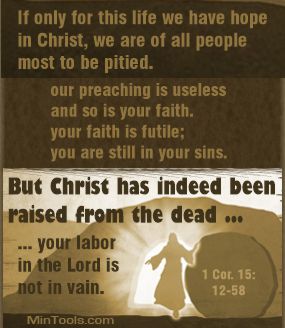
And if Christ has not been raised, our preaching is useless and so is your faith. – And if Christ has not been raised, your faith is futile; you are still in your sins. (1 Cor. 15:14, 17)

6) We can live in newness of life now because the power that raised Jesus from the dead is available to us now.

For we know that our old self was crucified with him so that the body ruled by sin might be done away with, that we should no longer be slaves to sin because anyone who has died has been set free from sin.(Rom. 6:6-7)

I pray that the eyes of your heart may be enlightened in order that you may know … his incomparably great power for us who believe. That power is the same as the mighty strength he exerted when he raised Christ from the dead and seated him at his right hand in the heavenly realms … (Eph. 1:18-20)

7) Because of the resurrection, we have a proclamation of Good News worth sharing.

And if Christ has not been raised, our preaching is useless and so is your faith. … And if Christ has not been raised, your faith is futile; you are still in your sins. (1 Cor. 15:14-17)

Is it any wonder the Apostle Paul wanted to “know Christ and the power of his resurrection” (Phil. 3:10)? What about you?

Church Leaders, Also Read: God’s Power for the Church – The Resurrection

For Help Teaching about the Death and Resurrection of Jesus, Go To: Lessons for Easter – A Real Act of Love

Share: