God is a God of New Beginnings

Share:

The nation of Israel repeatedly turned their backs on the God who brought them out of bondage. As a God of new beginnings, He would give them opportunities to start anew by sending deliverers. As long as those judges were still living, the people would follow God. After these leaders died, they would go back to their wayward living. As a consequence, God would eventually exile them from the Promised Land. But even then, God would not totally give up on them.

A God of New Beginnings

2 Kings 19 comes after the King of Assyria was trying to instill doubts and fears into the people that God was inadequate to deliver them. Hezekiah, king of Judah at the time, prayed to God about the situation. Isaiah the prophet was sent to let Hezekiah know that God is a God of new beginnings. He would restore a remnant of His people. Notice the words “once more” in the following verse.
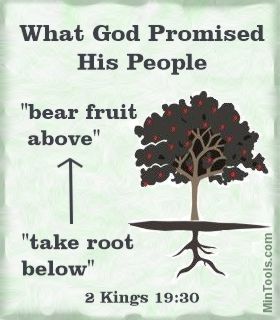
Roots Below, Fruit Above Promised by Our God of New Beginnings

Once more a remnant of the kingdom of Judah will take root below and bear fruit above. (2 Kings 19:30)

This remnant would again be established and grow. God would first work in ways that are unseen (root below) to produce the outward growth (fruit above). Eventually the Messiah would even come from this root.

Reason for God’s New Beginnings

Let’s be clear that the people were not restored because they deserved it. They didn’t receive new beginnings because of what they would do but rather because of what God would do. We cannot stop at verse thirty.

For out of Jerusalem will come a remnant, and out of Mount Zion a band of survivors. The zeal of the LORD Almighty will accomplish this. (2 Kings 19:31)

How interesting that the verse doesn’t say “the power of the Lord” but rather “the zeal of the Lord” will accomplish it. God’s intense feelings or passion toward His people drives Him to over and over again to provide His people with new beginnings.

What about us beginning new today?

These verses were written about the kingdom of Judah. However, the God who was jealous for them, is also our God. If we are in Christ, we are His people.

if we are faithless, he remains faithful, for he cannot disown himself. (2 Tim. 2:13)

being confident of this, that he who began a good work in you will carry it on to completion until the day of Christ Jesus. (Phil. 1:6)

As a result of His faithfulness and His zeal toward us, new beginnings are possible! Let’s give Him all the glory!!

Share:

Our Creator God: Seeing God in What He Made

Share:

Beauty of Pike's Peak and Grand Canyon Points to Our Creator GodWhen I went to graduate school I camped across the United States from Pennsylvania to get to California, taking in many of the wonders of our Creator God in the great outdoors. I viewed the Grand Canyon via a rim tour by bus and also in a small Cessna plane, camped near the base of Pike’s Peak, and more.

I could only come away from these spectacular sights saying, “How can anyone say there is no God?” “How can we not attribute all this to a Creator?” I concluded that it would take more faith for me not to believe than to believe. It was like nature spoke, without words, about the great God we have.

The heavens declare the glory of God; the skies proclaim the work of his hands. Day after day they pour forth speech; night after night they reveal knowledge. They have no speech, they use no words; no sound is heard from them. Yet their voice goes out into all the earth, their words to the ends of the world. (Ps. 19:1-4)

We can see who God is reflected in what He does.

Here is some of what I saw about our Creator God in what He made:

1) He is a great and powerful God to be able to bring all of this into being.

2) He is a wise God to be able to be able to design such intricacies and coordinate it all so that it all works together.

3) He is a good God to be able to bring so much beauty into being.

4) He is a creative God to be able to provide so much variety.

I can determine all of that about God without opening a Bible, just by looking at nature around me.

For since the creation of the world God’s invisible qualities – his eternal power and divine nature – have been clearly seen, being understood from what has been made, so that people are without excuse. (Rom. 1:20)

Check out the Our Great God from A to Z Discipleship Tool Download for a list of traits from A to Z about our Creator God. It also contains other alphabetical lists about who God is and what He does.

Are you seeing evidence of God in what He made?

Let me encourage you as you vacation, or even as you look out the airplane window on a business trip, to not just be in awe of what you see in the great outdoors but to stop, even for a moment,

to reflect on what it tells you about our great, powerful, and wise Creator God,

and then to thank and praise God for who He is.

If you are on a family vacation, use these spectacles as teachable moments to point your children to God.

Share:

Beyond a Cerebral Understanding of the Names of God

Share:

Today we don’t often think of the meaning of a person’s name but in Bible times that was significant.  And so, we find many different names for God in the original languages of Scripture.  The names are significant to the circumstances around which those names were used.  Understanding the context helps us understand how the names relate to life.
Names of God

Knowing the Names of God is Just the Starting Point

Scripture suggests how the name of the Lord can be used.

Call on the name of the Lord. (Ps. 105:1)
Trust in the name of the Lord. (Ps. 20:7)

When you know how His name can be used, it is a matter of applying the specific names into life situations in ways that fit.

  1. Call on God by name as you seek to navigate life. (circumstances, needs)
    . . .  How important it is to call on Jehovah-Raah to shepherd you.
  2. Remember God by name as you seek to process your stress and anxieties as well as joys and celebrations.  (feelings)
    . . .  How strategic it is to seek peace in the name of Jehovah Shalom.
  3. Trust God according to His name to take care of you and those you love.  (relationships)
    . . .  How critical it is to trust in Jehovah Rapha for the healing so desperately needed in relationships.

Whether you are studying about the character of God, the names of God, or any other theological topic, the key is to understand the implications and application of these truths to life.  Knowing the names of God and their meanings is only the starting point.  We need to get beyond a cerebral understanding to actually calling on His name, trusting in His name, and proclaiming His name.

If you are looking for a list of the names of God and their meanings, click on the links below for tools in our affiliate store, but remember to get beyond a cerebral understanding.

Share:

Your View of the Goodness of God Matters in Ministry

Share:

Taste and See the Goodness of God

Taste and see that the Lord is good; blessed is the man who takes refuge in Him. (Ps. 34:8)

Our View of the Goodness of God is Critical to Thriving in Ministry

When we consider what we have as a result of God’s goodness, we begin to realize how critical it is.

  1. Perspective comes from His goodness.

A good God works good in all things (Rom. 8:28) so you don’t have to fear, doubt, or worry even if you don’t understand what is happening.  No matter how hard ministry may get, even if others wrongly come against you or obstacles stand in your way, you don’t have to despair.  You can know His goodness lies ahead.  “I am still confident of this,” the psalmist said, “that I will see the goodness of the Lord in the land of the living” (Ps. 27:13).  Because of His goodness, you can have hope which leads to perspective.

  1. Provision comes from His goodness.

“The lions may grow weak and hungry, but those who seek the Lord lack no good thing” (Ps. 34:10).  “If you then, though you are evil, know how to give good gifts to your children, how much more will your Father in heaven give good gifts to those who ask him” (Matt. 7:11). God knows what you most need and when you need it.  He looks at the big picture and will bring about what is best in the best timing and way.  You can “seek first His kingdom and His righteousness” truly believing that all you need “will be given to you as well” (Matt. 6:33).

  1. Pardon for sin comes from His goodness.

Be honest.  You do not always control your words, reactions, use of time, etc. in ways that honor God in ministry.  You sometimes sin.  You make wrong choices. If you didn’t have a good God, you may as well give up.  Wrapped up in His goodness is mercy and forgiveness.  He may not remove the consequences of your sin because He is also just but He will forgive you and give you grace to cope with the consequences.

  1. Protection comes from His goodness.

God gave you His Word to instruct and direct you.  His commandments are good (Rom. 7:12) and they are for your good (Deut. 10:13) because they come from a good God.  A good God isn’t going to lead you down the wrong path.  When you understand this your prayer will be as the psalmist’s in Psalm 143:10 — “Teach me to do your will, for you are my God; may your good Spirit lead me on level ground.”

Out of His goodness come the perspective, provision, pardon, and protection you need to not only continue on but to thrive in ministry.

Your view of God’s goodness matters in ministry but so do His other attributes. Get alphabetical listings of His attributes in the Our Great God from A to Z Discipleship Tool Download.

Share:

Sanctity of Life – When God is Our Standard

Share:

As noted in a previous post, the sanctity of life is more than a social issue. The real issue gets down to who/what we consider to be the source of authority for determining the sanctity of human life. With an absolute authority comes a consistency not found when we take a humanistic or relativistic approach.

Consistency About the Sanctity of Life When God is Our Standard

When God is our standard or authority on the sanctity of human life, we find a consistency from conception to old age in how people should be valued.

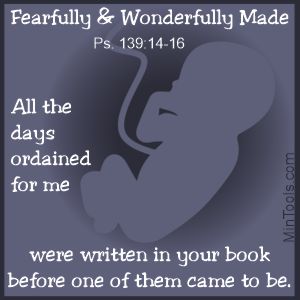
With God as Our Standard, There's Sanctity of Life from Conception to Old AgeFor you created my inmost being; you knit me together in my mother’s womb.  I praise you because I am fearfully and wonderfully made; your works are wonderful, I know that full well. My frame was not hidden from you when I was made in the secret place. When I was woven together in the depths of the earth, your eyes saw my unformed body. All the days ordained for me were written in your book before one of them came to be. How precious to me are your thoughts, O God! How vast is the sum of them! (Ps. 139:13-17)

Gray hair is a crown of splendor. (Prov. 16:31) The glory of young men is their strength, gray hair the splendor of the old. (Prov. 20:29) Even when I am old and gray, do not forsake me, O God, till I declare your power to the next generation, your might to all who are to come.  (Ps. 71:18)

When God is our standard or authority on the sanctify of human life, we find a consistency in all stages and conditions of life in how people should be viewed and valued.

Gen. 1:27 – “all” created in the image and likeness of God
2 Cor. 5:14-15; 1 Pet. 3:18 – Christ died for “all”

When God is our standard or authority, we find a consistency in commands and instruction on how people who are oppressed, needy, or defenseless should be treated.

Sampling of verses:  Ps. 68:5; 82:3, James 1:27, 1 Jn. 3:17

Inconsistencies When God is Not Our Standard of Authority

When God is not the standard, we find inconsistency because sanctity of life is based on personal opinion, scientific interpretation, or circumstances which are individualistic or relative rather than universal or absolute.   Some lives could therefore be considered more valuable than others.  Further, the same life could be valued in some settings or times but not in others.

Share: