NOT the BLAs that come from a boring, dull class with a teacher stuck in a rut where students passively sit and listen or find other inappropriate ways of keeping awake or amusing themselves.
BUT, the BLAs that are experienced in an active, enthusiastic class learning from God’s Word in ways that get students involved — Bible Learning Activities.
Why Use BLAs (Bible Learning Activities)
Because of the way God created people to learn through their senses
Because people learn best and retain more when actively involved in the learning process
While all ages would benefit from this kind of instruction, children particularly need lessons that allow them to do something, to explore and discover.
How to Use BLAs (Bible Learning Activities)
– Always having a purpose for the activities you use.
– Use a variety of activities.
– Give students choices when possible.
– Turn some of the planning of activities over to students if appropriate.
– Use guided conversation with students as they do the activities.
– Don’t limit Bible Learning Activities to acquiring knowledge but also use them in practicing life application.
What Kind of Bible Learning Activities to Use
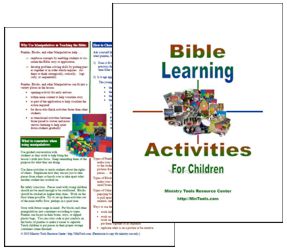
You will now find a resource in the MinTools.com store called Bible Learning Activities for Children. This resource provides a one page handout on each of the following types of of activities. The pages can be ordered separately but cost less bundled which you will see if you click on the above link.
Books
Crafts
Dramatic Play
Games
Manipulatives (blocks, puzzles, other)
Media
Music
Pictures
Depending on how they are used, these activities can enable students to research in order to gain new knowledge or to have what has already been learned reinforced.
Each handout looks at why this activity is good to use, how to choose specific means within that method, what you need to remember when using it, and how to expand its use.
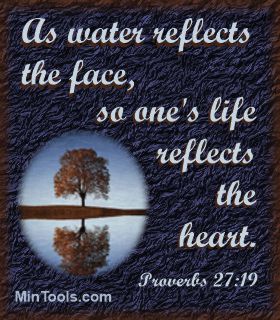
As water reflects the face, so one’s life reflects the heart. (Prov. 27:19)
Applied to teachers, Proverbs 27:19 would say, “so a teacher’s heart reflects the teacher.”
As teachers, we need to do the right things, but our hearts need to be right as well. “All a man’s ways seem right to him, but the Lord weighs the heart” (Prov. 21:2).
Teacher Acrostic of Traits that ought to be in a Teacher’s Heart
Teachable Heart (attentive, listens, observes)
Prov. 10:8; 22:17; 23:12; 24:32
Enlightened Heart (wise, discerning)
Prov. 15:14; 16:21; 23:15
Aligned Heart (walks in truth; trusts in God, not self)
Ps. 86:11; Prov. 3:5-6
Caring Heart (loves, compassionate)
Prov. 3:3; 1 Pet. 1:22
Humble Heart (not proud)
Ps. 51:17; 131:1
Earnest Heart (sincere)
Col. 3:22; Heb. 10:22
Righteous Heart (pure, maintains integrity)
Ps. 15:1-2; 51:10; 119:80
Steadfast (firmly established)
Ps. 57:7; 112:7
What’s in Your Heart?
Remember, “a teacher’s heart reflects the teacher.”
So, what’s in your heart?
To answer that questions, start by praying something similar to the following verses:
Test me, O Lord, and try me, examine my heart and my mind. (Ps. 26:2)
Search me, O God, and know my heart; test me and know my anxious thoughts. (Ps. 139:23)
Then get specific in your prayers about each of the heart conditions in the above acrostic, particularly in how it relates to your teaching. Ask:
Do I have this kind of heart?
Why do I need this kind of heart in teaching?
Then ask God to more fully develop this heart within you.
If you want to connect with and motivate people, you must tap into their needs and what interests them. A good starting point is to look at their age developmental characteristics. You can make even well-known stories and truths relevant.
Example of How to Make Well-Known Truths Relevant Using the Christmas Story
(Click to check out children’s nativities in our affiliate store.)
In adding nativity sets to the children’s ministry section on the Christmas Ministry Resources page from our affiliate stores, I found quite a variety — fabric, finger puppet, stickers, magnetic, puppet glove, plastic/PVC, soft and squeezable, vinyl clings, and wooden. I wanted to include nativities that could be used in children’s classes, or in the home, that would serve not just as touchable decorations but also visual aids or learning tools.
If I were to look for nativity sets for adults, I would add resin, glass, ceramic, metal, porcelain, along with possibly other kinds of materials.
Just like you will find some nativity sets constructed more suitably for toddlers, some for older children, and others for adults, so we must consider how to communicate in relevant ways to the different age levels.
Think about people’s developmental needs as we approach the holiday season. How can you present this Jesus in the manger in ways that are relevant to them?
1) Early Childhood: They need a sense of security as they look to people to care for their needs while beginning to exert a degree of independence and initiative.
Present to them this Jesus who came to earth as a baby, loved by God, and who grew up gaining favor with God and man and showed others love. If they feel His unconditional love they will learn to open their hearts to Him.
2) Grade School: They need a sense of success or competence in this industrious age level marked by curiosity, skill development, and performance.
Present to them this Jesus who came to earth as a baby but who grew in wisdom and did many wonderful things, the best of which was salvation. If they study His life through His Word, they will become equipped to do good in life, to reach their potential in Him through His power.
3) Junior High: They need a sense of stability in this period of uncertainty with all the changes going on within them.
Present to them this Jesus who came to earth through a most peculiar set of circumstances and was not always understood as He grew and did the Father’s will. He kept doing the Father’s will regardless of how hard it was and how He felt. If they learn to trust Him, He will help them navigate this turbulent time.
4) Senior High: They need a sense of identity as they transition into adulthood.
Present to them this Jesus who came to earth as a little baby though fully aware He was God. As He grew, He did not let ego or peer direct His decisions but the Father. If they discover who they are in Him, they will come to realize that it isn’t about what others think of them but what God thinks.
5) Young Adults: They need a sense of belonging and intimacy as they build relationships and learn to cope in a big world.
Present to them this Jesus who came to earth because God so loved the world and wanted to reconcile people to Himself. Jesus knew His purpose, sought to accomplish His goals, yet remembered the people around Him and built relationships with them. If they keep a relationship with Him their top priority, others pursuits will fall into place.
6) Middle Aged Adults: They need a sense of purpose as they begin to wonder if their life is really making a difference.
Present to them this Jesus who came to earth, with humble beginnings in the manger but didn’t stay there. Rather, He went on to make a difference. If they line up with Him, they too will live abundant and productive lives to the very end.
7) Senior Aged Adults: They need a sense of satisfaction and contentment, of fulfillment, with their lives, that they are leaving a legacy.
Present to them this Jesus who came to this earth to make a difference and so for the joy set before Him endured the cross, did not revile when reviled, but rather offered love and forgiveness. If they continue to walk in Him, they too will live a life of integrity that others can look to as a role model. If they have failed to walk faithfully, they can receive grace and forgiveness even now with Jesus’ challenge to “Go and sin no more.”
You can run any truth through these age level needs to increase relevancy. If you don’t think too much about the difference these factors play in your students’ understanding and motivation, perhaps the Age Level Characteristics Resource from Ministry Tools Resource Center would be useful to you.
I’ve already started a teacher training session with a circle response activity wherein I asked everyone to communicate in one word or noise how they felt about teaching. Replies ranged from “ugh” to excited. What I discovered is that responses often stemmed out of one of the following:
1) how they were gifted
2) how they were recruited
3) how they perceived God would use them
How They Were Gifted: If a person did not have the gift of teaching, exhortation, prophecy, or perhaps pastor, they tended to feel insecure, afraid of failing, and frustrated. However, those who had these gifts, especially the gift of teaching, tended to find themselves with a renewable energy that converted into an excitement and passion about teaching.
How They Were Recruited: If arm-twisted into teaching or made to feel guilty if they didn’t, more times than not, even if spiritually gifted to teach, they tended to lack enthusiasm and even begrudged the time they had to invest into teaching. If nabbed in the parking lot, they tended to have a low view of their role. However, those who were approached in a serious manner and were given time to pray about their decision, tended to perceive teaching with more of a priority and sense of purpose. They tended to be more enthused and willing to invest time and effort into it.
How They Perceived God Would Use Them: If just doing their time with hopes something good might come out of it, they tended to display some apathy, having a spiritual lethargy. However, if they truly believed that God would use them to make a difference in people’s lives, trusting God to not let His Word return void (Isa. 55:11), they tended to find joy and have a sense of anticipation every time they entered the classroom.
The PowerPoint Presentation, Rediscovering the Joy of Teaching, addresses this point, showing how JOY comes through an anticipation of what Jesus will do through you as you invest into other people’s lives, keeping a proper perspective of your place and purpose in teaching.
If the needle on the gauge of your feelings toward teaching is pointing more toward “ugh” rather than excitement, perhaps this resource is for you. It can be used by individual teachers or in a group. You do not need to have the PowerPoint program on your computer if you download Microsoft’s free viewer.
What Do We Do About these Feelings about Teaching?
For those of you who are in leadership, remember these points as you recruit. Look for people who are spiritually gifted to teach. Take great care in the way you recruit people that you are communicating the importance of the task. And, be sure to emphasize the ultimate purpose and potential of them teaching.
For those of you being sought after to teach, look for your best fit in ministry based on your spiritual gifts. Do not let someone pressure you into teaching without spending time in prayer. Know if it is something GOD wants you to do. If it is, depend on Him to use you to make a difference in people’s lives.
For those of you already teaching who do not feel very good about it, trust God to work through you, even if teaching is not your best fit or if you are not doing it for the right reasons because of how you were recruited. Work toward a better fit in ministry when the time is right. It is about God’s will and timing, which could be a temporary placement in teaching.
For those of you already teaching who do feel good about it, praise the Lord yet be careful. Stay alert, standing firm in the Lord and His mighty power. The enemy is like a roaring lion looking for those he can devour. All that he must do is to rob you of your joy to render you less effective.
I’ve done a lot of teacher training seminars through the years and learned that a very large number of teachers in children’s ministry rate classroom discipline issues as their number one frustration. Many of these teachers want a step by step play book for “fixing” the problems which I have not been able to provide. Instead, I have handed them an umbrella for classroom discipline. — No, not the kind that keeps them from getting wet. An analogy.
An Analogy, Using an Umbrella, for Classroom Discipline
Teachers need a big picture perspective or philosophy under which all discipline should come. This is like the canopy of the umbrella. Without this material over the framework, or spokes, their efforts will not protect or provide shelter. All that is done needs to come under the umbrella of God’s Word. The Effectively Handling Classroom Discipline Workbook provides this kind of perspective.
Under that canopy are spokes, the framework on which the material hangs. These are principles that can apply to all discipline situations. Again, the workbook will help you work through these principles but the Handbook on the Basics of Classroom Discipline can also help with that.
The umbrella with its canopy and framework won’t help unless you personally grab hold of it. This is where the handle comes in — the specific application to your situation. One reason I can’t provide steps to handling discipline problems is that there are so many variables. For example, two children can engage in the same behavior but for different reasons making the application specific to that situation.
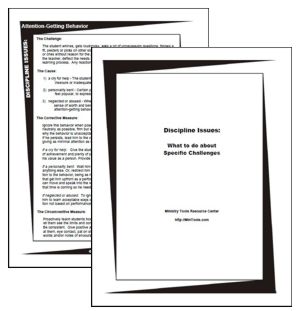
The Discipline Issues: What to Do About Specific Challenges resource provides help with 56 different discipline issues. You’ll find a page for each challenge listing possible causes with resultant suggestions for each issue.
Here are some examples:
Attention-Getting Behavior with 3 possible causes
Bringing Toys & Objects from Home with 3 possible causes
Constantly or Excessively Moving Children with 3 possible causes
Crying When Children Dropped off with 3 possible causes
Talking Incessantly/Inappropriately with 3 possible causes
Teasing & Bullying with 6 possible causes
When Staff Kids Misbehave with 4 possible causes
As you keep God’s big picture perspective in mind and apply the principles in ways appropriate to your situation and student needs, “rainy days” won’t have to get you drenched with frustration and despair. If you line up what you do with God and His Word, you can depend on God for the long-range results and short-term coverage.
This website uses cookies to improve your experience. By using the site, you agree to the use of cookies. AcceptRead Policy
Privacy & Cookies Policy
Privacy Overview
This website uses cookies to improve your experience while you navigate through the website. Out of these, the cookies that are categorized as necessary are stored on your browser as they are essential for the working of basic functionalities of the website. We also use third-party cookies that help us analyze and understand how you use this website. These cookies will be stored in your browser only with your consent. You also have the option to opt-out of these cookies. But opting out of some of these cookies may affect your browsing experience.
Necessary cookies are absolutely essential for the website to function properly. This category only includes cookies that ensures basic functionalities and security features of the website. These cookies do not store any personal information.
Functional cookies help to perform certain functionalities like sharing the content of the website on social media platforms, collect feedbacks, and other third-party features.
Performance cookies are used to understand and analyze the key performance indexes of the website which helps in delivering a better user experience for the visitors.
Analytical cookies are used to understand how visitors interact with the website. These cookies help provide information on metrics the number of visitors, bounce rate, traffic source, etc.
Advertisement cookies are used to provide visitors with relevant ads and marketing campaigns. These cookies track visitors across websites and collect information to provide customized ads.

 You will now find a resource in the MinTools.com store called Bible Learning Activities for Children. This resource provides a one page handout on each of the following types of of activities. The pages can be ordered separately but cost less bundled which you will see if you click on the above link.