Easter Points to the Grace of God

Share:

God has always been a God of grace but Easter highlights that trait. Easter points to the grace of God. —

This grace was given us in Christ Jesus before the beginning of time, but it has now been revealed through the appearing of our Savior, Christ Jesus, who has destroyed death and has brought life and immortality to light through the gospel. (2 Tim. 1:9-10)

Grace cost Jesus His life but it is free to us. It is a gift.  If grace was earned in any way, then it would no longer be grace.  (Rom. 5:15; 11:6; Eph. 1:6; 2:8-9; Gal. 2:21)

Easter Points to the Grace of God Available for Us Beyond Salvation

Easter Points to the Grace of God Available for Us Beyond Salvation

Easter reminds us that “For it is by grace you have been saved, through faith-and this not from yourselves, it is the gift of God” (Eph. 2:8). But, Easter grace not only saves us.  It enables us to walk the walk, as seen in Colossians 2:6, NASB, — “Therefore as you have received Christ Jesus the Lord, so walk in Him.”

We receive grace upon grace, even after we are saved.  Grace goes beyond the impartation of life because of Easter.

  1. Easter Grace continues by blessing. (Jn. 1:16)
  2. Easter Grace continues by giving.  (2 Cor. 8:7-9)
  3. Easter Grace continues by forgiving.  (Eph. 1:7)
  4. Easter Grace continues by empowering.  (Rom. 12:6; 1 Cor. 15:10; 2 Cor. 9:8; 12:9; 1 Pet. 4:10)
  5. Easter Grace continues by encouraging.  (2 Thess. 2:16)
  6. Easter Grace continues by strengthening.  (Heb. 13:9)
  7. Easter Grace continues by teaching and motivating.  (Titus 2:11-12)
These realities teach us that grace compliments, rather than cheapens truth.  Jesus came full of both grace and truth (Jn. 1:14).  We are not talking about licentiousness. (Rom. 6:1, 15)  Grace reigns through righteousness.  (Rom. 5:20-21)  We are talking about looking to God to do for us what we cannot do for ourselves.
Easter grace is something we need to better understand so we grab hold of it more fully.  May we “grow in the grace and knowledge of our Lord and Savior Jesus Christ. To him be glory both now and forever! Amen” (2 Pet. 3:18).

Grace is just one of God’s many attributes. Check out the Our Great God from A to Z Discipleship Tool Download for alphabetical renderings about who God is and what He does for us.

Looking for Curriculum for Teaching Over the Easter Season? Go To: Bible Lessons for Easter
Share:

Easter Points to the Love of God

Share:

Easter Points to the Love of God for God So Love the WorldEaster points to the love of God, demonstrated by sending Jesus to die in our place.

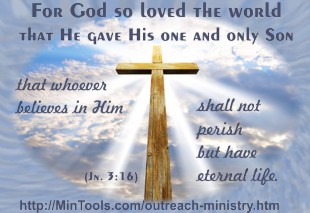
For God so loved the world that he gave his one and only Son, that whoever believes in him shall not perish but have eternal life. (Jn. 3:16)

Ways Easter Points to the Love of God

Easter defines love.

This is how we know what love is: Jesus Christ laid down his life for us. And we ought to lay down our lives for our brothers. (1 Jn. 3:16)  For God so loved the world that he gave his one and only Son … (Jn. 3:16)

Easter demonstrates God’s love.

But God demonstrates his own love for us in this: While we were still sinners, Christ died for us. (Rom. 5:8)  This is how God showed his love among us: He sent his one and only Son into the world that we might live through him. (1 Jn. 4:9-10) 

Easter epitomizes love.

Greater love has no one than this, that he lay down his life for his friends. (Jn. 15:13)

Easter enables us to love.

We love because he first loved us. (1 Jn. 4:19). And live a life of love, just as Christ loved us and gave himself up for us as a fragrant offering and sacrifice to God. (Eph. 5:2)

What We Can Learn About Love Because of Easter

Easter teach us that love . . .

  1. sacrifices for another.
  2. gives to others.
  3. wants the best for others.
  4. does not wait for someone else to take the first step.
  5. reaches out unconditionally, even to the seemingly unlovable.

“And I pray that you, being rooted and established in love, may have power, together with all the saints, to grasp how wide and long and high and deep is the love of Christ, and to know this love that surpasses knowledge-that you may be filled to the measure of all the fullness of God.”  (Eph. 3:17-19)

Love is a very important aspect of God’s being but so are His other attributes. Get help looking at the sum total of who He is using the Our Great God from A to Z Discipleship Tool Download.

Looking for Curriculum for Teaching Over the Easter Season? Go To: Bible Lessons for Easter – A Real Act of Love

Share:

Easter Points to the Holiness & Righteousness of God

Share:

Easter reminds us that Jesus died on the cross for our sin because God is holy and righteous. Consequently, Easter points to the holiness and righteousness of God.

Christ Died for Our Sin - Easter Points to the Holiness and Righteousness of God
“The wages of sin is death” (Rom. 6:23). 

Because of sin, not only did physical death become a reality but also eternal, spiritual death … separation from God.

Why? — Because He is a holy and righteous God who cannot stand in the presence of sin.  Hebrews 12:14 says “without holiness no one will see the Lord.”

The sin problem must be taken care of in order for a holy and righteous God to enter into a relationship with people.  That’s what happened at Easter.

Jesus died and took our sin upon Him so that we could be made pure.  When God looks at those who have accepted His Son, He no longer sees their sin but rather Jesus’ blood which covers them.

“But now he has reconciled you by Christ’s physical body through death to present you holy in his sight.” (Col. 1:22)

“And by that will, we have been made holy through the sacrifice of the body of Jesus Christ once for all.”  (Heb. 10:10)

Looking at How Easter Points to the Holiness and Righteousness of God Teaches Important Truths

So, what does Easter teach us about holiness & righteousness?

  1. Easter reinforces that keeping God’s laws cannot make us holy. “Therefore no one will be declared righteous in his sight by observing the law; rather, through the law we become conscious of sin” (Rom. 3:20).  As verse 27 says, “Where, then, is boasting?”
  1. Easter reminds us that we are all in the same lost condition and all in the same need of a Savior.  “This righteousness from God comes through faith in Jesus Christ to all who believe. There is no difference, for all have sinned and fall short of the glory of God” (Rom. 3:22-23).  To think we gain God’s favor over someone else because we are “better” than them is pure foolishness.  Apart from Jesus, we would all get F’s on the test, even if someone seemed to do better than another.
  1. Easter emphasizes that apart from a work of God in our lives to impute that holiness on us, we will always miss the mark.  “There is no one righteous, not even one … This righteousness from God comes through faith in Jesus Christ to all who believe. . . . for all have sinned and fall short of the glory of God” (Rom. 3:11-23).  How absurd for us to think we can ever live up to the just demands of a holy God in and of ourselves.

When we trust in the work Jesus did on the cross, we stand righteous and holy in Him. We are thus called to “to a holy life – not because of anything we have done but because of his own purpose and grace” (2 Tim. 1:9).    The state of our lives does not always match our standing.  What will it take for us to be holy as He is holy?  Perhaps Colossians 3:12 provides a clue:

Therefore, as God’s chosen people, holy and dearly loved, clothe yourselves with compassion, kindness, humility, gentleness and patience.  (Col. 3:12)

Notice the phrase “clothe yourselves.”  The idea in these phrases is that we are putting on something that is not a natural part of us.  The garment of righteousness we put on is His. The key to being holy, then, begins with realizing our need for Him to work in and through us.

Holiness and righteousness are just two of God’s many attributes. Get alphabetical listings describing who God is in the Our Great God from A to Z Discipleship Tool Download.

Looking for Curriculum for Teaching Over the Easter Season? Go To: Bible Lessons for Easter

Share:

Easter Points to the Wisdom of God

Share:

From creation to the cross, God’s wisdom is exhibited for all to see, leaving us without excuse. At the root of God sending Jesus to die on the cross is God’s wisdom.  Easter points to the wisdom of God, contrasting it with the wisdom of the world.

Christ Crucified, Easter Points to the Wisdom of God“We preach Christ crucified … Christ the power of God and the wisdom of God.  It is because of him that you are in Christ Jesus, who has become for us wisdom from God – that is our righteousness, holiness and redemption” (1 Cor. 1:23-24, 30). … Christ, “in whom are hidden all the treasures of wisdom and knowledge”  (Col. 2:3).

Since Easter Points to the Wisdom of God, What Can We Learn about His Wisdom?

  1. Easter teaches us that wisdom involves preparation.  Beginning at the fall of man in Genesis 3 we see God laying the groundwork for his plan of redemption through Jesus.
  1. Easter reminds us that God not only uses wisdom in the preparation stages but also throughout the process.  Redemption is not just the end result of God’s wisdom but is enveloped in His wisdom from start to finish.  When God does something, He does it right.  “In him we have redemption through his blood, the forgiveness of sins, in accordance with the riches of God’s grace that he lavished on us with all wisdom and understanding” (Eph. 1:7-8).
  1. Easter shows God’s wisdom in getting to the root of man’s problem and addressing that problem with the best solution. “For the wages of sin is death, but the gift of God is eternal life in Christ Jesus our Lord” (Rom. 6:23).
  1. Easter let’s us know that wisdom is needed in the application of grace.   In redemption, the riches of God’s grace are “lavished on us with all wisdom and understanding” (Eph. 1:8).

Yes, let’s think about wisdom at Easter.  This same wisdom of God that brings us salvation is available to us in our everyday living if we will just take the time to learn from Him.  Here are some resources about walking in His wisdom:

Easter points to the wisdom of God, giving us cause to worship Him.  Romans 11 lets us know that the rejection of Jesus by the Jews of His day opened the door for the Gentiles to “receive mercy as a result of their disobedience.”  What seemed like a closed door actually opened the door for His mercy to extend to even more people.  Then begins the doxology:  “Oh, the depth of the riches of the wisdom and knowledge of God!  How unsearchable his judgments, and his paths beyond tracing out!” (Rom. 11:33)

Remember, if it wasn’t for the unsearchable wisdom of God, there wouldn’t even be an Easter.

We certainly do have a wise God who deserves our praise and worship. Yet, as you can see in the Our Great God from A to Z Discipleship Tool Download, He is so, so much more. That resource provides five different renderings about who God is and what He does for us.

Looking for Curriculum for Teaching Over the Easter Season? Go To: Bible Lessons for Easter

Share:

Easter Story? – Ask “What If” Questions

Share:

Did the events of Easter recorded in Scripture really happen?  Rather than question the veracity of the Easter phenomenon, perhaps we would be better helped by asking “what if?” … what if it hadn’t happened that way?

“What If” Questions from the Garden of Gethsemane Scene

In my personal time with the Lord I was reading through the Gospel of Matthew and came to the Garden of Gethsemane scene in Matthew 26:36-56. As I was studying the passage, I began to ask myself, “What if?”  What if these events hadn’t happened?

  • What if Jesus had taken this a bit more casually?
  • What if Jesus had not followed the Father’s will?
  • What if the disciples had reacted differently?
  • What if Judas had changed his mind at the last minute?
  • What if Jesus had let the disciples fight with swords?

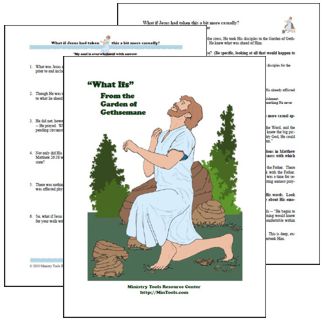
What Ifs from the Garden of Gethsemane - Discussion Questions for Easter
How different things would be if it hadn’t happened the way Scripture records it.  As I thought through the implications of these “What If” questions, I became more energized and appreciative of all Jesus went through for me.  I enjoyed this study so much, I had to pass it on to others and so you will now find the “What Ifs” from the Garden of Gethsemane Discussion Guides in the MinTools.com store.

More Questions from Other Parts of the Easter Story

As I continued on through Matthew, I kept asking the questions.  Here are some more “what ifs”:

  • What if they had arrested Jesus publicly?
  • What if Peter had not denied Jesus?
  • What if Jesus had a fair trial?
  • What if Pilate had released Jesus instead of Barabbas?
  • What if Jesus had come down from the cross?
  • What if no phenomenon had occurred when Jesus breathed His last?
  • What if the women hadn’t watched Jesus’ death and burial?
  • What if Jesus hadn’t stayed in the grave for three days?
  • What if Jesus hadn’t risen at all?
  • What if Jesus hadn’t appeared to anyone after His resurrection, or perhaps to just the inner core of disciples?

Take some time to think through these questions.  Perhaps it will help encourage you to see that Easter had to happen the way Scripture tells the story or things would be quite different for you and I today.

Looking for More Help Teaching Over the Easter Season? Go To: Bible Lessons for Easter

Share: