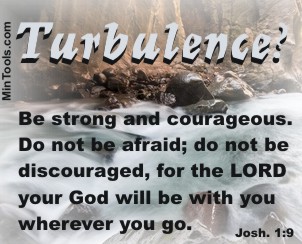
As we walk with God, putting our trust in Him, we can have peace and perspective in hardships, trials, suffering, and struggles of any kind. We can rise above.
We live in turbulent times. We face many unknowns. The kind of strength and courage we need won’t come from within. Nor will we find it in our circumstances. We need the strength and courage Joshua, of the Old Testament times, needed as He faced many unknowns, seeking to lead a rebellious people.
Where Joshua Found Strength & Courage
God’s Promises
I will give you every place where you set your foot, as I promised Moses. Your territory will extend from … No one will be able to stand against you all the days of your life. As I was with Moses, so I will be with you; I will never leave you nor forsake you. Be strong and courageous, because you will lead these people to inherit the land I swore to their ancestors to give them. (Josh. 1:1-6)
God’s Presence
As I was with Moses, so I will be with you; I will never leave you nor forsake you … Be strong and courageous. Do not be afraid; do not be discouraged, for the LORD your God will be with you wherever you go. (Josh. 1:5, 9)
God’s Precepts
Be strong and very courageous. Be careful to obey all the law my servant Moses gave you; do not turn from it to the right or to the left, that you may be successful wherever you go. Keep this Book of the Law always on your lips; meditate on it day and night, so that you may be careful to do everything written in it. Then you will be prosperous and successful. Keep this Book of the Law always on your lips; meditate on it day and night, so that you may be careful to do everything written in it. Then you will be prosperous and successful. (Josh. 1:7-8)
Finding Strength & Courage Today
Need strength and courage? Though our circumstances may differ from Joshua’s and all the particular promises and precepts God gave him may not apply to us, we nonetheless serve the same God.
Reflect on the many promises throughout Scripture that apply to you. (2 Cor. 1:20; 7:1; Heb. 8:6; 10:23; 2 Pet. 1:3-4)
Remember that God is always with you. (Matt. 28:20; Rom. 8:38-39; Heb. 13:5)
Return to God’s Word over and over again for the guidance you need. (Ps. 119:105; 2 Tim. 3:16-17)
In the midst of trials and hardships we can still have joy — purposeful joy. While it may be difficult to imagine such joy when surrounded by so much turmoil, it is possible.
If we look at Bible verses about joy, we find some tips for attaining and keeping this joy in our hearts.
Cues from Bible Verses about How Joy is Possible
Raise your level of joy in the midst of whatever you face by doing the following:
1) Accept that there’s a bigger and better picture than what’s happening in the moment.
Consider it pure joy, my brothers and sisters, whenever you face trials of many kinds, because you know that the testing of your faith produces perseverance. Let perseverance finish its work so that you may be mature and complete, not lacking anything. (James 1:2-4)
fixing our eyes on Jesus … For the joy set before him he endured the cross … (Heb. 12:2)
2) Focus on God’s history of faithfulness to His people … and to you.
The LORD has done great things for us, and we are filled with joy. (Ps. 126:3)
3) Bask in God’s presence.
You make known to me the path of life; you will fill me with joy in your presence, with eternal pleasures at your right hand. (Ps. 16:11)
4) Focus on the Lord and what He can do rather than your circumstances.
May the God of hope fill you with all joy and peace as you trust in him, so that you may overflow with hope by the power of the Holy Spirit. (Rom. 15:13)
5) Yield yourself to the Holy Spirit to produce this joy in you. — That which might seem humanly impossible is possible with Him.
But the fruit of the Spirit is love, joy, peace, forbearance, kindness, goodness, faithfulness, (Gal. 5:22)
For the kingdom of God is not a matter of eating and drinking, but of righteousness, peace and joy in the Holy Spirit, (Rom. 14:17)
May the God of hope fill you with all joy and peace as you trust in him, so that you may overflow with hope by the power of the Holy Spirit. (Rom. 15:13)
6) Pray that God would enable you to let go of that which is keeping you from His joy.
Restore to me the joy of your salvation and grant me a willing spirit, to sustain me. (Ps. 51:12)
What is purposeful joy? No, it’s not a term used in the Bible but I believe the concept is there, specifically in James 1:2-4.
Consider it pure joy, my brothers and sisters, whenever you face trials of many kinds, because you know that the testing of your faith produces perseverance. Let perseverance finish its work so that you may be mature and complete, not lacking anything.
How is Joy Purposeful?
First, notice how we are to “consider it” joy when faced with trials. That’s a purposeful choice to let joy reign in our lives, not our circumstances.
The Greek word for “consider” (hegeomai) literally means to lead or go before, to have rule or authority over something. That means we don’t let our circumstances control us or pull us down. Instead, we choose to rise above by gaining perspective. We deem, or think about, our circumstances as joy — not just a glimmer of joy but “pure” joy. A better rendition for “pure joy” would be “all joy” as the Greek word (pas) means all, individually and collectively — complete.
Second, notice the reason for considering it joy when faced with trials. Trials have a purposeful outcome which give us a reason to grab hold of joy in adverse circumstances.
By looking at the big picture, that of the character trials build within us, we’re able to gain the perspective we need to choose joy. Persevering in hardships not only produces mature character but also leads to a sense of contentment in which we’re “complete, not lacking anything”. If we allow our circumstances to rule us, rather than considering them pure joy, we won’t arrive at this outcome.
Third, notice the expectation of life to not always be easy, filled with only “feel good” moments. “WHEN” not “IF” trials come, we can be prepared by having a purposeful plan already in place to combat human tendencies.
Jesus told us to expect problems when He said, “In this world you will have trouble” (Jn. 16:33). God uses His Word to prepare us. If we’re Bible illiterate, it’s going to be difficult, in the midst of trials, to grab hold of the perspective we need to purposefully choose joy. However, when we’re familiar with verses like James 1:2-4, we will be more likely to head in the direction of joy over despair, to let joy reign in our lives rather than our circumstances. We will need purposeful joy because it won’t come naturally. In the next post we’ll look at other Bible verses that show how this kind of joy is possible!
As immorality creeps more and more into our society, with that which is unnatural and that which violates the standards of a holy God seen as normal, Christians who hold fast to the Word of God will more and more find themselves on the fringe, viewed as inflexible, intolerant, and even haters. To be sure, some “Christians” do take a more aggressive and antagonistic approach and reap what they sow. But, even those who do seek to “speak the truth in love” exercising both grace and truth, will undoubtedly find themselves increasingly under attack.
(Click to enlarge in Pinterest & repin.)
Jesus was no stranger to criticism, betrayal, rejection, torture, and then paying the ultimate price of His life for righteousness sake. — “Consider him who endured such opposition from sinful men, so that you will not grow weary and lose heart. In your struggle against sin, you have not yet resisted to the point of shedding your blood.”(Heb. 12:3-4)
What We Can Learn About Suffering From Jesus?
If we look at the first two verses of Hebrews 12, we can gain some understanding about the example Jesus provides for us.
1) There is a bigger picture to consider than our momentary suffering.
“Jesus, the author and perfecter of our faith, who for the joy set before him endured … ”
Perhaps this was behind James’ exhortation to “Consider it pure joy, my brothers and sisters, whenever you face trials of many kinds because you know that the testing of your faith produces perseverance. Let perseverance finish its work so that you may be mature and complete, not lacking anything.” (James 1:2-4) — If nothing else, our suffering has the potential of making us better people.
2) Sometimes we just have to endure whatever it is we are facing because of that bigger picture.
“Jesus … endured the cross”
Jesus did not try to escape His suffering. When his disciples wanted to fight Jesus said, “Put your sword back in its place . . . Do you think I cannot call on my Father, and he will at once put at my disposal more than twelve legions of angels? But how then would the Scriptures be fulfilled that say it must happen in this way?” (Matt. 26:52-54) — If we aren’t willing to endure some suffering, how is the greater good to come about?
3) As we endure the suffering, we must be careful not to succumb to the shame people try to throw on us.
“Jesus … endured the cross, scorning its shame”
Jesus didn’t retaliate against the insults thrown at Him. Rather, “when he suffered, he made no threats. Instead, he entrusted himself to him who judges justly.” (1 Pet. 2:23) — If we don’t rise above the criticism, how can we claim to be taking the Christ-like approach?
4) We can be assured that in the end, God will triumph over the suffering.
“and sat down at the right hand of the throne of God”
Jesus didn’t remain in the grave. He triumphed over sin and death and one day every knee will bow to Him. “And being found in appearance as a man, he humbled himself by becoming obedient to death – even death on a cross! Therefore God exalted him to the highest place and gave him the name that is above every name, that at the name of Jesus every knee should bow, in heaven and on earth and under the earth, and every tongue acknowledge that Jesus Christ is Lord, to the glory of God the Father.” (Phil. 2:8-11) — If God was able to bring about such a glorious outcome from Jesus’ suffering, can’t we trust Him to take care of us?
Let’s remember that people are looking at not only how we react to the sin and immorality around us but also how we respond to their provocation or attacks because of it, to the resultant suffering we might experience. The passage we have used in this post began,
“Therefore, since we are surrounded by such a great cloud of witnesses, let us throw off everything that hinders and the sin that so easily entangles, and let us run with perseverance the race marked out for us. Let us fix our eyes on Jesus …” (Heb. 12:1).
Let’s make sure we react properly for “how is it to your credit if you receive a beating for doing wrong and endure it? But if you suffer for doing good and you endure it, this is commendable before God.” (1 Pet. 2:20) “… keeping a clear conscience, so that those who speak maliciously against your good behavior in Christ may be ashamed of their slander. For it is better, if it is God’s will, to suffer for doing good than for doing evil.” (1 Pet. 3:16-17)
Though facing difficult times of crisis, the Old Testament prophet Habakkuk was able to not only rise above and pray, but also rejoice. The verses in Habakkuk 3:17-10 do not actually use the words thanks or gratitude, but it certainly could be implied. Joyful people tend to be thankful people. He was glad for who God is and what God does which would have been thanksgiving.
Thankful in crisis because of who God is:
the Sovereign Lord, the One who has all things under control, who knows the beginning from the end, who works all things for the good
the Savior, the One who delivers in the midst of crisis
the Strength, the One who enables us to persevere
*** How could Habakkuk not rejoice in God? How could he not give thanks?
Giving thanks in the midst of crisis because of what God does:
He gives strength so we can make it through hardships.
He provides what we need to rise above the negativity, discouragement, and bitterness that can grow in the midst of crisis, like the feet of deer running across the ground.
He enables us to triumph over that which would keep us from looking to God as the Source of all we need in these difficult times, like treading on the heights where other gods were placed.
*** How could Habakkuk not rejoice in God? How could he not give thanks?
God is the same yesterday, today, and tomorrow. His character and abilities do not change. And, He continues to work on behalf of His people. Even in the midst of crisis, how can we not rejoice in our God? How can we not give Him thanks?
Though the fig tree does not bud and there are no grapes on the vines, though the olive crop fails and the fields produce no food, though there are no sheep in the pen and no cattle in the stalls, yet I will rejoice in the LORD, I will be joyful in God my Savior. The Sovereign LORD is my strength; he makes my feet like the feet of a deer, he enables me to tread on the heights. (Hab. 3:17-19)
We considered how we can rise above in times of crisis using the example of the Old Testament prophet Habakkuk, specifically looking at verses 18-19 in the third chapter of the book by his name.
Now let’s notice how this chapter begins — “A prayer of Habakkuk the prophet.”
So, when Habakkuk says “Though …” all these bad things are happening or will occur “yet I will rejoice in the LORD …”, he is acknowledging to God his choice to find all he needs in Him. Habakkuk is expressing his trust and praising God for being the One who makes rising above possible in the midst of crisis.
Praying in the Midst of Crisis
Prayer must be a part of the process if we’re going to rise above and be thankful no matter what circumstances we face.
Pour out your heart to God.
This is what Habakkuk was doing in the beginning verses of chapter three. He was laying the crisis out before the Lord and admitting how it made him feel afraid.
Also reflect on these Scripture verses:
These things I remember as I pour out my soul: how I used to go to the house of God under the protection of the Mighty One with shouts of joy and praise among the festive throng. Why, my soul, are you downcast? Why so disturbed within me? Put your hope in God, for I will yet praise him, my Savior and my God. (Ps. 42:4-5)
Trust in him at all times, O people; pour out your hearts to him, for God is our refuge. (Psalm 62:8)
Arise, cry out in the night, as the watches of the night begin; pour out your heart like water in the presence of the Lord. (Lam. 2:19)
Put your trust in God.
Habbakuk acknowledged God as his Lord, Savior, and strength. Notice that he didn’t merely recognize God as the Lord but also as the Sovereign Lord … the One who had all things under control and therefore could be trusted. Acknowledging to God who he knew Him to be served as a reminder that he could indeed trust God no matter what happened.
Also reflect on these Scripture verses:
God is our refuge and strength, an ever-present help in trouble. (Ps. 46:1)
Yes, my soul, find rest in God; my hope comes from him. Truly he is my rock and my salvation; he is my fortress, I will not be shaken. My salvation and my honor depend on God; he is my mighty rock, my refuge. (Ps. 62:5-8)
Praise God even in the midst of crisis.
Habakkuk was afraid yet chose to rejoice in the Lord, to be joyful in Him. He was basically telling God that He was enough. He was able to praise God because in His presence there was fullness of joy regardless of the circumstances (Ps. 16:11).
Also reflect on these Scripture verses:
Do not be anxious about anything, but in every situation, by prayer and petition, with thanksgiving, present your requests to God. And the peace of God, which transcends all understanding, will guard your hearts and your minds in Christ Jesus. (Phil. 4:6-7)
Rejoice always, pray continually, give thanks in all circumstances; for this is God’s will for you in Christ Jesus. (1 Thess. 5:16-18)
This website uses cookies to improve your experience. By using the site, you agree to the use of cookies. AcceptRead Policy
Privacy & Cookies Policy
Privacy Overview
This website uses cookies to improve your experience while you navigate through the website. Out of these, the cookies that are categorized as necessary are stored on your browser as they are essential for the working of basic functionalities of the website. We also use third-party cookies that help us analyze and understand how you use this website. These cookies will be stored in your browser only with your consent. You also have the option to opt-out of these cookies. But opting out of some of these cookies may affect your browsing experience.
Necessary cookies are absolutely essential for the website to function properly. This category only includes cookies that ensures basic functionalities and security features of the website. These cookies do not store any personal information.
Functional cookies help to perform certain functionalities like sharing the content of the website on social media platforms, collect feedbacks, and other third-party features.
Performance cookies are used to understand and analyze the key performance indexes of the website which helps in delivering a better user experience for the visitors.
Analytical cookies are used to understand how visitors interact with the website. These cookies help provide information on metrics the number of visitors, bounce rate, traffic source, etc.
Advertisement cookies are used to provide visitors with relevant ads and marketing campaigns. These cookies track visitors across websites and collect information to provide customized ads.