
Many churches and ministries rely on newsletters of some sort to communicate.
Tips for Ministry & Church Newsletters
While there are many suggestions that could be given about using newsletters, here are three tips to give some broad perspective. The MinTools.com newsletter will be used as an example.
- Have a purpose for your newsletter.
Develop a newsletter for a good reason, not just because other churches or ministries do it. When you have an overall, broad objective you’ll have clearer direction for what content to include in it.
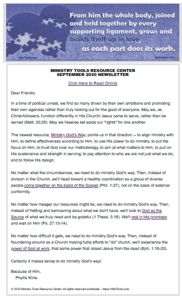
MinTools.com Example:
At the start of every new month at MinTools.com an e-mail newsletter is sent to those who sign up for it. I praise God for the many people from around the world who have subscribed to it. These newsletters have multiple purposes:
- They provide an update of new material on this site, as well as the sites devoted to training for Bible teachers and Church leaders.
- They address a spiritual issue or ministry need relevant to believers in the Church.
- They seek to encourage or challenge us to think about how well we are lining up with the character of God and principles from His Word, the Bible, in that area.
Please take time to read this month’s newsletter. You can subscribe to it on that same page. Please know that your e-mail address is used for no other purpose.
- Strategically determine the newsletter’s format and means of distribution.
If you have a primarily online ministry, a digital format of some sort may be the way to go for you too. But, if a church or ministry is not primarily online or worldwide, postal mail may be more of the way to go. If you decide to hand them out in person (i.e., at the doors on their way out, in their church mailboxes, etc.) to save money, you’ll need to accept the reality that many newsletters may not actually make it home and get read. You’ll also need to be aware that very likely not everyone will have attended the meeting during which you distributed them.
Remember, budget alone should not be the determining factor for the format you use. Always consider your readers. What will the people you minister to/with be most likely to read? A combination of e-mail/online and hardcopy might be necessary if you want to increase the number of people who read it.
MinTools.com Example:
Since Ministry Tools Resource Center targets believers around the world, the best format to date has been to use e-mail as the medium. Not only would the cost be prohibitive to send a hardcopy newsletters through the postal service, but it also would not be as conducive to directing people to updates on the site, one of the key purposes for doing the newsletter. In an e-mail newsletter, people can easily click on links to new posts and/or new resources. The newsletter can also be found online as well. You can freely sign up to receive these e-mail newsletter updates generally sent once a month.
- Don’t assume everyone will read it.
One thing you quickly learn in ministry is that no matter how purposeful and strategic you might be in using a newsletter update, not everyone will read it. And, while some may thoroughly read it, others will merely glance over the highlights.
If you’re using a newsletter to communicate something you don’t want people to miss, be sure to use other formats of communication. Also, figure out a way to highlight that information in the newsletter so it will less likely be missed.
MinTools.com Example:
In looking at the statistics about the MinTools.com newsletter, I realize that not everyone reads it — very common with e-mail newsletters. Sometimes the e-mail goes into people’s junk/spam folder. Sometimes the e-mail may not even get to people’s e-mail account at all. And, sometimes when it makes it, it still doesn’t get read, in large part because people are just so busy and/or they get so much e-mail they can’t look at it all. But, I also note that enough people do receive it and read it to make the newsletters worth the time and effort. At times people respond with positive feedback about how God used it to encourage and spur them on.
Of course, there are many other factors to consider (how often, who will develop it, layout, name, etc.). Rather than just do a newsletter the way you’ve always done it, seek God’s wisdom on how you can be more purposeful and strategic, increasing the potential of more people actually reading it.