Lining Up with God: What It Means, Why It Matters

Share:

Lining Up with God by Trusting in Him
Proverbs 3:5-6 provides a good reminder of lining up with God and not relying on ourselves or human wisdom.

Trust in the Lord with all your heart and lean not on your own understanding; in all your ways submit to him, and he will make your paths straight.

What Lining Up with God Means

If we break down the above verses, we can better grasp what’s required to align with God.

1) Trust in the Lord.

We need to see God for the Great God He is. We’re not going to line up with someone we don’t hold to be true, right, and worthy of following.

2) Trust in the Lord with all your heart.

We can’t be on again and off again in our pursuit and expect to remain in alignment with Him. God is a worthy standard to follow all of the time and in every way. Consequently, there isn’t any area to withhold our trust in Him. He won’t let us down so we’re safe to wholeheartedly pursue His ways.

3) Lean not on your own understanding.

We trust Him as One with unlimited understanding, who is always right. His thoughts and ways are higher than ours (Isa. 55:9) so it’s foolish to “be wise in your own eyes” (Prov. 3:7). We have limited understanding and we can be wrong.

4) In all your ways submit to him.

Even when we don’t understand God’s ways, we still align with Him. We don’t pick and choose which of His ways to follow.

Why Alignment with God Matters

To know why it’s important to line up with God, look at the results in Proverbs 3:6-8.

1) He will make your paths straight. (Prov. 3:6)

We have sure footing.

2) This will bring health to your body … (Prov. 3:8)

We find strength and stability.

3) This will bring … nourishment to your bones. (Prov. 3:8)

We have the sustenance needed to remain strong.

We’ve considered what it means to line up with God and why it matters. Look at the next post for how to come into alignment with Him.

Share:

The Process of Providing Christian Nurture

Share:

When we love God, we want to grow more and more in that relationship. That love spills over into love for others which leads to wanting them to know Him better too. God’s Word provides us with help about the process of providing Christian nurture.

3 Points to Remember about Providing Christian Nurture

Whether for ourselves, or to provide Christian nurture for others in the Church, the following three points should guide the process.

1) Christian nurture is a life-long process. We never stop learning.

Not that I have already obtained all this, or have already arrived at my goal, but I press on to take hold of that for which Christ Jesus took hold of me. (Phil. 3:12)

2) The growth process is developmental. Not everyone will be at the same place.

Therefore let us move beyond the elementary teachings about Christ and be taken forward to maturity … (Heb. 6:1)

3) Nurturing our walk with God should happen in different settings. Each setting adds a different layer to the growth process.

Until I come, devote yourself to the public reading of Scripture, to preaching and to teaching. (1 Tim. 4:13)

Let the message of Christ dwell among you richly as you teach and admonish one another with all wisdom through psalms, hymns, and songs from the Spirit, singing to God with gratitude in your hearts. (Col. 3:16)

Do your best to present yourself to God as one approved, a worker who does not need to be ashamed and who correctly handles the word of truth. (2 Tim. 2:15)

Providing Christian Nurture in the Church Purpose Ministry Manual
You’ll find these points listed in the Church Purpose Ministry Manual which looks at Christian nurture, taking time to get to know Him better, as one of the ways to express our love to God.

For resources about some venues for Christian nurture, go to:

Share:

The “Omni-” Nature of God

Share:

By definition, God is the One of whom there is no greater. None can compare. None can compete. The “omni-” nature of God, that is, the God of the Bible, demonstrates how He meets this definition.

The “Omni-” Nature of God According to Scripture
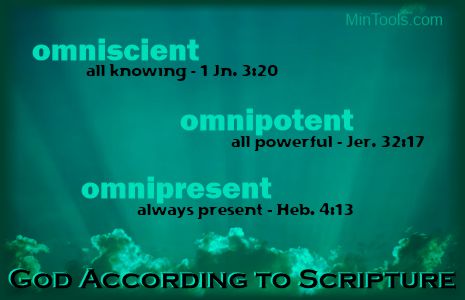
The Omni- Nature of God According to Scripture
The Bible presents us to a God who is omni- (all) — all knowing, all powerful, and always present.

1) God is omniscient. — all-knowing

Do you know how the clouds hang poised, those wonders of him who has perfect knowledge? (Job 37:16)

… the LORD searches every heart and understands every desire and every thought. (1 Chr. 28:9)

You have searched me, LORD, and you know me. You know when I sit and when I rise; you perceive my thoughts from afar. You discern my going out and my lying down; you are familiar with all my ways. Before a word is on my tongue you, LORD, know it completely. (Ps. 139:1-4)

Great is our Lord and mighty in power; his understanding has no limit. (Ps. 147:5)

Who can fathom the Spirit of the LORD, or instruct the LORD as his counselor? Whom did the LORD consult to enlighten him, and who taught him the right way? Who was it that taught him knowledge, or showed him the path of understanding? (Isa. 40:13-14)

See, the former things have taken place, and new things I declare; before they spring into being I announce them to you. (Isa. 42:9)

Remember the former things, those of long ago; I am God, and there is no other; I am God, and there is none like me. I make known the end from the beginning, from ancient times, what is still to come. I say, “My purpose will stand, and I will do all that I please.” (Isa. 46:9-10)

Oh, the depth of the riches of the wisdom and knowledge of God! How unsearchable his judgments, and his paths beyond tracing out! (Rom. 11:33)

If our hearts condemn us, we know that God is greater than our hearts, and he knows everything. (1 Jn. 3:20)

2) God is omnipotent. — all-powerful

Is anything too hard for the LORD? … (Gen. 18:14)

The Almighty is beyond our reach and exalted in power … (Job 37:23)

I know that you can do all things; no purpose of yours can be thwarted. (Job 42:2)

Ah, Sovereign LORD, you have made the heavens and the earth by your great power and outstretched arm. Nothing is too hard for you. (Jer. 32:17)

I am the LORD, the God of all mankind. Is anything too hard for me? (Jer. 32:27)

Jesus looked at them and said, “With man this is impossible, but with God all things are possible.” (Matt. 19:26)

For since the creation of the world God’s invisible qualities – his eternal power and divine nature—have been clearly seen, being understood from what has been made, so that people are without excuse. (Rom. 1:20)

3) God is omnipresent. — always present, seeing everything

Be strong and courageous. Do not be afraid or terrified because of them, for the LORD your God goes with you; he will never leave you nor forsake you. (Deut. 31:6)

From heaven the LORD looks down and sees all mankind; from his dwelling place he watches all who live on earth. (Ps. 33:13-14)

God is our refuge and strength, an ever-present help in trouble. (Ps. 46:1)

Where can I go from your Spirit? Where can I flee from your presence? If I go up to the heavens, you are there; if I make my bed in the depths, you are there. If I rise on the wings of the dawn, if I settle on the far side of the sea, even there your hand will guide me, your right hand will hold me fast. If I say, “Surely the darkness will hide me and the light become night around me,” even the darkness will not be dark to you; the night will shine like the day, for darkness is as light to you. (Ps. 139:7-12)

The eyes of the LORD are everywhere, keeping watch on the wicked and the good. (Prov. 15:3)

“Who can hide in secret places so that I cannot see them?” declares the LORD. “Do not I fill heaven and earth?” declares the LORD. (Jer. 23:24)

Nothing in all creation is hidden from God’s sight. Everything is uncovered and laid bare before the eyes of him to whom we must give account. (Heb. 4:13)

Implications of Having an Omniscient, Omnipotent, Omnipresent God

As an “omni-” God, He is self-sufficient. He doesn’t need anyone or anything. He has it all, knows it all, sees it all, and can do it all.

God isn’t dependent on us. We are dependent on Him. God doesn’t owe us anything. We owe Him everything. See: 1 Chron. 29:13-14; Job 41:11; Acts 17:25; Romans 11:35-36

Learn more about the “omni-” God of the Bible in the Our Great God from A to Z Discipleship Tool Download. Get to know the attributes of God including the kind of God it would take to create the heavens and earth. Also discover how each member of the Godhead works on our behalf. You’ll find five different alphabetical listing for each of these renderings of who God is as well as suggestions for reflection and taking it further.

For More about God: Theology Resources

Share:

The Attributes of God

Share:

“When you’re tired and you can’t sleep, just count your blessings instead of sheep ….” The song suggests a good alternative for sleepless nights, especially if we direct thanksgiving to God for those blessings. Another possibility? List the attributes of God going through the alphabet, from A to Z.

When referring to God’s attributes, we’re speaking of the character of God, the traits or qualities that make up His nature, or being. To be God, He must be the sum total of all these traits, all the time, without fail.

Attributes of God from A to Z

Here’s my alphabetical list. Be aware that it only gives one attribute for each letter but other qualities could be listed for many of the letters.

A – Almighty
B – Boundless
C – Compassionate
D – Dependable
E – Eternal
F – Faithful
G – Good
H – Holy
I – Immortal
J – Just
K – Kind
L – Love
M – Merciful
N – Never-Failing
O – One
P – Perfect
Q – Qualified
R – Righteous
S – Sovereign
T – True
U – Unchanging
V – Victorious
W – Wise
X – X-traordinary
Y – Yahweh
Z – Zenith


Our Great God from A to Z - His Attributes
Order the Our Great God from A to Z Discipleship Tool Download for this alphabetical listing in a format you can print that also includes a brief definition for each term and Scripture verses that point to those attributes of God. The resource also encourages you to respond to who God is and suggests a plan for focusing on each attribute.

You’ll also find another listing about Our Creator God from A to Z in the above resource with traits showing the kind of God it would take to create the heavens and earth. In addition, it includes an alphabetical listing for each member of the Godhead pointing to what God the Father, God the Son, and God the Holy Spirit do and what they distinctly provide for us.

Responding to Who God Is

Consider making up your own alphabetical list describing how you feel or what you think about our great God. The more we get to know this God who is all of the above plus more, the more we will revere and trust Him. We will find Him to be enough. We will want to serve and worship Him with our whole being for He is worthy.

For More about God: Theology Resources

Share:

Biblical Ways to Fellowship with One Another

Share:

Biblical Ways to Fellowship with One Another
The Greek word used in the Bible for fellowship, koinonia, means the sharing of what we have in common (koinos). Our life in Jesus Christ brings us together as that which we share in common, superseding all of our differences. But how do we share, or participate, in that common life? There are at least four biblical ways to fellowship with one another.

Four Biblical Ways to Fellowship with One Another

If we look at Bible verses where koinonia appears, we find the process of fellowshipping with one another.

1) Celebrate together what Jesus has done for us through the Lord’s Supper, also known as Holy Communion.

Is not the cup of thanksgiving for which we give thanks a participation (koinonia) in the blood of Christ? And is not the bread that we break a participation (koinonia) in the body of Christ? (1 Cor. 10:16)

2) Contribute materially to the needs of one another.

For Macedonia and Achaia were pleased to make a contribution (koinonia) for the poor among the Lord’s people in Jerusalem. (Rom. 15:26)

For I testify that they gave as much as they were able, and even beyond their ability. Entirely on their own, they urgently pleaded with us for the privilege of sharing (koinonia) in this service to the Lord’s people. (2 Cor. 8:3-4)

3) Communicate about God’s work in each other’s lives.

that the sharing (koinonia) of your faith may become effective by the acknowledgment of every good thing which is in you in Christ Jesus. (Phil. 1:6)

4) Connect with one another in sharing the whole of our lives on a regular basis, engaging in true community.

They devoted themselves to the apostles’ teaching and to fellowship (koinonia), to the breaking of bread and to prayer. … All the believers were together and had everything in common (koinos). … (Acts 2:42-47)

All the believers were one in heart and mind. No one claimed that any of their possessions was their own, but they shared (koinos) everything they had. … (Acts 4:32-35)

You’ll find these processes of fellowshipping listed in the Church Purpose Manual which looks at fellowship as one of the ways to fulfill our purpose to love people. It also considers other ways to live our our purpose to love God and people.

For More: Fellowship Resources

Share:

Compliments to God

Share:

Compliments to God as We Ascribe to the LordA compliment is “an expression of esteem, respect, affection, or admiration” (Merriam-Webster). Hence, when we give compliments to God, we’re honoring Him for who He is and what He’s done. Biblically we might say that we are:

  • ascribing to God the glory due His name (Ps. 29:2; 96:7-8)
  • expressing His worth (Rev. 4:11; 5:11-14)
  • exalting Him, lifting Him up (Ps. 99:5, 9)

We might also use terms like praising and worshiping God. In essence, we’re telling God how great He is. We’re attributing the glory to Him, praising Him for who He is, and giving Him credit for what He’s done.

God Doesn’t Need Our Compliments

God is worthy whether we acknowledge it or not. Who He is, isn’t based on our recognition of Him. He is who He is. Our compliments, or lack of praise, doesn’t affect His significance and worth.

Through the generations there have been people who have failed to acknowledge Him as the Source (Rom. 1:20-25). Some defiantly turn their backs on Him, disbelieving He could really be great enough to do all Scripture says He did and will do. But a day will come when “every knee will bow” before Him and “every tongue will acknowledge God” (Rom. 14:11).

Compliments to God Show Our Appreciation, Thankfulness, Respect, and Admiration

We express appreciation and thankfulness when we compliment people. God has done, and will continue to do, more for us than all the people combined in our lives.

Think of His wonderful and thorough work of salvation. Who else will love us enough to come and die in our place, or be able to take on the punishment our sin deserves? Certainly such a merciful, gracious, loving, and holy God deserves our compliments.

Think of His Written Word. Who else could compose such a consistent body of truth over the span of nearly 2000 years, dynamic and sufficient to thoroughly equip and teach us, that could stand the test of time and attacks of enemies? Without doubt, we owe such a wise, all-knowing, powerful, and righteous God our compliments.

We express respect and admiration for traits in people we think are commendable. God consistently demonstrates admirable qualities because He is perfect in every way, something we could never say about ourselves or any other human being. Compliments go to Someone we can always depend on to be faithful and true in what He says and does because He can’t deny Himself. He always was and always will be who He is.

Take time today to express compliments to God not just for what He does but also for who He is. He deserves our appreciation, thankfulness, respect, and admiration!

For More About Our God: Theology Resources

Share: