Stuck in Perpetual Motion?

Share:

When referring to churches or ministries as stuck in perpetual motion, it’s like we’re on a hamster wheel going around and around. We’re moving, but we’re just going around in circles not moving forward.

The Problem with Being Stuck in Perpetual Motion

Stuck in Perpetual Motion Because We've Forsaken Our First Love
(Click to enlarge in Pinterest & repin.)

We can engage in a lot of activity that consumes a lot of time and energy but we have little to show for it of eternal value. Before we know, it becomes mere religious activity. When we start merely going through the motions, our love for God tends to grow cold. We leave our “first love” (Rev. 2:4) and may become motivated by a need to perform, or accomplish something, rather than love.

Because we’re active, we may feel like we’re accomplishing something. Pride could even set in because we’re so busy “for the Lord”. We become blind to the reality that we’re stuck. We’re spinning our wheels, doing the same thing over and over, going nowhere.

Perhaps what we’re busy doing was at one point a good thing, but it no longer propels growth. We keep doing it nonetheless and therefore stop meeting needs. Instead of helping people “grow in the grace and knowledge of our Lord and Savior Jesus Christ” (2 Pet. 3:18), we’re enabling them to stay where they are.

What It Takes to Get Unstuck

Since being stuck in perpetual motion affects our motivations and attitudes, we need a heart and mind transformation. That begins when we say, “whatever was to my profit I now consider loss for the sake of Christ. What is more, I consider everything a loss compared to the surpassing greatness of knowing Christ Jesus my Lord.” (Phil. 3:7-8) That kind of transformation requires help. To get unstuck, we can’t rely on ourselves. Jesus said, “If you remain in me and I in you, you will bear much fruit; apart from me you can do nothing.” (Jn. 15:5)

Because being stuck in perpetual motion tends to affect our perspective of what’s most important, we must learn what is essential and what isn’t, and focus on what truly matters. We must “seek first the kingdom of God” (Matt. 6:33) “for the kingdom of God does not consist in words but in power” (1 Cor. 4:20). “The kingdom of God is … righteousness and peace and joy in the Holy Spirit” (Rom. 14:17). We find little joy when we’re merely on the treadmill of life. When, on the other hand, we keep pace with the Spirit, walking with Him, we go somewhere that leads to greater Christlikeness and fruitfulness (Gal. 5:22-25).

Share:

Not Visionary Because We’re Stuck

Share:

Do you feel like your church or ministry isn’t going anywhere? If you aren’t visionary, you’re undoubtedly stuck in something that keeps you from moving forward.

Typical Reasons Churches and Ministries Lack Vision

Below are five reasons churches and ministries aren’t going anywhere. They’re stuck. Click on links for a look at each of these reasons.

Stuck in Perpetual Motion
Stuck in Parroting
Stuck in Preparations
Stuck in the Past
Stuck in the Present

God Wants Us To Press On, Not Get Stuck in Place

Not Arrived So Press On - Visionary, Not StuckGod wants us to “grow in the grace and knowledge of our Lord and Savior Jesus Christ” (2 Pet. 3:18). Growth implies progression. We’re not growing if we’re staying in the same place. We’re to “press on to take hold of that for which Christ Jesus took hold” of us. None of us will ever arrive on this side of eternity (Phil. 3:12). Pressing on suggests that we’re in a constant spiritual pursuit, not locked in place.

One day God will even transform our lowly bodies. — “But our citizenship is in heaven. And we eagerly await a Savior from there, the Lord Jesus Christ, who, by the power that enables him to bring everything under his control, will transform our lowly bodies so that they will be like his glorious body.” (Phil. 3:20) — If He can do that, certainly He can provide the power we need right now to move forward. Let’s not be content to stay where we are. — “I can do everything through him who gives me strength.” (Phil. 4:13)

God Wants Us to be Visionary Which Requires His Power and Perspective

When we try to move staying in the same spot, we merely build ruts. The deeper the rut, the harder it is to get out. Often it takes someone, or something, powerful enough to pull us out. God is our Power Source. — “His divine power has given us everything we need for a godly life through our knowledge of him who called us by his own glory and goodness.” (2 Pet. 1:3)

We may get weary of staying vigilant and moving forward but not God. In Him we not only have the power to persevere but also the needed perspective. — “Do you not know? Have you not heard? The LORD is the everlasting God, the Creator of the ends of the earth. He will not grow tired or weary, and his understanding no one can fathom. He gives strength to the weary and increases the power of the weak.” (Isa. 40:28-29)

God can pull us out of our ruts, no matter what we may be stuck in. But, we must put our hope in Him, no matter how things appear. — “… but those who hope in the LORD will renew their strength. They will soar on wings like eagles; they will run and not grow weary, they will walk and not be faint.” (Isa. 40:31)

Help for Church and Ministry Leaders: Goal-Setting & Vision Casting

Share:

Find Yourself Making Excuses in Ministry?

Share:

God Makes All Grace Abound so No Excuses in MinistryIf we find ourselves making excuses in ministry about why we didn’t do something or didn’t do a better job, we need to work through how this verse relates.

And God is able to make all grace abound to you, so that always having all sufficiency in everything, you may have an abundance for every good deed. (2 Cor. 9:8, NASB)

Principles from 2 Corinthians 9:8 that Apply to Ministry

The Apostle Paul wrote to the Corinthians about their ministry to the Macedonian church in 2 Corinthians 9. He told them that they needed to be prepared to follow through with their commitment and should do so generously and cheerfully. Though these verses refer to giving, we could apply the principles in 2 Corinthians 9:8 to any kind of ministry.

  1. What God wills, He provides for. — “And God is ABLE to make”
  1. God’s provision to do His will is complete, not just a trickle or portion of grace. — “ALL grace ABOUND to you”
  1. God will always come through with the grace to do His will, no exceptions. — “so that in ALL things at ALL times”
  1. Though God will give us everything essential for accomplishing His will, He may or may not give us excess. — “having ALL you NEED”
  1. God’s objective in giving us grace to do His will isn’t that we keep His provision for ourselves but that we have in order to give. — “you will ABOUND in EVERY good work”

Do Some Soul Searching If You Find Yourself Making Excuses in Ministry

If we have problems following through on commitments, the problem is with us, not with God. Before making excuses for not doing ministry, or doing it well, let’s ask God to search our hearts (Ps. 139:23-24) as we seek to answer these questions.

Is this really God’s will?

Perhaps we’re struggling because we’re pursuing something that’s not truly God’s will. We may have good intentions but not God’s intentions. We may have good ideas but not God’s ideal. — Keep praying about it to make sure you’re on page with God.

Are my motives right?

Perhaps in the depths of our hearts, we want God’s grace so we’re blessed. While God does take care of us, ultimately He gives us His grace so we can serve others. “Each one should use whatever gift he has received to serve others, faithfully administering God’s grace in its various forms.” (1 Pet. 4:10) — Learn to be generous and faithful with the little God gives. He could be waiting to give more until our motives are right.

Am I missing what God is actually doing?

Perhaps we’re putting expectations on God as to how He must operate and therefore don’t see what He’s putting into place for us. God provides for ministry in a variety of ways, not just monetarily. He might be providing but we don’t see it because we’re looking elsewhere. — Let God be God, and we won’t give up just because we don’t see it. God knows what’s truly needed to accomplish His will. He sees the big picture.

Maybe instead of making excuses in ministry, what we need is to ask God for a restart based on His abundant grace.

Church Leaders, Also Read: God’s Power for the Church: The Grace of God

Share:

Church Leaders, Be an Example of Servanthood

Share:

Servanthood Follows Jesus' ExampleChurch leaders, do you want your church body to engage in Body life, living out the one another passages of Scripture with everyone doing their parts? Do you want people to treat their spouses and families well? Do you want them to extend the love of Christ to people in the workplace? Do you want people to reach out with charity and kindness to those in need? Do you want people to work out conflict and find unity in the midst of diversity? — Then follow Jesus’ ways and be an example of servanthood.

Be shepherds of God’s flock that is under your care, serving as overseers – not because you must, but because you are willing, as God wants you to be; not greedy for money, but eager to serve; not lording it over those entrusted to you, but being examples to the flock. (1 Pet. 5:2-3)

Notice that we’re to be eager to serve, doing so willingly and authentically.

Ways Leaders Exemplify Servanthood

While serving can manifest itself in what we do, it also comes out in our attitudes and how we treat others.

  • Leaders have many opportunities to be a servant example by the way they treat those who criticize, falsely accuse, or betray them.
  • Leaders can exemplify being a servant in the way they deal with personality conflicts, differences of opinion, and philosophical challenges.
  • Leaders can model servanthood in their approach to people who seem unlovable, difficult, or hard to reach.
  • Leaders can demonstrate servanthood by respecting all people regardless of age, spiritual maturity, gender, type or position of ministry, etc.

In a world disillusioned and distrusting of people in leadership, someone who authentically leads in these ways as a servant, will tend to get people’s attention in a good way. This is the kind of leader who can make a real impact in people’s lives.

Also Read: Church Leadership Qualities: Be a Servant

Share:

Grounds for Obedience

Share:

Jesus commissioned His disciples to “go and make disciples of all nations” (Matt. 28:19-20). We tend to point to those words as a prime command in support of outreach. While that’s true, Jesus obviously intends for us to do more than help people come to know Him as their Savior. He also wants to be their Lord as seen in what comes next in the instructions to baptize them and teach them “to obey everything” He commanded. We find the grounds for such obedience in verse 18, right before He said to go and make disciples.

Jesus’ Authority Provides Grounds for Expecting Obedience to Him

Jesus' Authority Gives Grounds for Obedience

Jesus said, “All authority in heaven and on earth has been given to me” (Matt. 28:18). That leaves nothing over which He wouldn’t have authority. He has full rights, not just in heaven, but also on earth. Jesus isn’t just the Head of the Church (Eph. 1:22; Col. 1:18) but “He is the head over every power and authority.” (Col. 2:10). He’s the ultimate, the One with whom everyone should align.

He could claim such authority “for in Christ all the fullness of the Deity lives in bodily form” (Col. 2:9). As such, He knows everything and has the power to do anything. But, since the fullness of God dwells in Him, He also has the wisdom, grace, mercy, and love needed to use that knowledge and might for our good. Hence, it only makes sense that we yield to Him as Lord of our lives, obeying Him in all things. Any commands He gives us look out for our welfare, protecting us and providing benefit to our lives. So, in our discipleship efforts, it has to be about more than trying to get people to conform out of fear of one day giving an account to God (Rom. 14:12). Yielding to Him is for our good as well as His glory.

Implications of Jesus’ Authority for Our Discipleship Efforts

Since Jesus has all authority, we need to make sure we communicate in a way that points people to Him as the ultimate authority. We must be careful we don’t inadvertently set ourselves up as the one to whom they owe their allegiance. We must make it about Him, not us. We must promote His purposes, design, and mission for the Church, not our personal agendas.

As a light in the world, we reflect His light (Matt. 5:14-16; Jn. 8:12). As the salt of the earth, we season what we say with His grace and truth (Matt. 5:13; Col. 4:6). As His ambassadors, we represent Him (2 Cor. 5:20-21).

Also Read: Authority in Communication

Share:

Requisites for Real Change over Quick Solutions

Share:

Driven by our own self-interests, comfort levels, or personal convenience, we may be tempted to simply apply a quick solution to situations rather than seek real change. We might therefore choose to take the easiest, least resistant, or quickest path rather than truly work through issues. God, however, desires real change and He shows us what it takes.

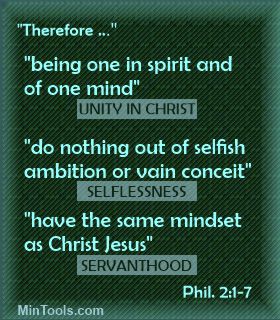
Philippians 2:1-7 Shows What It Takes for Real Change3 Requisites for Pursuing Real Change Over Quick Solutions in Philippians 2:1-7

God knows our natural tendencies and therefore instructs us in what it will take to do what is best for all rather than merely applying a bandage and hoping it will go away.

1) Seek Unity out of Diversity

Therefore if you have any encouragement from being united with Christ, if any comfort from his love, if any common sharing in the Spirit, if any tenderness and compassion, then make my joy complete by being like-minded, having the same love, being one in spirit and of one mind. (Phil. 2:1-2)

We must find our unity in Christ and fellowship in the Spirit, rather than caring more about our personal opinions and preferences. When we do, we’ll exhibit tenderness, compassion, joy, and love toward one another. We’ll be able to work through differences rather than cover over them or compromise merely to keep peace. — This means truly accepting and respecting one another regardless of where we stand on issues. We come together in Christ and seek to get on page with Him.

2) Be Driven by Selfless Motivations

Do nothing out of selfish ambition or vain conceit. Rather, in humility value others above yourselves, not looking to your own interests but each of you to the interests of the others. (Phil. 2:3-4)

When we truly look out for the good of others, we realize that it isn’t about what’s the most convenient or comfortable for us. We realize that taking the path of least resistance isn’t always what is best for everyone involved. — This means truly trying to help the other person reach their potential in Christ from the inside out, not merely tolerating them or being satisfied with mere outward conformity.

3) Maintain Christ-like Attitudes

In your relationships with one another, have the same mindset as Christ Jesus: Who, being in very nature God, did not consider equality with God something to be used to his own advantage; rather, he made himself nothing by taking the very nature of a servant, being made in human likeness. (Phil. 2:5-7)

When we approach people with a Christ-like attitude, we find ourselves willingly giving of our time to serve in ways that truly make a difference. We seek the best for others regardless of the time and effort it takes. — This means truly investing our lives into people and the ministry God has given us, not doing just enough to get by.

Church Leaders, Also Check Out These Posts: Change Management

Share: