Obedience About More Than Mere Religious Activity?

Share:

When life in Christ becomes little more than religious activity, we could find ourselves with a dull, lifeless group of people busy doing what appears to be all the right things with little to show for it. Where is the appeal in that? Why would people who need Jesus be drawn to that? Yet, that’s what we have when we merely focus on obedience in the Christian life.

Obedience is Important But Not God’s Top Priority

Scripture speaks of the wisdom of obeying:

Therefore everyone who hears these words of mine and puts them into practice is like a wise man who built his house on the rock. But everyone who hears these words of mine and does not put them into practice is like a foolish man who built his house on sand. (Matt. 7:24-25)

The Word also refers to the blessing that comes from obedience:

But the man who looks intently into the perfect law that gives freedom, and continues to do this, not forgetting what he has heard, but doing it — he will be blessed in what he does. (James 1:25)

But, Scripture also points to something that supersedes the law. Jesus referenced the two greatest commandments as loving God with all of who we are and loving others as ourselves. He said, “All the Law and the Prophets hang on these two commandments.” (Matt. 22:37-40)

Emphasis on Love Gets Us Beyond Mere Religious Activity
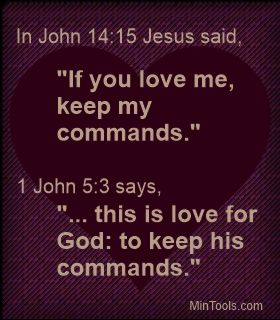
Obedience About Love Not Religious Activity
Jesus died on the cross to bring us into a relationship with the Father (Jn. 14:6; Rom. 5:10-11; 2 Cor. 5:18; Heb. 4:16). That makes the Christian life more of a relationship than a religion. When we’re in a love relationship with God, we have added motivation to do what pleases and honors Him. Obedience is not burdensome.

  • It’s about showing love to God by doing what He says not trying to earn His favor. (Matt. 22:37-38; Jn. 15:10; 1 Jn. 5:3)
  • It’s about getting to know God better which comes as we step out in faith and do what He says. (Col. 1:9-10)
Share:

Application About More Than Mere External Conformity?

Share:

Whether you preach, teach, or disciple others one-on-one, remember that application is important to God. As a teacher training worksheet says, Application is God’s Idea, Not Merely a Good Idea. Read Matthew 7:24-25, James 1:25 and 2:17.
Guard Your Heart, Internal Change Not mere Application
But, God’s Word also says, “The Lord does not look at the things people look at. People look at the outward appearance, but the Lord looks at the heart.” While application is important, we must put more emphasis on what’s happening in the heart “for everything you do flows from it” (Prov. 4:23).

Mere External Conformity versus Internal Change

If we’re satisfied with mere external conformity, we could be building a church full of hypocrites. We could find ourselves with a group who are quick to give up when the going gets tough because their hearts aren’t in it. How is that honoring to God? How is that a testimony to the world around us?

God cares about the motives behind what we do (Prov. 16:2), what’s in our heart. It’s not just about saying or doing the right things. It’s about doing them for the right reasons, and that’s a matter of the heart.

God cares about our attitudes, not just our actions. We’re “made new in the attitude of our minds” in Christ Jesus (Eph. 4:23). How we respond to life and treat others changes when we’ve been internally transformed.

Internal Change Leads to Application

When our whole heart is given over to God, we will do what we’re supposed to do. That’s why we find verses like the following:

  • “love the Lord with all your heart …” (Matt. 22:37)
  • “trust in the Lord with all your heart …” (Prov. 3:5)
  • “keep your precepts with all my heart …” (Ps. 119:69)

When we change from the inside out, we tend to do what we should do. Obedience to God’s Word flows from a heart in tune with Him. When we keep His commandments because we love Him, “his commands are not burdensome” (1 Jn. 5:3). We want to please Him. We want to align with Him. Our perspective about the Christian life changes when we’ve been internally changed. We find that His yoke is easy and His burden is light (Matt. 11:30).

Share:

Disciplined But Not Forgotten

Share:

We live in a world where people seem to think they can do whatever they wish, even that which clearly violates God’s commands, and get away with it. Even many who say they believe in God fall prey to the line of thinking that God didn’t really mean what He said about sin and its consequences. He won’t discipline us. After all, they reason, He is a God of love and grace. If God disciplines us, then He must be a mean God, they reason, rather than a loving One.

Would a Loving God Really Discipline Us?

Absolutely! God explains it this way:

And have you completely forgotten this word of encouragement that addresses you as a father addresses his son? It says, “My son, do not make light of the Lord’s discipline, and do not lose heart when he rebukes you, because the Lord disciplines the one he loves, and he chastens everyone he accepts as his son. (Heb. 12:5-6) If you are not disciplined – and everyone undergoes discipline – then you are not legitimate, not true sons and daughters at all. (Heb. 12:8)

The Lord Disciplines Those He Loves and Doesn't Forget Them
God wants more than happy people. He wants holy people, those whose righteous character enables them to truly love Him and others (Matt. 22:37-40) and be at peace with themselves. And so we read, “… God disciplines us for our good, in order that we may share in his holiness. No discipline seems pleasant at the time, but painful. Later on, however, it produces a harvest of righteousness and peace for those who have been trained by it. (Heb. 12:10-11)

When we properly react to His discipline, we come out better. God restores us. That’s not the objective of a mean God, of a God who is simply out to get us by making us suffer consequences for sin. That’s the intent of a God who deeply cares and loves us beyond measure.

Example of Being Disciplined But Not Forgotten

Read through the Old Testament and you’ll find God’s people, Judah, constantly turning away from God to follow after the gods of the nations surrounding them. Yet, God had clearly commanded them that they should have no other gods before Him or make idolatrous images, worshiping them. He also stressed consequences of disobeying this command. (See Exodus 20:1-6.)

Judah suffered consequences for their sin but then God sent judges to lead them back to Himself. When a judge died, however, they reverted back to their sinful ways and so the cycle continued. God sent prophets to warn them but they persisted in their rebellion. They had to suffer more severe consequences, so God sent them into exile to Babylon for seventy years.

Read what God told them:

This is what the Lord says: “When seventy years are completed for Babylon, I will come to you and fulfill my good promise to bring you back to this place. For I know the plans I have for you,” declares the Lord, “plans to prosper you and not to harm you, plans to give you hope and a future. Then you will call on me and come and pray to me, and I will listen to you. I will be found by you,” declares the Lord, “and will bring you back from captivity. I will gather you from all the nations and places where I have banished you,” declares the Lord, “and will bring you back to the place from which I carried you into exile.” (Jer. 29:10-14)

That’s a loving God!! He may discipline His people, but He doesn’t forget them. When we undergo hardships, let’s look at it from God’s perspective. If we fight against Him and the means He’s using to work in our lives, we could miss out on the good He desires to bring us. — “…do not despise the Lord’s discipline, and do not resent his rebuke because the Lord disciplines those he loves, as a father the son he delights in.” (Prov. 3:11-12) “Godly sorrow brings repentance that leads to salvation and leaves no regret, but worldly sorrow brings death.” (2 Cor. 7:10)

Share:

In Some Cases Knowledge Really is Power

Share:

The phrase “knowledge is power” often really means that knowledge leads to power, but only if it’s used. So, in the worldly scheme of things, knowledge itself isn’t really power. There’s a very real sense in which knowledge isn’t power unless applied to life in the spiritual realm as well. Head knowledge alone won’t cause us to bear fruit. Notice the flow in Colossians 1:9-11 from knowledge to understanding to applying that knowledge to then bearing fruit and getting to know God even better. — “We continually ask God to fill you with the knowledge of his will through all the wisdom and understanding that the Spirit gives, so that you may live a life worthy of the Lord and please him in every way: bearing fruit in every good work, growing in the knowledge of God.”

Power Through Our Knowledge of Him
Yet, for us a believers, there is a very real sense in which knowledge “is” power as “His divine power has given us everything we need for a godly life through our knowledge of him who called us by his own glory and goodness” (2 Pet. 1:3).

How Knowledge is Power in the Spiritual Realm

We have power to live a godly life (2 Pet. 1:3), an empowered life that’s fruitful, one that makes an eternal difference (Jn. 15:1-5). To claim knowledge as power for us as believers depends on two factors:

1) It depends on how we define knowledge.

When 2 Peter 1:3 equates having divine power “through our knowledge of Him” it uses the Greek word epignosis which Vine’s Expository Dictionary defines as “full, or thorough knowledge, discernment, recognition”. It’s the kind of knowledge wherein we’re so intimately in tune with Him that we recognize His voice and actions above all others like sheep that know their shepherd’s voice and only follow him (Jn. 10:2-5). It’s the kind of knowledge that has firsthand experience with who God is so that like Job we say, “My ears had heard of you but now my eyes have seen you.” (Job 42:5) It’s the kind of knowledge that puts us in awe of God, what Scripture refers to as the fear of the Lord which “is a fountain of life, turning a person from the snares of death” (Prov. 14:27).

2) It depends on the subject of that knowledge.

2 Peter 1:3 goes on to say we have divine power “through our knowledge of him who called us by his own glory and goodness”. Such power is possible when we know the glorious King of kings and Lord of lords, the Great and Almighty God of whom there is none greater (Eph. 1:19). It’s about knowing the good and loving Savior who is full of mercy and grace, whose love is better than life itself (Ps. 63:3). It’s about knowing the reliable One who keeps His promises which are “very great and precious” (2 Pet. 1:4). His promises are great because of His glory and precious because of His goodness. This God must be the subject of knowledge, not a god of my own design. Otherwise we have an anemic god in whom there is little or no power.

The Results of Such Knowledge

Knowledge of this God, as described in Scripture, results in power that gives us “everything we need for a godly life” (2 Pet. 1:3). Here’s how it tends to go:

The more we get to know God for who He really is, the more we will revere and trust Him in all we do. “The fear of the Lord is the beginning of wisdom.” (Prov. 9:10)

As we trust this Almighty, Great, and Awesome God to work in and through us, we can’t help but get excited about Him. It’s what makes Romans 12:11 possible: “Never be lacking in zeal, but keep your spiritual fervor, serving the Lord.” This makes a big difference in ministry.

And, seeing His power at work in and through us, we won’t be able to help but worship and praise Him. He is the Great I Am, the One of whom there is none greater, worthy of our love and adoration. Worship truly focuses on Him.

Share:

Back to the Basics

Share:

We cannot neglect fundamental principles in ministry and expect to make a difference for eternity. We might put up some good appearances but in time what we do will suffer. We need to keep going back to the basics.

Why Remembering the Basics of the Christian Life Are So Important

How well we remember the basics can determine how well we stand and persevere. The basics form the foundation of all we do. A faulty foundation and eventually we crumble. A firm foundation and we can stand no matter how difficult life becomes. (Read Luke 6:46-49.)

How well we remember the basics can determine how well we flourish. Roots need good soil. Toxins, chemical imbalance, or excessive weeds can weaken or destroy what started as a good plant. Hard or rocky soil can keep things from growing. (Read Luke 8:12-15.)

Church Leaders May Need to Get Back to the Basics of God’s Purposes, Design, and Mission

Back to the Basics of Life in ChristEverything church leaders do needs to be firmly rooted in the basics of life in Christ like God’s purposes, design, mission, heart, and power for the Church. When leaders have a good grip on God’s intent for the Church, their own roles become more obvious, as well as the heart and means needed to fulfil that role.

Check out the church leadership training division of Ministry Tools Resource Center, TrainChurchLeaders.com, which devotes a section to getting leaders back to the basics.

Also check out the downloadable resources to help leaders steer the church in these directions.

All Believers Need to Remember and Live in Accordance with Who We are and What We Have in Christ

We all, regardless of ministry roles, need to get back to the basics in order to walk worthy of our calling in Christ Jesus (Eph. 4:1). We need to remember some key spiritual truths:

  • We are sinners saved by grace, cleansed from sin because of Jesus’ death on the cross. — Are you remembering that it is all about what He has done for you?
  • We were taken out of darkness to live in the light of His truth. — Are you living like a child of the light?
  • We are new creatures in Christ Jesus. — Are you growing more and more into the likeness of who you are in Christ Jesus?
  • We were placed into a Body of believers to be members of one another. — Are you taking time to fellowship with and serve other believers?
  • We are to be salt and light in this world. — Are you a testimony for Jesus in a bland and dark world?

Let’s guard against complicating the Christian life and what the Church is about. If we remember these basics we will be used by God to make a difference for eternity.

Share:

Living an Abundant Life is Possible Because of Jesus

Share:

In light of the hardships, dangers, sorrows, and trials of this world, we might question if the abundant life Jesus promised is possible. If it was up to us or dependent on our circumstances, we’d have reason to doubt. The possibility of us living the abundant life, however, rests on Jesus.

Living an Abundant Life Possible Because of Who Jesus Is

Abundant Life, to the Full, Possible Because of JesusJesus said, “I have come that they may have life, and have it to the full” (Jn. 10:10). If Jesus merely came to earth as a man, albeit a good teacher and great example, then His claim of abundant life would probably just be an ideal to work toward. That, however, isn’t the case. Consider the One who made the claim and how that makes a full life possible right now.

  1. Jesus is our Creator. Having always existed, He knows the beginning from the end (Jn. 1:1-3; Rev. 21:6). He knows how we were made and what we truly need to have an abundant life and He has the power to give it to us.
  1. Jesus is Immanuel, God with us (Matt. 1:23). As God in the flesh, all the fullness and radiance of God resides in Him (Col. 2:9-10; Heb. 1:3). He possesses the kind of life He promised to give.
  1. Jesus is the Good Shepherd who cares for the sheep like none other can, ultimately laying down His life for the sheep (Jn. 10:11, 14-15). He has the love and compassion that drives Him to provide a full life for us.
  1. Jesus is the Resurrection and the Life, the firstborn from among the dead (Jn. 11:25-26; Col. 1:18). In being brought back to life, Jesus demonstrated that in Him there is power over death and sin so we can be overcomers.
  1. Jesus is the Living Water (Jn. 4:9-10; 7:37-38). He quenches our thirst like none other can. In Him we can be satisfied with little or much.
  1. Jesus is the Bread of Life (Jn. 6:35). He Himself is our daily sustenance. In Him we have what we truly need.
  1. Jesus is the King of kings and Lord of lords (Rev. 17:14; 19:16), sovereign over all. He not only has the power to grant us the life He offers but also the authority to do so.

No matter what we experience in this life, we can still have a full life because of this One who came to give us that life. Remember, “neither height nor depth, nor anything else in all creation, will be able to separate us from the love of God that is in Christ Jesus our Lord” (Rom. 8:39).

Take time to further reflect on the abundant life Jesus came to give us.

Jesus’ Claim
The Difference It Makes
How to Have It

Share: