Ways for Adults to Memorize Scripture

Share:

In a previous post giving a personal testimony about Scripture Memorization I wrote that I would give some ideas for how adults can memorize Scripture.  Here’s a list of some ideas.  You should be able to find something that fits you … your learning style, personality, etc.  Incorporating variety into the way you memorize Bible verses should help keep it from getting boring, from being mere routine.

Ideas to Help Adults Memorize Scripture Verses

  1. Use a Scripture memory system like the Navigators’ Topical Memory System or  The MacArthur Scripture Memory System.  (links will take you affiliate store)
  1. Use music.  There are plenty of Scripture memory songs for children out there. (The link will take you to our affiliate store.)  Although designed for children, this music could be an easy way for us adults to learn as well.  Scripture Release offers some free downloads of songs based on Scripture verses that are geared more for adults. Get creative and make up your own song using a Scripture verse for the lyrics.
  1. Get some how-to books used for children’s ministry and make it fun for yourself using some of the game ideas suggested in them.  One book in our affiliate store is 52 Ways to Teach Memory Verses.  Who said adults can’t memorize verses using games and other activities?
  1. Find an app for Scripture memorization for your phone or computer.
  1. Put some rhythm into it.  Say it with emphasis on different words or syllables, clapping or tapping to each word, etc.
  1. Make symbols or draw pictures to represent words or phrases, either literally on paper or with mental images.  Use these images to guide you through recall of the verse.
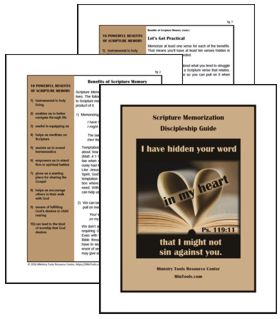
Scripture Memorization Discipleship Guide includes Means of Memorizing
You’ll find eight more ways to memorize God’s Word in the Scripture Memorization Discipleship Guide. This resource also explores ten benefits of memorizing Scripture, as well as some tips, and also help making it age appropriate.

Share:

Scripture Memorization: A Personal Testimony

Share:

Scripture Memorization Discipleship Guide
If you grew up going to church and/or Bible clubs, you’ve undoubtedly had some experiences with Scripture memorization. Following is my personal testimony of memorizing Scripture. It’s included in the Scripture Memorization Discipleship Guide along with some tips for memorizing Gods Word. That resource also explores benefits and means of Scripture memory.

The Experiences I Had with Memorizing Scripture

I remember the Scripture memory contests in Sunday School when I was a child.  I recall many times cramming right before class so I could go in, say the verse, and get the prize.  That’s as far as my memory goes on those verses.  I also remember times when teachers were more creative in their approach and made it fun to learn the verses.  We did it together, in class, sometimes for prizes but often not.  Those are the verses I still remember.

Consequently when I began teaching children’s classes, and writing lesson plans incorporating Scripture memorization, like Children Learn to Worship using Psalm 100, I wanted to do it in ways that built positive attitudes toward memorizing Bible verses.

Ten helpful principles for teachers to do that are in the Effective Scripture Memorization Worksheet.

As I grew older physically into adulthood but also spiritually, I began to memorize verses that related to my life situations, sort of as a spiritual discipline, but more because I simply wanted to know them.  I memorized for the intrinsic value of it, not for some extrinsic reward.  What a difference!

The Means I Have Used to Memorize Verses

I have found that variety works best for me.  And I like to have fun doing it.  Why can’t memorizing Scripture be fun?  I do believe the best way to memorize Scripture is to do what fits you … your learning style, your personality, etc.  I’ll give some ideas in another post for how adults can memorize Scripture.

But, let me say that what helps me the most, and what I believe we all need to do, is to understand the meaning of the passage and not merely memorize the words. And, of course, much repetition and review has also been necessary.

Share: