Bible Teaching That Communicates God’s Words

Share:

Bible Teaching That Communicates the Authoritative Word of God
Do you truly realize what happens when we teach Scripture?

In Bible teaching, we’re handling and sharing with others, the words of an Almighty God, the Creator of the universe, the Sustainer of life, the all-knowing, all-powerful, always wise and sovereign King of kings and Lord of lords.

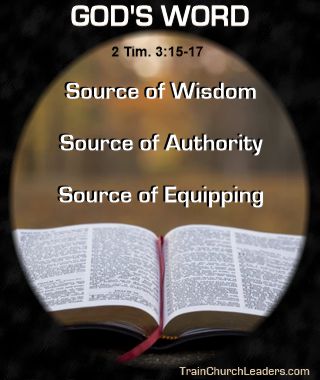
Scripture describes itself as penned by human writers, but “men spoke from God as they were carried along by the Holy Spirit” (2 Pet. 1:21). We also read that “all Scripture is God breathed” which makes it so useful to thoroughly equip us for every good deed (2 Tim. 3:16-17).

No other book has the same authoritative base because of its Author … an absolute standard to live by. No other book has as much power to change lives because of its Author … a relevant standard to live by. — What an awesome privilege and responsibility we have in teaching God’s Word to others.

Implications for Teachers and Leaders for Bible Teaching

Bible teachers, the first question to ask is if you truly believe this to be true. If so, you will then treat God’s Word as unique and more important than any other book. You will take great care to “rightly divide” it (2 Tim. 2:15) and then you will confidently and enthusiastically present a Lesson Worth Teaching.

Church leaders, you also need to ask if you truly believe in the Bible’s authoritative base. If so, you will see the importance of making Bible teachers training a priority to equip teachers to effectively teach the Word of God. (The TrainBibleTeachers.com site can help you think through this process.) Also, if you truly believe in the Bible’s authoritative base, you will seek to align what you say and do with Scripture. (The TrainChurchLeaders.com Practicum seeks to look at various leadership tasks and responsibilities through the grid of God’s Word.)


Share:

Leaving Church Changed?

Share:

When We Follow the Light We Leave Changed
We have good, life-changing news. The Gospel touches every need. We move from death to life and from out of darkness into His glorious light. God intends for us to not only have eternal life but that we live in His abundant life and light right now, every day. Each encounter with God and His Word has the potential of changing us from the inside out. Here’s the question for us: Are people leaving our churches changed? — How sad when it’s like they were never there!

The Need for Change

Perhaps people come with burdens that seem too heavy to bear. Maybe they come with a bad habit or sin they just can’t overcome. People may come empty spiritually. Or, perhaps they come never having put their trust in the Lord to save them.

  • How sad when they leave unchanged!
  • How sad when it’s like they were never there!

Even those who may seem to have it together still have room for growth. None of us have obtained all there is to life in Christ and what He wants to do in and through us. We each, with the Apostle Paul, must say, “I press on to take hold of that for which Christ Jesus took hold of me” (Phil. 3:12).

  • How sad when we think we don’t need to change!
  • How sad when any of us leave like as though we were never there!

The Goal of People Leaving Church Changed

You’ve probably heard it said, “Aim at nothing and you’ll hit it every time.” If we want to see changed lives, we must prayerfully and purposefully head in that direction. What will it take to experience the presence and power of the Lord in our midst? What will it take to “grow in the grace and knowledge of our Lord and Savior Jesus Christ” (2 Pet. 3:18)?

  1. We must purposefully point people to a God who is great enough and caring enough to make a difference in their lives. (Ps. 145:3; Prov. 14:27; Rom. 8:28)
  2. We must purposefully work at connecting with the whole person and show people how the unconditional and all-encompassing love and power of the Lord reaches into every aspect of their lives. (2 Cor. 1:3-4; 1 Thess. 5:23; Heb. 4:12)
  3. We must purposefully help people get beyond head knowledge about God and His Word by presenting it as the life-changing, powerful Book it is that affects everything we do. (Ps. 19:7-11; 2 Tim. 3:16-17)
  4. We must purposefully encourage people to engage with God and His truth right there in our gatherings rather than remain passive bystanders. (Col. 3:16-17; Eph. 4:16)
  5. We must be the kind of leaders and teachers who authentically and purposefully model seeking after God and allowing His power to work in and through us. (Acts 20:28; 1 Pet. 5:2-3; Titus 2:7-8)

Pray to this end, trusting God to work in people’s lives, including your own.

Share:

Prayer in Outreach Ministry

Share:

Too often in the church we set up strategies for reaching others with the Good News of Jesus without investing adequate prayer in outreach ministry. Scripture, however, keeps pointing to our need to go to God about all that pertains to outreach.

The Importance of Prayer in Outreach Ministry

I urge, then, first of all, that petitions, prayers, intercession and thanksgiving be made for all people . . . This is good, and pleases God our Savior, who wants all men to be saved and to come to a knowledge of truth. For there is one God and one mediator between God and mankind, the man Christ Jesus, who gave himself as a ransom for all people. (1 Tim. 2:1-6)

We’re urged to pray for everyone because God “wants all people to be saved and to come to a knowledge of truth” (1 Tim. 2:4). It’s one of the ways we work in cooperation with God (1 Cor. 3:7-10) as His co-workers. Not only do we live in obedience to God’s command for us to pray for all people, but we’re doing something good which pleases God.

Biblical Content for Praying About Outreach

Our situations may vary, taking our prayers in specific directions, but we all can pray these biblical prayers ..

  • that God would bring people to salvation (1 Tim. 2:1-4)
  • that the Lord of the harvest would send forth laborers (Matt. 9:36-38)
  • that we would have boldness and clarity in sharing the Gospel (Eph. 6:18-20; Col. 4:4)
  • that doors would open (Rom. 15:30-32; Col. 4:3; 2 Thess. 3:1-2)
  • that God’s protection would be upon us as we spread the message of the Gospel (2 Thess. 3:1-3)

Outreach Manual with Info about Prayer in Outreach Ministry
The above list of prayer needs in outreach is listed in the Outreach Ministry Manual which gives additional reasons for connecting with God in prayer about outreach. It also takes a deeper look at 1 Timothy 2:1-4. Click on the link to learn more about other areas of outreach ministry covered in the manual.

Share:

The Gospel Touches Every Need of Our Heart

Share:

At the core of our being is a deep longing that if left unfilled produces a vacuum or emptiness. Sadly we seek to fill that void with things that ultimately will not satisfy but rather lead to addictive behavior, dysfunctional relationships, and a host of emotional turmoil. Here’s the Good News: The Gospel touches every need, filling our hearts with what we need to live healthy and productive lives regardless of circumstances surrounding us. That’s why we proclaim Jesus!

Evangelizing the World Around Me Discussion - Gospel Touches Needs

The first guide in the Evangelizing the World Around Me Discussion Guide looks at this reality. It starts by looking at some of the descriptions the Bible uses. Scripture refers to the Gospel of …

God’s Grace (Acts 20:24)
The Kingdom (Matthew 24:14)
Salvation (Ephesians 1:13)
Peace (Ephesians 6:15)
Truth (Colossians 1:5)
Hope (Colossians 1:23)
Eternal Glory (2 Timothy 2:10)

How the Gospel Touches Every Need

Take some time to reflect on each of the descriptions used of the Gospel. Some reading this post may not fully realize all we have because of Jesus dying on the cross for us. Others may be caught up in the busyness and stress of life and forget. As we let these realities sink deep into our hearts, grasping the Good News of the Gospel not just for those who don’t know Him but also for those who do, we’ll find the hole in our hearts filled fuller and fuller.

Gospel of God’s Grace – Within all of us is the need to feel worthy. The Gospel teaches us that when it comes to salvation we are all on the same plain. There is no one righteous enough, yet Christ still loved us. In Him we find our worth.

Gospel of the Kingdom – We can seem insignificantly small in this vast universe but through the Gospel we’re a part of something bigger than us, giving us a sense of community, of belonging.

Gospel of Salvation – The Gospel is a way to right the wrong in this world, a way to be forgiven so we no longer have to live in guilt, a way out of darkness and futility of life.

Gospel of Peace – The conflict between ideals and reality diminishes as we trust in a sovereign God enabling us to experience an unexplainable peace and contentment.

Gospel of Truth – There is something absolute, a standard without which everything would be a subjective mess and flux. It roots us on a solid foundation that cannot be shakened or tumbled down through the storms of life.

Gospel of Hope – A rational view of the universe exists explaining why things are the way they are and that they will get better, thus giving meaning to life. Even if we don’t understand it all or see the good right now, we gain a perspective that enables us to keep going.

Gospel of Eternal Glory – If there’s no life after death, everything we go through here seems meaningless. But, with the realization of life eternal after death, what we do in this life matters. Though we know death could come at any moment, we find purpose in the here and now as well as a future home in glory.

This is the Good News we have to share with those who don’t have a personal relationship with God through Jesus, and the foundation upon which those who do know Him live.

Share:

What Makes a Friendly Church?

Share:

Some churches would identify themselves as a friendly church while visitors say otherwise. The discrepancy comes, in large part, from the criteria being used.

Criteria Some Use to Claim Their Church is Inviting and Friendly

Some think that because they have helpful parking lot attendants and greeters at the door, people’s first impressions must be that this is a friendly church. Maybe they have a welcome center and/or kiosk stations to take away some discomfort of people not knowing what to do or where to go. To make people feel even more welcome, they’ll have a designated time to greet one another in the service. To provide time to get to know people better, they may even add a coffee hour or shop and/or a hospitality room or fellowship hall to meet and greet.

These Factors Alone Don’t Give Off the Impression of a Friendly Church

We may see nothing wrong with the above strategies in and of themselves. These acts of hospitality can be quite helpful. But, programmed acts of kindness should never be a substitute for real body life that leads to spontaneous acts of friendship that come from the heart.

God designed the Church to function with everybody doing their part (Eph. 4:16) to make everyone feel welcomed, loved, and accepted as seen in so many of the “one another” commands of Scripture (Rom. 12:5, 10; 13:8; 15:7; 16:16; 1 Cor. 12:25; Eph. 4:32; 1 Pet. 4:9). When we are who we should be as a church, His Body, we will relate with people in ways that make them feel like they belong.

A Better Criteria to Determine Friendliness

So, let’s look through our tactics again and see what also needs to be there for a truly friendly church.

Helpful Parking Lot Attendants?

What about members who give you the right of way or let you back out of your parking spot without an attendant having to tell them to?

Greeters at the Door?

What about an awareness of people’s presence throughout their visit, not just when they arrive … like people making eye contact and saying “hello” as they walk the halls rather than look right through you?

Welcome Center?

What about members who are not on the hospitality committee coming up to a visitor and helping them find their way?

Kiosk Stations?

What about going to people and personally inviting them to get involved rather than expecting them to always take the first step?

Designated Time to Greet One Another in the Service?

What about members greeting people outside of their normal circle of friends before and after the service without having to be told to greet one another?

A Coffee Hour or Coffee Shop?

What about a body who is able to stay and mingle without the coffee incentive?

Hospitality Rooms & Fellowship Halls to Meet and Greet?

What about churches who make it hard for people not making their way to these rooms to slip out the door unnoticed … without at least a few people greeting them before they leave?

Seriously, who wouldn’t rate churches with spontaneous acts of kindness, helpfulness, and hospitality by its various members as the most friendly churches? Programmed strategies should only be seen as a starting point. Spontaneous acts of friendship make the real difference.

Are you doing your part to make people feel truly welcomed?

Share:

Benevolence God’s Way

Share:

We find so many needs in the lives of those in our Church Body, albeit around the world. As individual believers, a church, or ministry, we certainly can’t meet all of those needs. That, however, shouldn’t discourage us from doing our part in helping those we can. Whether helping one individual or many, lets make sure we do benevolence God’s way.

Four Points to Remember If We’re Going to Do Benevolence God’s Way

Scripture teaches us much about helping people in need. These four objectives just scratch the surface but are good points to remember.

  1. Get beyond merely applying quick fixes to assistance that helps people learn how to do better.

Blessed are those who find wisdom, those who gain understanding, for she is more profitable than silver and yields better returns than gold. (Prov. 3:13-14)

  1. Address more than people’s felt needs. Help them with core issues.

Jesus stepped into a boat, crossed over and came to his own town. Some men brought to him a paralyzed man, lying on a mat. When Jesus saw their faith, he said to the man, “Take heart, son; your sins are forgiven.” At this, some of the teachers of the law said to themselves, “This fellow is blaspheming!” Knowing their thoughts, Jesus said, “Why do you entertain evil thoughts in your hearts? Which is easier: to say, ‘Your sins are forgiven,’ or to say, ‘Get up and walk’?” (Matt. 9:1-5)

  1. Provide resources but also remember Jesus’ Great Commission to make disciples.

Therefore go and make disciples of all nations, baptizing them in the name of the Father and of the Son and of the Holy Spirit, and teaching them to obey everything I have commanded you. And surely I am with you always, to the very end of the age. (Matt. 28:19-20)

  1. Guard against doing benevolence merely out of duty. Make it about sharing God’s love with those we help.

If I give all I possess to the poor and give over my body to hardship that I may boast, but do not have love, I gain nothing. (1 Cor. 13:3)

Benevolence God's Way Points Listed in Church Purpose Ministry Manual
You’ll find these four points listed in the Church Purpose Ministry Manual with benevolence as one of the ways we show love for God that spills over into loving people.

Share: