Responsibilities of Team Leaders

Share:

Team Leaders Responsibilities to Promote God's Design for Body Life
Unified teams, that function according to God’s design for Body Life, need team members with the right kind of qualities. Team leaders have the responsibility of promoting these kinds of qualities in members of the team.

Acrostic of Team Leaders’ Responsibilities in Promoting Teamwork

Here’s what team leaders should provide to help team members become a unified group:

T – Training

Don’t assume the team will be unified and accepting of each other’s differences. Rather, provide pre-team training of what it takes to be on a team as well as continued trust-building exercises.

Leadership Skills Required: communication, modeling

E – Empowerment

Don’t expect people to merely attend meetings and give occasional input. Rather, truly give them authority to do their parts.

Leadership Skills Required: delegation

A – Accountability

Don’t let self-centered attitudes fester. Rather, point to the attitude and servant heart of Jesus as the standard for the team.

Leadership Skills Required: coordination, conflict management

M – Motivation

Don’t forget the big picture and get lost in all the details. Rather, promote the development of perspective and an expectancy toward what God will do for the whole.

Leadership Skills Required: vision-casting

When team leaders fulfill these responsibilities, it tends to build the qualities needed in team members to work as a unified group.

Click on this link for more on this leadership skill: Team Building

Share:

Qualities Needed in Team Members

Share:

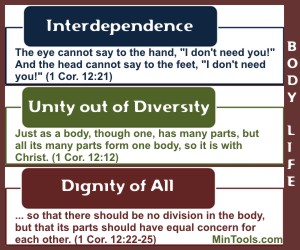
God designed the church to function as a unit … a body, a team (1 Cor. 12) … which requires unity.

Acrostic with Qualities Needed in Team Members

Following are four qualities that will help team members be more united. You will notice that it requires the removal of “self.”

T – Trust

All must learn to respect and accept one another regardless of opinions, personalities, or differences in gifting and abilities.

E – Engaged

All must eagerly do their part according to God’s design.

A – Adaptable

All must humbly accept what’s best in order to accomplish God’s purposes rather than push their own agendas or personal gain.

M – Missional

All must look at the big picture and strategically pursue God’s purposes.

Note the word “all” under each of the above team qualities.  To truly be a unified team and reach optimal effectiveness, each member of the team must pursue these qualities.

In the next post we will look at the team leader’s responsibility to promote these kinds of qualities.

Help Steering the Team Members Toward God's PurposeYou’ll find this acrostic in the Steering the Church Toward God’s Purposes Leadership Guide where team building, along with 24 other leadership responsibilities, is examined in light of our church purpose to love God and people. In addition to the acrostic as it is above, you’ll also find a line under each letter of the kind of commitment it takes to get there.

Share:

Jesus’ Example of Being a Servant

Share:

Being a servant is as much of an attitude as it is action.

Jesus the Servant - Example of ServanthoodYour attitude should be the same as that of Christ Jesus: Who, being in very nature God, did not consider equality with God something to be grasped, but made himself nothing, taking the very nature of a servant, being made in human likeness. And being found in appearance as a man, he humbled himself and became obedient to death — even death on a cross! (Phil. 2:5-8)

We can do acts of service and still not be a servant if our motivation is rooted in selfish ambition, if our intended outcome is recognition, and if our ultimate purpose is to benefit ourself in some way. True servanthood begins with selflessness, maintains humility throughout, and ultimately seeks the good of others which requires the right heart attitude.

Learn from Jesus about What It Takes to be a Servant

We can learn much about servanthood by looking at Jesus’ attitude.

1) Jesus “did not consider equality with God something to be grasped, even though He was in very nature God.”

Having the attitude of Jesus means we will not let position, status, or superior qualities and skills get in the way of serving.

Servants are not status seekers but rather display humility.

2) Jesus “made himself nothing.”

Having the attitude of Jesus begins with a choice. He purposefully laid aside all the glories of heaven to come to earth as a human baby. Still God, He chose to grow and live as a man who would suffer a humiliating and cruel death for us.

Servants do not get caught up in a sense of entitlement but rather give of themselves sacrificially.

3) Jesus took on “the very nature of a servant.”

Having the attitude of Jesus requires certain heart qualities. He didn’t put on a front. It wasn’t a contrived effort on His part but was real because it was the essence of who He was.

Servants do not merely act the part but rather are servants to the very core of their being.

4) Jesus was “made in human likeness.”

Having the attitude of Jesus means we will identify with those we serve. Jesus not only came to where we live but became one of us.

Servants are not aloof but rather empathize and enter into the lives of those they serve.

5) Jesus, “being found in appearance as a man humbled himself and became obedient to death — even death on a cross.”

Having the attitude of Jesus might lead to doing things we don’t want to do for the sake of others. Jesus prayed “not my will but Thy will be done” as He faced the cross.

Servants are not self-serving but rather submissive for the sake of the big picture.

Servanthood is a Choice

So much of the attitude of Jesus began with a choice … a choice to make himself nothing, take on the nature of a servant, humble himself and become obedient.

Do you and I truly WANT TO become servants … not just do what we think we are supposed to do?

Notice that the choice He made was to put His own status and comforts aside to work for the good of others.

Are you and I truly WILLING TO abandon our own agendas, ambitions, and applause to build others up and help them reach their potential in Christ?

Understand that working for the good of others was marked by suffering, submission, and sacrifice.

Are you and I truly WALKING the same road Jesus did to serve others?

Help for Church Leaders:

Share:

Ministry Tools that Encourage Us in Serving

Share:

In a previous post we considered how the following ministry tools equip us for serving. These same tools are what encourage us to persevere in serving.

Ministry Tools to Equip

Click on to enlarge in Pinterest & Repin.

Tools God Provides to Encourage Us in Ministry

The ministry tools God uses to encourage us in serving include the following:

God’s Word:

For everything that was written in the past was written to teach us, so that through endurance and the encouragement of the Scriptures we might have hope. (Rom. 15:4)

Understanding God’s purpose for the written Word, should provide us with hope. We can be encouraged by the example of God’s faithfulness in times past.

The Cross of Jesus:

Let us fix our eyes on Jesus, the author and perfecter of our faith, who for the joy set before him endured the cross, scorning its shame, and sat down at the right hand of the throne of God. Consider him who endured such opposition from sinful men, so that you will not grow weary and lose heart. (Heb. 12:2-3)

May our Lord Jesus Christ himself and God our Father, who loved us and by his grace gave us eternal encouragement and good hope, encourage your hearts and strengthen you in every good deed and word. (2 Thess. 2:16-17)

Understanding all Jesus did for us on the cross and how great His grace is toward us, should provide us with motivation. We can be encouraged by Jesus’ example of suffering in the process of serving and know it is worth it in the end.

The Holy Spirit:

Then the church throughout Judea, Galilee and Samaria enjoyed a time of peace. It was strengthened; and encouraged by the Holy Spirit, it grew in numbers, living in the fear of the Lord. (Acts 9:31)

Understanding the role of the Holy Spirit as the Counselor, Comforter, and Helper in both times of persecution and peace should provide us with a sense of contentment regardless of our circumstances. We can be encouraged by the example of the early church knowing that the same Spirit is both with us and in us each step of our way.

Knowing that God has “given us everything we need for life and godliness through our knowledge of him” (2 Pet. 1:3) should be a very encouraging reality for us as we serve.

Share:

Ministry Tools that Equip Us for Serving

Share:

God empowers us to serve through the use of spiritual gifts (1 Cor. 12:4-11). He prepares us to serve through gifted teachers and leaders (Eph. 4:11-13). He uses our spiritual gifts to help determine our part in the Body of Christ (Eph. 4:16). And, God has given us tools to enable us to wisely and effectively use our gifts in serving.

Ministry Tools to Equip

Click on to enlarge in Pinterest & Repin.

Tools God Provides to Equip Us

The ministry tools God uses to equip us for serving include the following:

His Word:

All Scripture is God-breathed and is useful for teaching, rebuking, correcting and training in righteousness, so that the man of God may be thoroughly equipped for every good work. (2 Tim. 3:16-17)

Grab hold of this ministry tool: Align all you do with the Word of God.

The Cross of Jesus:

May the God of peace, who through the blood of the eternal covenant brought back from the dead our Lord Jesus, that great Shepherd of the sheep equip you with everything good for doing his will, and may he work in us what is pleasing to him, through Jesus Christ, to whom be glory for ever and ever. Amen. (Heb. 13:20-21)

Let us fix our eyes on Jesus, the author and perfecter of our faith, who for the joy set before him endured the cross … (Heb. 12:2-3)

Grab hold of this ministry tool: Look to Jesus, not just as your example, but as the source and sustainer of all you do because of the shedding of His blood on the cross.

The Holy Spirit:

And I will ask the Father, and he will give you another Counselor to be with you forever … (Jn. 14:16-18)

But the Counselor, the Holy Spirit, whom the Father will send in my name, will teach you all things and will remind you of everything I have said to you. (Jn. 14:26)

… be filled with the Spirit … (Eph. 5:15-21)

Grab hold of this ministry tool: Yield control to the Spirit so ministry is about the Lord … done for and through Him.

Of course, part of the way we grab hold of these ministry tools is through prayer and study of His Word … abiding in Him.

“I am the vine; you are the branches. If a man remains in me and I in him, he will bear much fruit; apart from me you can do nothing.” (Jn. 15:5)

Share:

Excellence: Is It Really All in the Details?

Share:

Churches get rated by people looking in whether they intend to be or not. What makes some churches seem more excellent than others?

Rating of Excellence
Is it really all their attention to the details? Or, is there more to it than the details?

Pay Attention to the Details:

In almost every ministry there are details to tend to that communicate a message to people about their importance to you and/or how much you expect them to value what’s about to happen. Lack of attention to details could lead to a negative impression. Excellence in quality and preparedness could stir up a good feeling leading to greater receptivity.

In Teaching: pencils sharpened, extra Bibles on hand, projector ready, chairs arranged, neat & legible visuals, lesson well prepared

In Leadership: consistent communication, begin and end meetings on time, come prepared

In Church Communications: well-designed & regularly updated church website, quality PowerPoint presentations, well-crafted written communication and promotional materials

In People Helping Ministry: food/clothes bank cleaned & stocked, emergency supplies ready for crisis, referral list previously prepared, people on call for counseling, support, or meeting of a variety of needs

In Worship:  worship leaders and team are well rehearsed, projected words to songs and Scripture are well-designed, printed materials lack typographical errors, the order of the service flows, attention was put into lighting, sound, and other technological issues

When you don’t concern yourself with excellence by paying attention to details, you’ll be scrambling to set things up, take too long to get back to people about how you can help, make excuses for why things aren’t going well, and the like. All that negatively impacts ministry.

Pay Attention to the Big Picture:

While details are important, so is the big picture. When it comes to excellence, God expects you to do the best with what you have, to work within the means and abilities He has provided for you. The bigger picture also communicates.

For the sake of excellence would God really want you to go into such debt for those facilities, high tech equipment, lighting, etc., that you have little or no resources for other kinds of ministry? — What about the bigger picture of stewardship? It’s a matter of maintaining a consistent testimony.

For the sake of excellence would God really want you to be so busy making things just right that you neglect other priorities like time with Him, family, and friends? — What about the bigger picture of relationships? It’s a matter of attaining to higher principles, that of love for God and people.

For the sake of excellence would God really want you to get so stressed that you worry, fret, and obsess? — What about the bigger picture of trusting God to be the real power source for ministry, not your efforts? It’s a matter of sustaining a proper perspective.

Pay Attention to Both the Details and the Big Picture:

Glorify God in all you do (Col. 3:17; 1 Cor. 3:12-15; 10:31). Details do matter, sending a message to the people you serve. But, if you aren’t careful, that same excellence could be communicating an even bigger message that could undo the effects of all your attention to detail.

Know your God-given parameters, realizing there may be times He will want you to step outside of them. Be sure, however, that He’s the One doing the prompting and not you. Be willing to say “Enough” when the costs soar too high, when your schedule is too full, and when your trust is more in what you are doing than in the Lord.

Share: