Is Desiring to Make Good Impressions Biblical?

Share:

Should Christians, and our churches, be concerned with making good impressions on others? As in all we do, let’s turn to God’s Word for an answer.

Bible Verses that Seem to Be Against Seeking to Impress People

We can find a number of Scripture verses that suggest we should be against trying to impress people. Here are some verses against seeking to make good impressions:

Am I now trying to win the approval of men, or of God? Or am I trying to please men? If I were still trying to please men, I would not be a servant of Christ. (Gal. 1:10)

Those who want to make a good impression outwardly are trying to compel you to be circumcised. The only reason they do this is to avoid being persecuted for the cross of Christ. Not even those who are circumcised obey the law, yet they want you to be circumcised that they may boast about your flesh. May I never boast except in the cross of our Lord Jesus Christ, through which the world has been crucified to me, and I to the world. (Gal. 6:12-14)

On the contrary, we speak as men approved by God to be entrusted with the gospel. We are not trying to please men but God, who tests our hearts. (1 Thess. 2:4)

Whatever you do, work at it with all your heart, as working for the Lord, not for men, since you know that you will receive an inheritance from the Lord as a reward. It is the Lord Christ you are serving. (Col. 3:23-24)

At first glance, the above verses do seem to suggest that we should not seek to impress people, that their opinions of us and what we do shouldn’t matter. God is the One to whom we stand accountable. God is the One whom we should seek to please.

Scripture that Seems to Suggest that We Should be Concerned About What Other People Think

Following are some verses that seem to indicate that what people think and feel matter in order to best reach and teach them. Scripture does appear to suggest benefit in making good impressions.

Though I am free and belong to no man, I make myself a slave to everyone, to win as many as possible. (1 Cor. 9:19)

so that in every way they will make the teaching about God our Savior attractive (Titus 2:10)

Reconciling Scripture Gives Us Biblical Grounds for Desiring to Make Good Impressions

As always, we must look at the full counsel of God. We must reconcile Scripture with Scripture. Here are verses that help us do that:
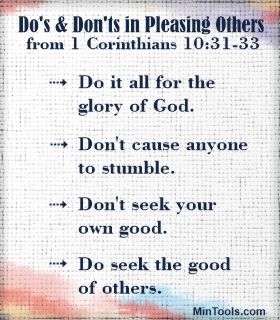
1 Corinthians 10:31-33 on Making Good Impressions to Please OthersSo whether you eat or drink or whatever you do, do it all for the glory of God. Do not cause anyone to stumble, whether Jews, Greeks or the church of God — even as I try to please everybody in every way. For I am not seeking my own good but the good of many, so that they may be saved. (1 Cor. 10:31-33)

Two issues must be in place when seeking to impress others, always in this order:

1) God’s glory

2) People’s good

Click on the above links to read about this criteria for trying to make good impressions on people.

Share:

Stuck in the Present

Share:

When we’re caught up in the needs of the moment without giving thought to the future, we might be stuck in the present. We may feel we have so much to do in the short term that we don’t have time to even think about the future. We then flounder about, seeming to have little purpose and direction.

The Problem with Being Stuck in the Present

Ministry tends to be shortsighted when we’re stuck in the present. We lack vision of what can be and of who people can become, if we don’t look past the needs of the moment. We consequently fail to build people and our ministries up in a way that prevents future issues. We aren’t preparing or equipping for the next stage of growth. Growth, then, rarely happens. If there is a spurt, it tends to be short-lived because we weren’t ready for it.

Churches and ministries stuck in the present tend to basically move from one crisis to another. When we’re constantly putting out fires, we lack the time and energy to do much more.

What It Takes to Get Unstuck

We must understand that moving forward doesn’t mean we neglect the present. Look at Philippians 3:14-16.

Stuck in Present? Press on yet Live Up to What's Already Obtained
I press on toward the goal to win the prize for which God has called me heavenward in Christ Jesus. All of us who are mature should take such a view of things. And if on some point you think differently, that too God will make clear to you. Only let us live up to what we have already attained.

To be sure, pressing on is important. There’s more to the Christian life and ministry than we see and experience in the present. Having goals and pursing them is biblical. Notice, however, that it doesn’t mean we neglect where we are currently. Right now, we take care to live up to “what we have already attained”. We’re accountable for what we do in the present.

We must keep our eye on “the prize” or we will be stuck in the present. And, we must take steps, even if they’re baby steps, to keep moving. We must “press on” despite the needs of the moment. — “And let us run with perseverance the race marked out for us, fixing our eyes on Jesus, the pioneer and perfecter of faith.” (Heb. 12:1-2)

Share:

Stuck in the Past

Share:

When we’re stuck in the past, we tend to be governed by tradition. We adhere to what have been called the famous last seven words of the church, — “but we’ve always done it this way”. Past hurts or mistakes can also keep us stuck. Maybe we had a bad church experience and don’t want to get hurt again. Perhaps we made mistakes and feel disqualified to go on.

The Problem with Being Stuck in the Past

Tradition isn’t wrong in and of itself. Throughout Scripture we read of God establishing various offerings and festivities for His people as a reminder of His work in their lives. The problem comes when we can’t see past our traditions and they become an end in themselves. Too often we then simply go through the motions rather than experiencing the reality and abundance of life Jesus came to give us. What worked in the past may not be God’s direction for the present. Stuck in the past, in the way we’ve always done it, we may find it hard to see how something else could work better. We’ll be quick to throw up the red flags — “but we’ve never done it that way” — and halt progress.

Mistakes, even obvious sin, don’t have to define us for “there is now no condemnation for those who are in Christ Jesus” (Rom. 8:1). “If we confess our sins, he is faithful and just and will forgive us our sins and purify us from all unrighteousness.” (1 Jn. 1:9) Think of the people in Scripture with tainted past whom God used nonetheless. When we let our past keep us from pressing on, it’s like saying the work of Christ on the cross wasn’t enough.

What It Takes to Get Unstuck

Forgetting the Past and Pressing On, Not Stuck in the Past
Before becoming a follower of Jesus Christ, the Apostle Paul, Saul at the time, was steeped in Jewish traditions, so much so that he actively persecuted Jesus’ disciples. As a follower of Jesus, however, he said, “Forgetting what is behind and straining toward what is ahead, I press on …” (Phil. 3:13-14). He wasn’t about to let the past hold him back … neither the habitual comfort of tradition or the guilt of how he treated Christians. We can learn from his example so we don’t stay stuck in the past.

We must first ask this question: Is our desire to “press on to take hold of that for which Christ Jesus took hold” of us (Phil. 3:12) stronger than our need to hold on to the past? If so, then we must be willing to do two things so we’re not stuck in the past.

1) We must forget what is behind, both the good and the bad. That doesn’t necessarily mean we obliterate it from our memory. Rather, we don’t hold onto it, nurturing our hurts or accomplishments to the extent that they keep us from pressing on.

2) We strain toward what is ahead. Just as physically stretching may be a bit uncomfortable but in the end develops stronger muscles, so when we “press on to take hold of that for which Christ Jesus took hold” of us (Phil. 3:12), God develops within us the strength we need to go the next mile, and then the next.

Share:

Stuck in Preparations

Share:

When indicating that it’s possible to get stuck in preparations, we’re suggesting that some churches and ministries can get so caught up in getting things right, that they spend most of their time perfecting rather than progressing. Excellence becomes their primary goal.

The Problem with Being Stuck in Preparations

All to God's Glory But Not Stuck in Preparations
Scripture exhorts us to do our best to the glory of God (1 Cor. 10:31; Col. 3:17) but we also have the example of making sure we “press on to take hold of that for which Christ Jesus took hold of” us (Phil. 3:12).
The Christian life here on earth is a journey, not a destination. It’s a process, not a product.

If we must perfect everything we do before moving forward, we may rarely get beyond preparations. Let’s be real: If this is our primary ambition and goal, what we do may never be good enough. We’ll tend to keep finding more to fix or add to it to make it better. Rather than perfecting something we’ve been doing, God may want to do something new.

What It Takes to Get Unstuck

We may need an adjustment in how we think about the Christian life and ministry. That could take humbling ourselves to admit we haven’t arrived (Phil. 3:12). Part of getting caught up in preparations is trying to make a good impression. We somehow think we must have it all together to make an impact.

It could also take challenging ourselves to move on rather than wade in the desperation of having the brightest and best of everything. We don’t have to wait until we can afford to renovate to invite people into our church. Nor do we have to spend countless hours crafting just the right words to speak. The power to make a difference doesn’t rest in perfecting all we do. Rather, the Holy Spirit works in and through us to accomplish God’s work. The Spirit doesn’t need the perfect building, an eloquent preacher, top of the line technology, etc. to make a difference. Let’s walk in the Spirit so we don’t get stuck in making it about our own endeavors.

Share:

Stuck in Parroting?

Share:

When suggesting we might be stuck in parroting, we’re referring to those who merely imitate what other churches or ministries are doing. It becomes about looking like others rather than pursuing God’s vision for our own church or ministry.

The Problem with Being Stuck in Parroting

What works in one church may not be best for another. Not all church cultures are the same. Not all church communities are the same. What’s needed in a given church to advance God’s work may be different than the current church fad. Mimicking what others do may therefore have minimal, if any, impact. It then serves no real purpose.

When we simply parrot what others do, we give little thought to whether it’s right for our church or ministry. Even worse, we may tend to put little prayer into it as well. Other churches or ministries become our standard rather than pursing what God may have for us.

What It Takes to Get Unstuck

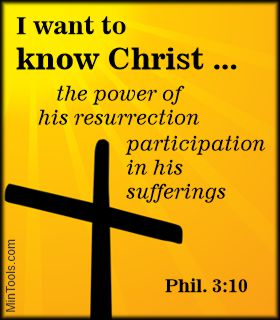
We must remember that Christ Jesus is the One we should be following. It’s about becoming more like Him. We won’t get unstuck unless our primary ambition and goal is “to know Christ and the power of his resurrection and the fellowship of sharing in his sufferings, becoming like him in his death …” (Phil. 3:10). This verse suggests that the road less traveled may not always be the easiest but it is the most worthwhile path to take. And, we have an incomparably great power to tap into. — “That power is the same as the mighty strength he exerted when he raised Christ from the dead and seated him at his right hand in the heavenly realms …” (Eph. 1:19-21)

It’s about pursuing God’s purposes and design for His Church as we fulfill His mission. While there is a broad dynamic to that, the specifics of how that happens could vary from church to church. We must therefore seek God’s wisdom for what we should do (James 1:5). Sometimes it could mean doing the same as another church or ministry, but when it’s about following the Lord, we have a different motivation. We’re doing it as unto the Lord (Col. 3:23), not to stay popular.

Share:

Stuck in Perpetual Motion?

Share:

When referring to churches or ministries as stuck in perpetual motion, it’s like we’re on a hamster wheel going around and around. We’re moving, but we’re just going around in circles not moving forward.

The Problem with Being Stuck in Perpetual Motion

Stuck in Perpetual Motion Because We've Forsaken Our First Love
(Click to enlarge in Pinterest & repin.)

We can engage in a lot of activity that consumes a lot of time and energy but we have little to show for it of eternal value. Before we know, it becomes mere religious activity. When we start merely going through the motions, our love for God tends to grow cold. We leave our “first love” (Rev. 2:4) and may become motivated by a need to perform, or accomplish something, rather than love.

Because we’re active, we may feel like we’re accomplishing something. Pride could even set in because we’re so busy “for the Lord”. We become blind to the reality that we’re stuck. We’re spinning our wheels, doing the same thing over and over, going nowhere.

Perhaps what we’re busy doing was at one point a good thing, but it no longer propels growth. We keep doing it nonetheless and therefore stop meeting needs. Instead of helping people “grow in the grace and knowledge of our Lord and Savior Jesus Christ” (2 Pet. 3:18), we’re enabling them to stay where they are.

What It Takes to Get Unstuck

Since being stuck in perpetual motion affects our motivations and attitudes, we need a heart and mind transformation. That begins when we say, “whatever was to my profit I now consider loss for the sake of Christ. What is more, I consider everything a loss compared to the surpassing greatness of knowing Christ Jesus my Lord.” (Phil. 3:7-8) That kind of transformation requires help. To get unstuck, we can’t rely on ourselves. Jesus said, “If you remain in me and I in you, you will bear much fruit; apart from me you can do nothing.” (Jn. 15:5)

Because being stuck in perpetual motion tends to affect our perspective of what’s most important, we must learn what is essential and what isn’t, and focus on what truly matters. We must “seek first the kingdom of God” (Matt. 6:33) “for the kingdom of God does not consist in words but in power” (1 Cor. 4:20). “The kingdom of God is … righteousness and peace and joy in the Holy Spirit” (Rom. 14:17). We find little joy when we’re merely on the treadmill of life. When, on the other hand, we keep pace with the Spirit, walking with Him, we go somewhere that leads to greater Christlikeness and fruitfulness (Gal. 5:22-25).

Share: