The Uniqueness of the God of the Bible

Share:

If we study about the God of the Bible, we must conclude that He truly is unique. In His uniqueness He is incomparable … meaning no one is like Him. Be encouraged to take the time to read all the Scripture referenced in this post to gain a better grasp of the uniqueness of the God of the Bible.

Scripture Speaks of How God is Unique from Other Gods

Uniqueness of God - Who is Like the Lord?The Bible describes God as unique being majestic in holiness (Ex. 15:11; 1 Sam. 2:2), awesome in glory (Ex. 15:11), great and having a strong hand (Deut. 3:24), sovereign (2 Sam 7:22), and more.

We see it in His working of wonders and mighty acts (Ex. 15:11; Ps. 86:8-10). Other gods may have wonders attributed to them but the God of the Bible is known for doing the impossible with nothing being too hard for Him (Jer. 32:17; Mk. 14:36; Lk. 18:27). —  For what god is there in heaven or on earth who can do the deeds and mighty works you do? (Deut. 3:24)

We also see His uniqueness in the way He is identified as the first and last, therefore able to not just declare what happened but also what will occur in the future (Isa. 44:6-8; 46:9-11).

As the Maker of all things (Jer. 10:16), He is unique from all else and Sovereign above all. He is our Source, Sustenance, and Strength. We live to fulfill His purposes and not the other way around (Isa. 45:9; 46:9-11; Rom. 9:20-21).

Significance of Grasping the Uniqueness of the God of the Bible

If we say we believe in the God of the Bible then we must acclaim Him as unique for that is how Scripture describes Him. Reading the verses referenced above leaves no doubt of this declaration of uniqueness. When we truly grasp who He is, we’ll find ourselves proclaiming similar to the writers of the Bible that apart from Him there is no savior (Isa. 43:11, 13). Apart from Him we have no rock to stand upon (1 Sam. 2:2; Isa. 44:8). Nothing and no one compares to Him. Nothing and no one else deserves our full devotion and praise.

You’ll find this content in the introductory pages of the Our Great God from A to Z Discipleship Tool Download which looks at His attributes using the alphabet. Understanding who God is, as described in the Bible, should lead to this view of Him as unique from all other gods.

Learn More about God: Theology Resources

Share:

Who God Is Reflected in What God Does

Share:

To gain a glimpse into who God is, take a look at what God does. We could go book by book through the Bible and examine many wondrous works of the Lord to learn about the kind of God we have. Here, however, we’ll examine just three of His wonders and discover numerous attributes that make Him a God worthy of our praise and devotion.

Who God is as the God of Creation

Who God is, His greatness, Reflected in What He Does Like CreationThe Bible provides many accounts of God’s activity beginning with creation. What kind of God would be able to speak the heavens and earth into existence (Gen. 1-2; Ps. 33:6, 9) as described in Scripture?

Such a majestic, strategically designed masterpiece shows us we have an all-powerful, creative, wise, purposeful, and sovereign God of order. This is the God we love, serve, and worship. — “You are worthy, our Lord and God, to receive glory and honor and power, for you created all things, and by your will they were created and have their being.” (Rev. 4:11)

For an alphabetical listing of traits it would take to be the kind of God who could create the heavens and earth, check out the Our Great God from A to Z Discipleship Tool Download. It includes that plus four other alphabet renderings about who God is and what He does.

How Scripture Reflects the Kind of God We Have

The writing, compilation, and preservation of the Bible is a testament to the kind of God we have. The Bible describes itself as inerrant, sufficient, dynamic, and powerful truth that is able to make us wise for salvation and thoroughly equip us for every good deed (2 Tim. 3:15-17; Heb. 4:12).

Only an eternal God of absolute truth, knowledge, wisdom, and perfection could produce such a comprehensive and cohesive manuscript though written over the course of time using many human writers. He not only sets the standard but is the Standard. These are the words of a God we should long to meditate on and follow in all we do. — “They are more precious than gold, than much pure gold; they are sweeter than honey, than honey from the honeycomb.” (Ps. 19:10)

What God Does in Salvation Reflects His Character, His Essence

We don’t have to look around us but just peer into our own hearts and we have to admit that we all miss the mark. We keep messing up, if not in our words and actions, in our attitudes. Scripture puts it this way: “all have sinned and fall short of the glory of God” (Rom. 3:23) — “For I know that good itself does not dwell in me, that is, in my sinful nature. For I have the desire to do what is good, but I cannot carry it out. For I do not do the good I want to do, but the evil I do not want to do – this I keep on doing.” (Rom. 7:18-19) — Here’s the real problem: “the wages of sin is death” (Rom. 6:23)

Because He is holy, righteous, and just, God can’t ignore sin. Yet, He is also a God of love who doesn’t want anyone to perish in their sin (Matt. 18:14). So, in His mercy and grace, He bridged the gap for us in Christ Jesus who, though perfect, died in our place, taking the punishment our sin deserved. Hence, if we receive Him and believe in His name (Jn. 1:12-13), our sin is forgiven and we’re made right in the eyes of God — by grace through faith (Eph. 2:8-9). This is a God we can trust to deliver us eternally from the penalty of sin and also from the power of sin in our lives here and now.

Share:

Not Just Knowing About God

Share:

Taste and See, Not Just Knowing About God
A previous post listed 26 attributes of God from A to Z, certainly not a complete list of all the traits we find in the Bible about our great God. While it’s good to know how to describe God, it’s also important we think through the implications of these attributes. The psalmist encourages us to “Taste and see that the LORD is good” (Ps. 34:8). That’s experiential knowledge, not just knowing about God.

Start by Knowing About God

Experiential knowledge of God must be built on a biblical foundation of who God is and what He does. That’s the starting point.

Check out the Our Great God from A to Z Discipleship Tool Download for a better understanding of the attributes of God. This resource provides five different alphabetical listing to help us know who God is. Since knowing God’s attributes is just the beginning, the resource also encourages you to respond.

Also Reflect on the Implications of Who God Is to Your Life

Who God is affects our lives. As head knowledge sinks into our hearts and we “taste and see” who the Lord is, we realize that He is enough, even when we don’t understand.

Think about the attributes of God. Take time to praise Him for who He is. Then think about the implications of His various traits. Perhaps you could say something like, “I praise You, God, for being … because …” Here are a few examples but seek to get even more personal in how it relates to your particular life right now:

I praise You, God, for being eternal,
because reality isn’t defined by my limited, time-based perspective, but by the One who, having always existed, sees the beginning from the end.
I praise You, God, for being faithful
because no matter what I’m going through, I can always rely on you, because having been dependable in the past, I can count on you now.
I praise You, God, for being holy
because you are an absolute standard to whom I can align so I will not conform to this world but rather yield to you to transform my mind so I “will be able to test and approve what God’s will is — his good, pleasing and perfect will” (Rom. 12:1-2).
I praise You, God, for being sovereign
because I can cease striving, or be still, knowing that you are God (Ps. 46:10), the God of gods and Lord of lords (Ps. 136:2-3), worthy of giving full reign of my life to You.
I praise You, God, for being wise
because you’re a Counselor like none other since Your understanding knows no limits (Rom. 11:33-34), making you the first One I should turn to in all situations.
Share:

The “Omni-” Nature of God

Share:

By definition, God is the One of whom there is no greater. None can compare. None can compete. The “omni-” nature of God, that is, the God of the Bible, demonstrates how He meets this definition.

The “Omni-” Nature of God According to Scripture
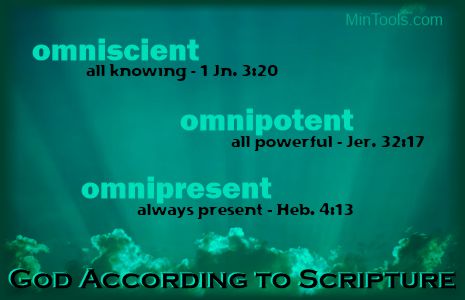
The Omni- Nature of God According to Scripture
The Bible presents us to a God who is omni- (all) — all knowing, all powerful, and always present.

1) God is omniscient. — all-knowing

Do you know how the clouds hang poised, those wonders of him who has perfect knowledge? (Job 37:16)

… the LORD searches every heart and understands every desire and every thought. (1 Chr. 28:9)

You have searched me, LORD, and you know me. You know when I sit and when I rise; you perceive my thoughts from afar. You discern my going out and my lying down; you are familiar with all my ways. Before a word is on my tongue you, LORD, know it completely. (Ps. 139:1-4)

Great is our Lord and mighty in power; his understanding has no limit. (Ps. 147:5)

Who can fathom the Spirit of the LORD, or instruct the LORD as his counselor? Whom did the LORD consult to enlighten him, and who taught him the right way? Who was it that taught him knowledge, or showed him the path of understanding? (Isa. 40:13-14)

See, the former things have taken place, and new things I declare; before they spring into being I announce them to you. (Isa. 42:9)

Remember the former things, those of long ago; I am God, and there is no other; I am God, and there is none like me. I make known the end from the beginning, from ancient times, what is still to come. I say, “My purpose will stand, and I will do all that I please.” (Isa. 46:9-10)

Oh, the depth of the riches of the wisdom and knowledge of God! How unsearchable his judgments, and his paths beyond tracing out! (Rom. 11:33)

If our hearts condemn us, we know that God is greater than our hearts, and he knows everything. (1 Jn. 3:20)

2) God is omnipotent. — all-powerful

Is anything too hard for the LORD? … (Gen. 18:14)

The Almighty is beyond our reach and exalted in power … (Job 37:23)

I know that you can do all things; no purpose of yours can be thwarted. (Job 42:2)

Ah, Sovereign LORD, you have made the heavens and the earth by your great power and outstretched arm. Nothing is too hard for you. (Jer. 32:17)

I am the LORD, the God of all mankind. Is anything too hard for me? (Jer. 32:27)

Jesus looked at them and said, “With man this is impossible, but with God all things are possible.” (Matt. 19:26)

For since the creation of the world God’s invisible qualities – his eternal power and divine nature—have been clearly seen, being understood from what has been made, so that people are without excuse. (Rom. 1:20)

3) God is omnipresent. — always present, seeing everything

Be strong and courageous. Do not be afraid or terrified because of them, for the LORD your God goes with you; he will never leave you nor forsake you. (Deut. 31:6)

From heaven the LORD looks down and sees all mankind; from his dwelling place he watches all who live on earth. (Ps. 33:13-14)

God is our refuge and strength, an ever-present help in trouble. (Ps. 46:1)

Where can I go from your Spirit? Where can I flee from your presence? If I go up to the heavens, you are there; if I make my bed in the depths, you are there. If I rise on the wings of the dawn, if I settle on the far side of the sea, even there your hand will guide me, your right hand will hold me fast. If I say, “Surely the darkness will hide me and the light become night around me,” even the darkness will not be dark to you; the night will shine like the day, for darkness is as light to you. (Ps. 139:7-12)

The eyes of the LORD are everywhere, keeping watch on the wicked and the good. (Prov. 15:3)

“Who can hide in secret places so that I cannot see them?” declares the LORD. “Do not I fill heaven and earth?” declares the LORD. (Jer. 23:24)

Nothing in all creation is hidden from God’s sight. Everything is uncovered and laid bare before the eyes of him to whom we must give account. (Heb. 4:13)

Implications of Having an Omniscient, Omnipotent, Omnipresent God

As an “omni-” God, He is self-sufficient. He doesn’t need anyone or anything. He has it all, knows it all, sees it all, and can do it all.

God isn’t dependent on us. We are dependent on Him. God doesn’t owe us anything. We owe Him everything. See: 1 Chron. 29:13-14; Job 41:11; Acts 17:25; Romans 11:35-36

Learn more about the “omni-” God of the Bible in the Our Great God from A to Z Discipleship Tool Download. Get to know the attributes of God including the kind of God it would take to create the heavens and earth. Also discover how each member of the Godhead works on our behalf. You’ll find five different alphabetical listing for each of these renderings of who God is as well as suggestions for reflection and taking it further.

For More about God: Theology Resources

Share:

The Attributes of God

Share:

“When you’re tired and you can’t sleep, just count your blessings instead of sheep ….” The song suggests a good alternative for sleepless nights, especially if we direct thanksgiving to God for those blessings. Another possibility? List the attributes of God going through the alphabet, from A to Z.

When referring to God’s attributes, we’re speaking of the character of God, the traits or qualities that make up His nature, or being. To be God, He must be the sum total of all these traits, all the time, without fail.

Attributes of God from A to Z

Here’s my alphabetical list. Be aware that it only gives one attribute for each letter but other qualities could be listed for many of the letters.

A – Almighty
B – Boundless
C – Compassionate
D – Dependable
E – Eternal
F – Faithful
G – Good
H – Holy
I – Immortal
J – Just
K – Kind
L – Love
M – Merciful
N – Never-Failing
O – One
P – Perfect
Q – Qualified
R – Righteous
S – Sovereign
T – True
U – Unchanging
V – Victorious
W – Wise
X – X-traordinary
Y – Yahweh
Z – Zenith


Our Great God from A to Z - His Attributes
Order the Our Great God from A to Z Discipleship Tool Download for this alphabetical listing in a format you can print that also includes a brief definition for each term and Scripture verses that point to those attributes of God. The resource also encourages you to respond to who God is and suggests a plan for focusing on each attribute.

You’ll also find another listing about Our Creator God from A to Z in the above resource with traits showing the kind of God it would take to create the heavens and earth. In addition, it includes an alphabetical listing for each member of the Godhead pointing to what God the Father, God the Son, and God the Holy Spirit do and what they distinctly provide for us.

Responding to Who God Is

Consider making up your own alphabetical list describing how you feel or what you think about our great God. The more we get to know this God who is all of the above plus more, the more we will revere and trust Him. We will find Him to be enough. We will want to serve and worship Him with our whole being for He is worthy.

For More about God: Theology Resources

Share:

Just Yet Merciful

Share:

In chapters one and two of Lamentations, the prophet Jeremiah laments the destruction of Jerusalem and its temple. — “How the Lord has covered Daughter Zion with the cloud of his anger!” (Lam. 2:1) — Some may ask how a loving God could display such wrath. Consider that a righteous, holy God must also be a just God. Though the people knew the Lord was righteous, they still rebelled against Him (Lam. 1:18). But, the account doesn’t end there. As we read on in Lamentations, we discover a God who is just yet merciful.

Why a Righteous, Holy God Must be Also be a Just God

Scripture links the righteousness of God with His justice as can be seen in this small sampling of verses:

For the LORD is righteous, he loves justice. (Ps. 11:7)

And the heavens proclaim his righteousness, for he is a God of justice. (Ps. 50:6)

May he judge your people in righteousness, your afflicted ones with justice. (Ps. 72:2)

Righteousness and justice are the foundation of your throne. (Ps. 89:14; 97:2)

Without a righteous standard “justice is perverted” (Hab. 1:4). Only a righteous God can truly be just. In themselves, people can’t claim to be righteous. We’re too driven by our selfish sin nature which leans toward doing what is right in our own eyes. We often don’t see the big picture and so we fail to always look at the end goal that we be holy as He is holy (1 Pet. 1:15). As a result, we may sometimes look at the justice of God and question His fairness. With a holy God, it’s not about being fair but righteous. His ways are so much higher than our ways (Ps. 36:6; Isa. 55:9) that it is difficult for us to always understand His ways.

God is Just Yet Merciful

As seen in the destruction of Jerusalem, sin has consequences. Don’t think for a moment, however, that God relishes in punishing people. In the third chapter of Lamentations we read, “He does not willingly bring affliction or grief to anyone” (Lam. 3:33). His righteousness demands it. Yet, His great love and compassion extends mercy when we “return to the LORD” (Lam. 3:40).

Just Yet Merciful God - Mercies New Every Morning

Though Jeremiah lamented the destruction of Jerusalem (Lam. 1-2) and the effect on him personally (Lam. 3), He said, “Yet this I call to mind and therefore I have hope: Because of the LORD’s great love we are not consumed, for his compassions never fail. They are new every morning; great is your faithfulness.” (Lam. 3:23-24)

God judged Israel for their sin but He did not totally consume them. As God, He would have been just in totally destroying them but He is also a merciful God. — “Though he brings grief, he will show compassion, so great is his unfailing love.” (Lam. 3:32)

God is righteous and therefore just. Sin must be atoned. The wages of sin is death (Rom. 6:23). God, however, always makes a way so He remains just yet merciful. God’s justice would, through the Jewish lineage, be met on the cross wherein Jesus took the punishment we deserve. — “God presented Christ as a sacrifice of atonement, through the shedding of his blood – to be received by faith. He did this to demonstrate his righteousness, because in his forbearance he had left the sins committed beforehand unpunished – he did it to demonstrate his righteousness at the present time, so as to be just and the one who justifies those who have faith in Jesus.” (Rom. 3:25-26)

We have a just God who is also merciful because He is the sum total of all His many attributes, all of the time, without fail. Reflect on His various traits using the Our Great God from A to Z Discipleship Tool Download which uses the alphabet to describe who God is.

Share: