Encouragement Needed: Who

Share:

Encourage One Another - 1 Thess. 5:11
In a previous post we considered why we need encouragement, concluding that we need help to maintain the qualities that enable us to live as lights in this dark world seen in 1 Thessalonians 5:1-10. Verse eleven answers the question of “who?”

“Therefore encourage one another and build each other up, just as in fact you are doing.”

Who Needs Encouragement

The Apostle Paul wrote these words to the Thessalonian church which experienced hardships but nonetheless became a model to churches elsewhere (1 Thess. 1:6-7). He also wrote of his own suffering because of opposition against him. Throughout his epistle, Paul pointed the Thessalonians to the future hope of the coming of the Lord.

Though an evangelist and church leader, the Apostle Paul wrote of his own need for encouragement. No matter how we serve, or who we are, we all need encouragement. As Jesus reminded us, we will face trouble in this world. Notice His words of encouragement as He went on to say, “But take heart! I have overcome the world.” (Jn. 16:33). Since we all live in in a world filled with trouble, we all benefit when encouraged by the hope we have in the One who overcomes.

In telling them to “encourage one another”, Paul reinforced the need everyone has for encouragement. The Greek word for “one another”, allelon, suggests a reciprocal effort. No one should have to face the hardships of life alone.

We Still Need to Encourage One Another Today

Though written to a specific church, these words still apply to us today because . . .

We still live in a dark and broken world filled with troubles that challenge us in our walk with God.

We continue to look forward to that day when the Lord will come and make everything right.

As followers of Jesus Christ, no matter who we are, where we live, or how we serve, we all need encouragement to brightly reflect the light of the Lord in our sphere of influence, in all we say and do, till Jesus comes again.

Share:

Putting Yourself in Someone Else’s Shoes – How?

Share:

Empathize by Rejoicing and Mourning with Others
In a previous post we looked at why we should empathize with others, concluding that it is both biblical and pragmatic to do so.

Knowing we should do something doesn’t mean we will do it.

How to Better Empathize with Others

We need to intentionally take the following measures to be more empathetic, to truly mourn with those who mourn and rejoice with those who rejoice (Rom. 12:15).

Praying

  • Ask God to build within you a heart of love and compassion that cares about other people’s feelings and opinions.
  • Ask God for wisdom and discernment.  Don’t rely on your own instincts about people.

Observing

  • Actually look at people in their eyes.
  • Take note of people’s facial expressions, gestures, and overall demeanor … not just their words.
  • Pay attention to what is happening in their lives.

Listening

  • Let the other person talk and pay careful attention to what is being said.
  • Do not be quick to jump in with advice or to share your experience.
  • Work at developing your listening skills.

Asking

  • Guard against assuming that you know what a person is thinking or feeling.
  • Use clarifying questions when talking with someone to make sure you truly understand.
Share:

Putting Yourself in Someone Else’s Shoes – Why?

Share:

Recently I put up a two page document on Role Playing as a Bible Teaching Method in the MinTools.com store.  Having students role play a situation helps them develop problem solving skills but also empathy.  They must “put themselves in someone else’s shoes.”

Exercising empathy would help with much church conflict. 

When we look at a situation from only our own perspective or experience base, we risk assigning wrong motives or misinterpreting the feelings, actions, or reactions of others.

When we seek to put ourselves in their shoes, we gain an understanding that often helps us be more patient and supportive of others.

Scriptural Basis for Empathy:

The word “empathy” is not used in the Bible but verses do point to our need for it as we relate to one another.

  1. God Himself empathizes with the people He created.
As a father has compassion on his children, so the LORD has compassion on those who fear him; for he knows how we are formed, he remembers that we are dust. (Ps. 103:13-14)
O LORD, you have searched me and you know me.  You know when I sit and when I rise; you perceive my thoughts from afar. You discern my going out and my lying down; you are familiar with all my ways. (Ps. 139:1-3)
  1. Jesus modeled empathy when he lived on this earth among people and continues to empathize.  Many verses point to His compassion which is an essential part of empathy, leading Him to do something about what He perceived.
When he saw the crowds, he had compassion on them … (Matt. 9:36)
When Jesus landed and saw a large crowd, he had compassion on them and healed their sick.  (Matt. 14:14)
When Jesus saw her weeping, and the Jews who had come along with her also weeping, he was deeply moved in spirit and troubled. … Jesus wept.  (Jn. 11:33, 35)
For you know the grace of our Lord Jesus Christ, that though he was rich, yet for your sakes he became poor, so that you through his poverty might become rich.   (2 Cor. 8:9)
For we do not have a high priest who is unable to sympathize with our weaknesses, but we have one who has been tempted in every way, just as we are–yet was without sin. (Heb. 4:15)
  1. Empathy is a part of walking in love as God loves.
Be imitators of God, therefore, as dearly loved children and live a life of love, just as Christ loved us … (Eph. 5:1-2)
So in everything, do to others what you would have them do to you, for this sums up the Law and the Prophets.  (Matt. 7:12)
Love your neighbor as yourself. (Matt. 22:39)
  1. Body Life demands we empathize with one another.
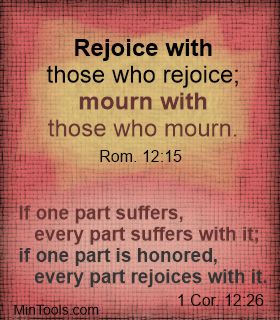
Empathize by Rejoicing and Mourning with Others
Rejoice with those who rejoice; mourn with those who mourn. (Rom. 12:15)
… so that there should be no division in the body, but that its parts should have equal concern for each other.  If one part suffers, every part suffers with it; if one part is honored, every part rejoices with it. (1 Cor. 12:25-26)
Carry each other’s burdens, and in this way you will fulfill the law of Christ. (Gal. 6:2)
Be kind and compassionate to one another, forgiving each other, just as in Christ God forgave you. (Eph. 4:32)
being like-minded, having the same love, being one in spirit and purpose.  Do nothing out of selfish ambition or vain conceit, but in humility consider others better than yourselves. Each of you should look not only to your own interests, but also to the interests of others.  (Phil. 2:2-4)
Finally, all of you, live in harmony with one another; be sympathetic, love as brothers, be compassionate and humble.  (1 Pet. 3:8)
  1. Effectively reaching out to others requires us to put ourselves in their shoes.
Remember those in prison as if you were their fellow prisoners, and those who are mistreated as if you yourselves were suffering. (Heb. 13:3)
I have become all things to all men so that by all possible means I might save some. (1 Cor. 9:22) … We must conclude that Paul did not literally become all things in every situation but that he identified with them which requires empathy.

An upcoming post will look at how to empathize.

Share:

Loving People a Priority in Your Church?

Share:
Priority to Love PeopleAfter Jesus identified love for God as the first and greatest commandment, He said:
“And the second is like it: ‘Love your neighbor as yourself.'” (Matt. 22:39)


In addition to loving God and helping others learn to love Him, the second greatest purpose we can have as a church is to love people as He loves.

Ways to Show People Love and Make Loving People a Priority

1)  Share the good news with them.

2)  Build a relationship with them.

3)  Value them and the contribution they can make to the kingdom of God.

4)  Encourage and help them in their walk with God in practical ways.

You’ll find the above points in the Steering the Church Toward God’s Purposes Leadership Guide in the form of a brief assessment for leaders of how well they and the Body they serve evidence love for people.

Share:

Sharing from the Overflow

Share:

Do you realize how blessed we are as Christians?  In Christ we are blessed “in the heavenly realms with every spiritual blessing in Christ” (Eph. 1:3).

Cup Runs Over - Sharing from the OverflowTruly, our cup overflows.

Someone has put it this way:
“I’m drinking from my saucer ’cause my cup has overflowed.”

Even if our finances and material resources are depleted –we can still drink from the saucer.  If our health is failing or we have suffered great loss  –we can still drink from the saucer.  No matter what our circumstances, with Jesus as our Savior, our cup has overflowed.  He is what we really need.  He is enough!  He fills our cup to overflowing and we can drink from the saucer.

Ways of Sharing from the Overflow

When it comes to sharing with others, even if we shared only from the overflow, we would have so much to offer others.  God fills our cup full and overflowing so we have something to share with others.

  • We share from the overflow of our cup through fellowship with one another.
  • We share from the overflow of our cup by serving one another
  • We share from the overflow of our cup when we pray for one another.
  • We share from the overflow of our cup when we give of our resources to meet a need.
  • We share from the overflow of our cup when we tell others the Good News.
  • We share from the overflow of our cup by comforting those who grieve.
  • We share from the overflow of our cup when we encourage the discouraged.
  • We share from the overflow of our cup when we express appreciation to those who labor among us.

Sharing from the overflow is not sacrificial giving.  The cup overflows because more than what it needs is being poured into it.  What I have found is that even when I share from the overflow, I am still drinking from the saucer because that is how much my cup has overflowed.

Share:

Homelessness: How to Get Your Church Involved

Share:

Jesus Views Helping with Homelessness as though Done to Him so How Can the Church Help?
You believe that Jesus takes how we respond to people’s needs personally. You see the needs of the homeless and want your church to get involved in this kind of ministry. Yet, even the mention of homelessness raises concerns.

Concerns Related to Homelessness & Getting Involved

Homelessness is broad and far reaching.  As an individual believer or church, you might feel there isn’t much you can do.

Homeless ministry demands a lot of resources.  You might feel you have enough problems and needs of your own.

Homelessness takes many of us out of our comfort zones.  You might have fears and insecurities about involvement.

Reasons not to get involved will abound so you need to just begin, but how?

A process for getting your church involved in Ministry with the Homeless:

  1. Promote an awareness of the causes and  solutions of homelessness.   Look at it from a biblical, theological perspective as well as the practical side.  — Educate people about homelessness.
  1. Partner with other ministries and community programs through giving of time, finances, and other resources.  Encourage individual giving but also set the example as a church and an easy path for individuals to give.  — Expose people to homelessness.
  1. Present or provide opportunities for people to help both in preventing homelessness and assisting those who are homeless locally and beyond.  Encourage everybody to do their part in ways that fit with their gifting and skill sets and you will make greater inroads into motivating them to get involved.  — Engage people with the homeless.

Note the process:

Educate, expose in less threatening ways, and then engage.
Share: