VBS . . . Is It Worth It?

Share:

Vacation Bible School can be very consuming of time, resources (people and financial), and energy. A lot of effort goes into a short blast of ministry. VBS … Is it worth it?

Suggestions to Help Make VBS Worth It

You’ll need to look at your particular situation to answer that question.  Here, however, are some suggestions that will maximize your effort.

1) View prayer as critical.

2) Have a clear purpose and diligently pursue it.

3) Plan well enough in advance.

4) Choose your curriculum wisely.

5) Recruit and strategically.

6) Train and equip staff adequately

7) Take time to follow-up.

Vacation Bible School Ministry Manual
Check out the Vacation Bible School Ministry Manual for input on each of these suggestions. If followed, it  could very well tip the scale on whether or not VBS is worth it for you because you go beyond simply having a nice program that is an end in itself and stresses out its workers. It becomes something God is in and is able to bless that leads to an even greater purpose and that people find rewarding.

Share:

Adults Build Walls

Share:

Jesus Says We Adults Need to be like Little ChildrenJesus said His followers need to be like little children (Matt. 18:3; 19:14).

Here is the problem:  By the time we have reached adulthood, that child-like trust, transparency, and sense of awe so vital to our spiritual growth and relationships with one another has been replaced with walls.

Adults Build Walls for Different Reasons

Walls to Block Out Unwanted Feelings:

How quickly we learn that life doesn’t always go our way, that it sometimes includes suffering.  Bad things do happen to good people.  And, it doesn’t feel good.   We try to block out the negative reactions these events can cause, repressing our feelings.  Why?  Perhaps we have learned along the way that big boys don’t cry, that we shouldn’t be a wimp.  We may have gotten pegged as not having enough faith.  If we don’t feel, then we won’t react.  If we don’t react, we won’t have to be uncomfortable around others.  We’ve learned to mask our feelings so well that sometimes we aren’t even honest with ourselves about how we feel about both the good and bad of life.

Result:  We lose that child-like awe and wonder.

Walls to Keep a Distance Between Us and Other People:

Too often, as children, we are hurt by the very people who we most look to for care, understanding, attention, and love … parents, family, teachers, best friends.  Perhaps we were neglected, abused, rejected, or betrayed.  We feel like we’ve been let down.  Relational hurts, especially those experienced early in life, can cause us to say, “Never again.”  We try to prevent the same thing from reoccurring.

Result:  We no longer have that child-like trust.

Walls to Hide Who We Really Are:

We didn’t make the grade, get the part, or win the competition.  We felt the shame of disappointing our parents or teachers.  We were put down one too many times.  Soon we don’t even like ourselves.  We begin to play the part, saying and doing what we feel people expect of us.  We don’t want others to see our weaknesses or failures so we begin to make excuses or blame someone or something else.

Result:  We no longer have that child-like transparency.

Walls Can Keep Us From Growing Spiritually

If you are a teacher of an adult Bible class, you soon realize that these same walls also keep truth and growth opportunities from getting in.  Consequently, part of our task as teachers of adults is breaking walls down.

Breaking Walls Down Training Session for Teachers of Adult Bible ClassesThe Breaking Walls Down Training Session for Teachers of Adult Bible Classes gives nine different tools you can use to chisel away at those walls.

Breaking down the walls in your life will probably take you out of your comfort zone.  You may not feel safe.  So, start in your relationship with the Lord.  Find your security in Him.  Get a sense of how much He truly is there for you, working on your behalf.  Pull on the power and resources He extends to you. Then, if others let you down or if life gets hard, you can be okay because your source of significance is in Him.  You are loved with an unending love.
Share:

Does your children’s class have the BLAs?

Share:

To teach the Bible effectively to children, classes need a good dose of the BLAs.  What??

NOT the BLAs that come from a boring, dull class with a teacher stuck in a rut where students passively sit and listen or find other inappropriate ways of keeping awake or amusing themselves.

BUT, the BLAs that are experienced in an active, enthusiastic class learning from God’s Word in ways that get students involved  — Bible Learning Activities.

Why Use BLAs (Bible Learning Activities)

  1. Because of the way God created people to learn through their senses
  2. Because people learn best and retain more when actively involved in the learning process

While all ages would benefit from this kind of instruction, children particularly need lessons that allow them to do something, to explore and discover.

How to Use BLAs (Bible Learning Activities)

– Always having a purpose for the activities you use.

– Use a variety of activities.

– Give students choices when possible.

– Turn some of the planning of activities over to students if appropriate.

– Use guided conversation with students as they do the activities.

– Don’t limit Bible Learning Activities to acquiring knowledge but also use them in practicing life application.

What Kind of Bible Learning Activities to Use

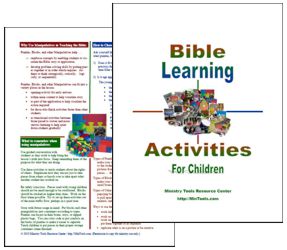
BLAS - Bible Learning Activities for ChildrenYou will now find a resource in the MinTools.com store called Bible Learning Activities for Children.  This resource provides a one page handout on each of the following types of of activities. The pages can be ordered separately but cost less bundled which you will see if you click on the above link.

Books
Crafts
Dramatic Play
Games
Manipulatives (blocks, puzzles, other)
Media
Music
Pictures

Depending on how they are used, these activities can enable students to research in order to gain new knowledge or to have what has already been learned reinforced.

Each handout looks at why this activity is good to use, how to choose specific means within that method, what you need to remember when using it, and how to expand its use.

Share:

Young People’s Perception of the Bible

Share:


Perception of BibleI read a Barna report about how young people today take a different approach to the Bible than previous generations and I have to admit that as I look at the overall landscape, I do see it.  Of course, not all young people hold this perception of the Bible but enough do that it should raise some questions.

The report is not saying that young people do not value the Bible or that they never read it.  Rather, it refers to the perceptions of young people toward the Bible, which would, in turn, affect the way they approach Bible study.  The report notes the following changes in young people from older generations.  For descriptions of the following perceptions, go to the Barna Report.

  1. less sacred
  2. less accurate
  3. more universalism
  4. skepticism of origins
  5. less engagement
  6. Bible appetite

How Did People’s Perception of the Bible Change in These Ways?

The first question we might ask ourselves is, “How did it get this way?”  Once we figure that out, answers to how to change the tide will become more evident.

Surely it did not get this way overnight.  And, change will not come by throwing on a few bandaids.  The seeds were undoubtedly planted over the course of time and the roots go deep.  If that is true, it means change must begin with the older generations as obviously we have been the ones who planted the seeds.  What have we done, or not done, that led young people to view the Bible in these ways?

We must also factor in the influence of the world with all of its relativistic and universal thinking.  In light of Romans 12:1-2, any change of perspective is going to be a transformation “by the renewing of the mind.”  What must that look like in discipleship efforts with young people?

We can be encouraged by the last point on Barna’s list.  Young people do have an appetite for the Bible, an “interest in gaining additional Bible knowledge” that scores higher than other generations.  That’s encouraging.  That gives hope that the tide can change.  But it also brings us back to those of us in older generations.  If we don’t have as much of an appetite for the Word, perhaps then we haven’t been modeling an approach to the Bible that communicates its worth and sufficiency.  Have we forsaken our first love?  If so, let’s be reminded of Jesus’ words to the church of Ephesus in Revelation 2:5 —

Remember the height from which you have fallen! Repent and do the things you did at first. If you do not repent, I will come to you and remove your lampstand from its place.

Consider also that a low view of the Bible could lead to a low view of the Church. What’s to keep young people coming once they’ve graduated if the Word we teach has minimal value to them?

More: Youth Ministry Resources

Share:

What To Do About a Mid-Week Children’s Program

Share:

What to do about a mid-week children's program?Sometimes the best way to help people is to answer their questions with questions.

That is what I did when I was asked about planning a mid-week children’s program.

Basic Questions to be Asked about a Mid-Week Children’s Program

1)  What is your purpose?

Notice I asked what your purpose “is” not what it should be.  Be honest because your actions and attitudes will eventually betray or underscore what “is.”

If your purpose is no greater than having something to do with the children while adults are meeting, you will find little motivation to put much into a mid-week program.  When babysitting or crowd control become objectives, even though it might not be communicated that way, it is easy to take an “anything will do” approach.

If, however, your purpose is truly to utilize all the opportunities you have to reach children for Jesus and to help disciple them to love and follow the Lord, you will be energized to make it the best you can with the resources you have.

Of course, the second “if” above is more in line with what your purpose should be.  What can you do to work toward a more impacting purpose?

2)  What structure will best accomplish that purpose and fit your situation? 

Structure should be an outgrowth of your purpose and realistically guided by your resources … available teachers/workers, time, facilities, etc.

If you adapt a structure simply because it is a pre-fab plan and easy to use, you might be missing the mark on what God wants to do in and through you.

If you tailor a structure that best meets your needs, you will have more potential of lining up with God’s desires and intent to work in and through you.

Of course, this doesn’t mean you can’t use somebody else’s plan or structure.  Nor does it mean that you must start from scratch and “reinvent the wheel.”  What it does mean is that you will invest much prayer and objective assessment into it.  If a pre-fab program best fits your purpose and resources, then that is what should be used.  Or, perhaps you will need to take an existing program and make some tweaks.  Maybe you will need to develop your own plan but if that is the case, then God will provide the person(s) equipped to do so.

3)  What curriculum will fit the structure?

Often the pre-fab programs mentioned under the second question above come with the curriculum for you to use.  I am listing this as a separate question, however, because too often we let the curriculum determine the structure.

If you let the curriculum determine the structure then you might find yourself frustrated as you try to make something work that doesn’t fit your resources.

If you let the structure determine the curriculum then you should be doing something that works for your situation.

A mid-week program should be a little more fun and fast-moving than a typical Sunday School or Children’s Church program.  Some churches have used Sunday School or Children’s Church curriculum for their mid-week program but if not careful, it can feel too much like school for the kids which they have been in all day prior to going to church on Wednesday evening.

Some churches use curriculum from publishing companies that use a large/small group approach.  You would need less high commitment – preparation teachers and more lower commitment – preparation small group leaders.

Some churches use VBS curriculum, using a lesson per week.  Often these types of curriculum rotate children through a number of learning stations.

The question is: What type of curriculum will best fit your purpose, the structure that grows out of it, and works with your situation?

From there it is a matter of implementation — ordering materials, recruiting teachers and workers, training them, scheduling, organizing, etc.

Share:

Special Needs Ministry Takes More Than a Program

Share:

Sometimes we in the church develop a program to “fix” things. But, when it comes to people with special needs or disabilities, it is not about “fixing” a problem. Special needs ministry takes more than a program. While we may need to make some adjustments to accommodate their challenges, it’s more about building an environment where everyone belongs.

Perspective Needed to Get Beyond Mere Programming for Special Needs Ministry

To build an inclusive environment, we need a proper mindset, attitude, and heart …

that sees the person, not the disability.

that views them as much a part of the Body as anyone else.

that unconditionally accepts those different than ourselves.

Help for Ministry Leaders and Bible Teachers

Sure, you will undoubtedly need to develop a program structured to best meet their unique needs but you already do that for children, youth, and adults, for men and women, etc.  But, just like with those ministries, the goal should never be to isolate them from total church life.  They are a valuable part of the Body.  They belong.

Special Needs Ministry in the Bible Classroom

Share: