Make Adult Ministry Instructional

Share:

Goal to make Adult Ministry Instructional
In setting goals for adult ministries, think about the phrase “teach us to number our days” from Psalm 90:12 as a starting point. We need to make adult ministry instructional to ensure adults build their lives on a good foundation of truth so when the storms of life hit, they’ll be able to stand firm (Matt. 7:24-27).

It doesn’t matter if you serve adults new to faith in Jesus or long-time believers. We never stop learning. Remember the words of the Apostle Paul:

Not that I have already obtained all this, or have already arrived at my goal, but I press on to take hold of that for which Christ Jesus took hold of me. (Phil. 3:12)

The psalmist spoke the words “teach us” as a prayer to the Lord so it’s God’s instruction we need which comes from His Word. — All Scripture is God-breathed and is useful for teaching, rebuking, correcting and training in righteousness … (2 Tim. 3:16-17)

Let’s not assume that just because we’re teaching or serving adults that we can ease up on the instructional aspect of ministry. It may be surprising just how many adults are Bible illiterate.

The Type of Instruction Adults Need

Adults need to know about the God we’re encouraging them to love and serve (Matt. 22:37-40). Always remember, however, that it must never end with merely knowing about God but rather knowing Him in a personal and intimate way.

For Help: Theology Resources

They need to learn about spiritual disciplines that lead to spiritual growth (2 Pet. 3:18). Structure nurturing opportunities into your ministries but also encourage them to make personal time with the Lord a priority. The busier we become with life’s responsibilities, the easier it can become to spend less and less time sitting at the Lord’s feet listening to what He has to say. Help adults understand that it’s a choice to make time with the Lord a priority. Read Luke 10:38-42.

For Help: Spiritual Growth Resources

And, adults need to be prepared to answer those who ask them to give the reason for their hope (1 Pet. 3:15). How will they be secure in their faith when confronted with other worldviews or religions? How will they help others come to faith in Jesus if they don’t know why they believe what they believe?

For Help: Apologetics Resources

Yet, Psalm 90:12 takes us beyond head knowledge to gaining “a heart of wisdom”. Basically, wisdom is knowledge applied to life. For our adult ministries to truly meet this goal, we need to help adults understand the difference these truths will make in navigating life as a single or married person, in child-rearing or grandparenting, in the workplace, or with friends, neighbors, and family.

How to Make Adult Ministry Instructional

Whet their appetite for more by the way you approach the instructional aspect of adult ministries. Make it interesting by employing creative methodology but most of all, make it relevant. Mere dissemination of facts will have minimal effect.

Show them how God’s Word thoroughly equips them (2 Tim. 3:16-17) to navigate life, no matter how difficult it becomes. Do that through personal testimonies, illustrations, video clips, and other means.

Help them process the truths they’re learning, by incorporating plenty of discussion time and by being available for one-on-one as needed. Get beyond one-way communication.

Foster discipleship and mentoring relationships. Be concerned about the individual, not just the masses, like Jesus. A “one-size-fits-all” approach in the instructional aspect of adult ministry will not reach all.

For More: Teacher Training for Teachers of Adults Bible Classes

Share:

What About Goals for Adult Ministries?

Share:

The words of Psalm 90:12 becomes more and more relevant as we get older. While it certainly relates to us as individuals, perhaps we can also pull out some goals for adult ministries.

Teach us to number our days, that we may gain a heart of wisdom.

Back up a couple of verses and we find the relevance of this verse for us as adults. — Our days may come to seventy years, or eighty, if our strength endures; yet the best of them are but trouble and sorrow, for they quickly pass, and we fly away. (Ps. 90:10)

In light of how difficult life can be and how fleeting it may seem, we need to make the best of the time we have. That will happen, as seen through a reading of the entire Psalm, by acknowledging God as the all-powerful, always existing God in whose unfailing love we find satisfaction and joy no matter what we experience in life.

Goals for Adult Ministries Derived from Psalm 90:12

Goals of Adult MinistriesWe can find at least three goals in Psalm 90:12 adults need to apply to their lives. It only makes sense, that we can turn these points into goals for adult ministries in our churches. (Click on the links below to read more about each goal.)

1) Adult ministry needs to be instructional. — “Teach us …”

2) Be intentional. — “Teach us to number our days … “

3) Look for an internal impact. — “… that we may gain a heart of wisdom.”

Also Check Out: Adult Ministry Resources

Share:

What About Training for Adult Ministries?

Share:

Adult MinistriesHave you ever noticed the low volume of training resources for adult ministries compared to what’s available for children and youth ministries? While the number of resources does increase when searching by age grouping, gender, and marital status, you’ll find relatively few resources for adult ministry in general.

Why isn’t more emphasis placed on training for adult ministry?

Adult ministries are important and, therefore, so should training be for it.

God Himself lays the foundation for why adult ministry is important:

Jesus, in His earthly ministry, welcomed children to Himself but primarily ministered to adults.

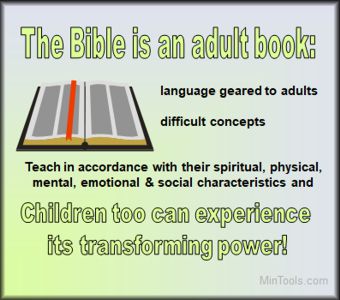
The Bible, though relevant to children, is written in language geared to adults with concepts difficult to understand.

God has given parents the main responsibility of nurturing children (Deut. 6:4-9; Eph. 6:4) so helping them grow in their walk with God will flow into the training of children. Even adults without children serve as role models for younger generations (Matt. 18:5-6).

If adults walk away from the Church, and more specifically from a growing relationship with the Lord, what will become of the next generation (Ps. 78:4)?

Adequately train adult ministry leaders and teachers so they more effectively disciple and meet the needs of those they serve.

Think about the difference it makes in adult ministries when the following questions can be answered affirmatively:

  1. Do we build the kind of atmosphere most conducive to adult ministry?
  1. Do we know how to break through the walls many adults have built?
  1. Do we adequately address the responsibilities and issues adults deal with as they journey from young adulthood to senior adulthood?
  1. Do we present a God big enough to meet the demands and crises of life?
  1. Do we adapt to the changing landscape of life adults face today, knowing what needs to change and what stays the same?
Share:

How Can We Teach Children to Serve?

Share:

Teach Children to Serve - They're Part of the Body

Since the only qualification the Bible puts on who gets spiritual gifts is that they are a follower of Jesus, it’s important to teach children to serve. They are part of today’s church, not merely the church of tomorrow.

Also Read: What about Children and Spiritual Gifts?

Ways to Teach Children to Serve God Using Their Spiritual Gifts

You may want to implement the following ideas before considering the use of a spiritual gifts test with children since their experience-base is so limited.

  1. Provide teaching about spiritual gifts and God’s design for the church.

Help young people to understand God’s purposes for the Church and for their lives which include serving. Help them realize that they have a part to do right now, not just when they’re older.

  1. Provide opportunities for children to serve.

Children need to develop a base of experience in ministry so they can begin to identify how they may be gifted. Encourage them to get involved in a variety of ways. Offer a consistent diet of ministry opportunities. Involve them, as you can, in the various aspects of total church life where they can work side by side with adults. Suggest that families serve together as teams. God will use these opportunities to grow passions within their hearts and to surface and develop their spiritual gifts.

  1. Provide children with affirmation and feedback.

When Jesus sent out his disciples to minister, He took the time to discuss how it went with them. Why would we do any less with the children and youth whom we deploy into ministry of any kind? First, they should be included in training opportunities. Second, they should be affirmed in what they are doing. If there seems to be an area in which they do particularly well, tell them. Third, provide feedback afterward. Evaluate with them what happened, both the positive and the negative. Offer suggestions on how they might improve. Or, if they just don’t seem to be suited for a particular type of ministry, help them find something that may be a better fit.

  1. Provide these young believers with role models.

Adults must set a good example for the kids. So many adults, however, do not do their part. This can send a strong message to them contradicting all your verbal teaching about why they should get involved. If you expect young people to get it, you better work at making sure the adults get it.

  1. Provide prayer support.

Develop a prayer base for the children and youth of your church that goes beyond praying for only the troubled ones. Pray also for those who seem to be doing well and who want to be a part. They need to be empowered by the Holy Spirit in whatever they do just as much as an adult. Let’s not grow kids who are self-sufficient and self-reliant in their Christian walks, starting their life of service learning to do it in the flesh. Both their motivations and means of serving need to be an outgrowth of abiding in Christ who said “apart from Me you can do nothing.”

  1. Provide a starting point for identifying their spiritual gifts.

While using spiritual gifts tests with children may prove inconclusive due to their lack of experience, a test geared to their age can be a starting point. Using a test would be most beneficial after having provided all of the above first.

Check out Your Gifts for Children: Kid-Friendly Spiritual Gifts Adventure by Church Growth’s Team Ministry as a tool to introduce children to spiritual gifts.

Or, if you’re in youth ministry, you’d be interested in Your Gifts For Teens: The Easy to Use, Self-Guided Spiritual Gifts Survey.

Share:

Should We Really Try to Teach Children Bible Truths?

Share:

The Bible is an adult book, written in adult language with adult concepts. Some therefore question if we can really teach children Bible truths, especially young children.

Scripture Response to Question about Trying to Teach Children Bible Truths

The Apostle Paul answers that question in his words to Timothy:

… from infancy you have known the holy Scriptures, which are able to make you wise for salvation through faith in Christ Jesus. (2 Tim. 3:15)

So, even if you serve in a church nursery, it’s possible to communicate Bible truths even to babies.

Paul goes on to in the very next verse to provide the ways God’s Word helps us.

All Scripture is God-breathed and is useful for teaching, rebuking, correcting and training in righteousness, so that the man of God may be thoroughly equipped for every good work. (2 Tim. 3:16-17)

What better source to teach, rebuke, correct, and train children of all ages than the Bible. The words of Scripture carry more authority and power than anything a parent or teacher can communicate.

How Children Best Learn the Bible

The question is not “if” children can learn the Bible but HOW.
Teach Children Bible Truths

  1. Begin by understanding their age level traits. Take into account the whole person when planning what to teach and how to teach it — spiritual but also physical, emotional, mental, and social traits.

The PowerPoint presentation, Teaching the Bible to Children, helps you know “how” to teach Bible truths in accordance with their age level characteristics.

Also check out:

  1. Do not underestimate the role of consistency and repetition when teaching children.
  • a consistency between what’s in the parent’s heart and what they say (also true for teachers)

These commandments that I give you today are to be on your hearts. (Deut. 6:6)

  • a consistency between what’s taught formally and informally

Impress them on your children. Talk about them when … (Deut. 6:7-9)

  • a repetition of truth in a variety of settings, using a variety of methods, teaching both verbally and visually

Talk about them when you sit at home and when you walk along the road, when you lie down and when you get up. Tie them as symbols on your hands and bind them on your foreheads. Write them on the doorframes of your houses and on your gates. (Deut. 6:7-9)

For More: Children’s Ministry Resources

Share:

Train Small Group Leaders

Share:

Due to the potential of life change that can come through small groups, it’s always been important to have leaders who are trained, not only to facilitate discussion, but also to shepherd members of their group. Take some time to examine what you’re doing to train small group leaders in your church. What kind of training do you provide? How encompassing is your support and encouragement?

Train Small Group Leaders to Meet the Challenges of the Days in Which We Live

Small groups form for various reasons and so training always needs to be specific to the focus and primary agenda for their meeting. But, in addition, training needs to prepare small group leaders for challenges relevant to the days in which we live.

  1. Since a question for small groups may no longer be about the “place” where they should meet but rather the online “platform” they should use, additional training may be required.

Some groups may meet online temporarily with others meeting that way for the long haul. Some may use a combination of online and in-person. Small group leaders need to be effectively trained to not only know how to use technology but also how to use it in ways that are safe and productive for their small group.

You’ll first need to determine the best platform for your small group needs (based on number of participants, length of meeting time, cost, group member’s ability to access it, etc.). Some common platforms include:

Church Online Platform
FaceTime
Google Meet (was Google Duo)
Google Chat (was Google Hangouts)
GoToMeeting
Microsoft Teams
Skype
Zoom

Also be sure to train small group leaders about the differences of leading a group online versus in-person. Here are some articles on other sites that can be of help:

  1. Though support groups used to be the main type of group for helping people work through addictions and mental health issues, more and more people are experiencing anxiety and depression today. Almost any type of group will consist of people with these kinds of needs more and more. Are your small group leaders prepared?

Small group leaders need to be trained on how to respond both within the group meeting and one-on-one. How can they and the group be a support system to one another? When is it time to guide the person in finding help outside of the group?

As relates to the days in which we live, perhaps providing leaders with coping skills suggestions to pass on would be helpful. Also remember that leaders too need support and comfort. Here are some articles on other sites that may be of help:

Maybe a study on dealing with anxiety and depression would be beneficial. The following links will take you to one of our affiliate stores:

If meeting online, people may find it easy to hide their feelings behind the screen. Small group leaders need to learn how to observe, connect, and engage with people in ways that get below the surface.

Share: