Ministry Endeavors All to the Glory of God?

Share:

All for the Glory of God
Scripture guides us in our ministry endeavors. Two verses in particular, when followed, will keep our ministries on track. Colossians 3:17 exhorts us to do whatever we do in the name of the Lord Jesus, the topic of a previous post. Here we’ll look at doing whatever we do “all for the glory of God” (1 Cor. 10:31).

Questions to Ask to Determine if Our Ministry Endeavors Are All Done to the Glory of God

When we look at some specific Scripture passages that deal with how glory can be brought to God, we can learn how to engage in ministry in ways that glorify Him. While it would be easy to respond positively because that’s our desire, we need a reality check because it’s so easy for us to digress.

1) Are we relying on God and His power to be at work in us to accomplish what we do?

“. . . and that by his power he may fulfill every good purpose of yours and every act prompted by your faith. We pray this so that the name of our Lord Jesus may be glorified in you, and you in him, according to the grace of our God and the Lord Jesus Christ.” (2 Thess. 1:11-12)

Be real: Sometimes we just want to get things checked off of our “to do” list. If we don’t rely on Him, it will be so easy to fall back on self-determination and self-effort … and that is not for the glory of God.

2) Are we holding on to the promises of God?

“For no matter how many promises God has made, they are ‘Yes’ in Christ. And so through him the ‘Amen’ is spoken by us to the glory of God.” (2 Cor. 1:20)

Be real: There are many voices clamoring for us to doubt or water down what we believe. If we don’t stand firm on God’s Word, without wavering, it will be so easy for us to compromise and miss out on God’s true blessings … and that is not to the glory of God.

3) Are we authentic and holding ourselves accountable in what we do?

“Then Joshua said to Achan, ‘My son, give glory to the Lord, the God of Israel, and give him the praise. Tell me what you have done; do not hide it from me.'” (Josh. 7:19)

Be real: There will be times that we err. If we don’t commit to doing ministry with honesty and integrity, it will be so easy to cover up or justify when we have done something wrong … and that is not for the glory of God.

4) Are we keeping our attitudes in check, being grateful to God even when adversity or opposition comes in what we do?

“I will praise God’s name in song and glorify him with thanksgiving.” (Ps. 69:30)

Be real: Things will not always go as we plan. If we don’t learn to be thankful and content in all circumstances, it will be so easy to complain and grumble … and that is not for the glory of God.

5) Are we exercising discernment so we choose what is the best and most righteous way to do what we do?

“… that you may be able to discern what is best and may be pure and blameless until the day of Christ filled with the fruit of righteousness that comes through Jesus Christ – to the glory and praise of God. (Phil. 1:9-11)

Be real: We’re often faced with many good options. If we don’t stop and pray and think through what God would have us do, it will be so easy to take short cuts or settle for second best out of convenience … and that is not to the glory of God.

6) Are we doing what we do so His grace is “reaching more and more people”?

“… so that the grace that is reaching more and more people may cause thanksgiving to overflow to the glory of God.” (2 Cor. 4:15)

Be real: Distractions abound in ministry. If we don’t guard and maintain this as an objective, it will be so easy to become ingrown … and that is not for the glory of God.

Share:

Ministry Methodology All in the Name of the Lord?

Share:

Ministry Methodology All in the Name of the Lord Jesus
And whatever you do, whether in word or deed, do it all in the name of the Lord Jesus, giving thanks to God the Father through him. (Col. 3:17)

When we serve “in the name of the Lord Jesus” we not only have His power and authority for ministry but also an example to follow. We have a Standard for ALL we do which means ministry methodology conforms to Him, not to the ways of the world or what’s comfortable for us.

Ways Doing All in Jesus’ Name Affects Ministry Methodology

1) We focus on what is most important.

Jesus taught about love being the Greatest Commandments but He also consistently focused on serving people out of love, not controlling or manipulating them by what He did.

Lessons for us:

  • Do keep love a top priority. Methods are important but they are not most important. Jesus said that everything, even the law and prophets, should be wrapped up in loving God and loving people (Matt. 22:36-40).
  • Don’t let methods divide.

2) We’re purposeful in what we do.

Jesus lived so that people would better understand and know the Father. He knew when it was time to make changes to better fulfill that purpose (Mk. 1:35-39).

Lessons for us:

  • Do showcase the Lord and His love in all you do.
  • Don’t let the method become more important than the Message.

3) We’re other-centered in what we do.

Jesus excelled at meeting people where they were. He knew people were at different places developmentally and spiritually and responded accordingly.

Lessons for us:

  • Do remember that not everybody is like you! People think and learn differently from one another.
  • Don’t do something a certain way just because it is comfortable or convenient for you.

4) We use variety.

Jesus used different means of healing, teaching, discipling, and relating with people throughout His ministry. He did not always heal the same way. He did not always teach the same way.

Lessons for us:

  • Do employ some creativity in ministry. There are often many ways to accomplish the same objective.
  • Don’t get stuck in a rut.

Let’s not get so caught up in our methodology that we feel we can’t change even when the method no longer works effectively. Let’s trust God to be at work in and through us rather than rely on methodology. That will happen when we do whatever we do in the name of the Lord Jesus.

More for Church Leaders: Church’s Power – The Name of the Lord

Share:

My Style – Your Style

Share:

My Style May Not Fit Your Style So Don't Take a One Size Fits Al ApproachWhat works with one person might not be the best approach for the next person. We have varying personalities, learning styles, backgrounds, intelligences, and we are at different places in our walk with God. Consequently, my style of doing certain things may not be your style which will have an effect on how we serve others. Taking a one size fits all approach may lessen ministry effectiveness.
My Style May Not Fit Your Style

We may have different bents or preferences. We may have differing needs. For example:

The way I came to know the Lord as my Savior might not have affected you the same way.

My approach to daily personal time with the Lord might not be as meaningful to you.

How I memorize Scripture might not work well for you.

The track I follow in training efforts might not be what you need.

How I teach or how I learn might not fit your learning style.

How I most like to worship may not be your preference.

Suggestions for Dealing with Varying Styles as We Serve

The Apostle Paul understood how people are different and provided his approach in 1 Corinthians 9:19-22 from which we can pull some implications for ourselves in serving others.

  1. We must get beyond the effects of ministry on ourselves. And, we must guard against projecting our own ways onto others.

Though I am free and belong to no one, I have made myself a slave to everyone, to win as many as possible. (1 Cor. 9:19)

  1. We need to meet people where they are if we want to have the greatest impact in their lives.

To the Jews I became like a Jew, to win the Jews. To those under the law I became like one under the law (though I myself am not under the law), so as to win those under the law. To those not having the law I became like one not having the law (though I am not free from God’s law but am under Christ’s law), so as to win those not having the law. To the weak I became weak, to win the weak. (1 Cor. 9:20-22a)

  1. We should avoid cookie cutter approaches when possible and use a variety of means in reaching and ministering to people.

I have become all things to all people so that by all possible means I might save some. (1 Cor. 9:22b)

Share:

Leaders & Teachers, Avoid Stagnation

Share:

Stagnation happens in bodies of water when the water stops flowing or moving. Stagnated water can lead to contamination, becoming a breeding ground for insects, bacteria and parasites which leads to disease and possibly death. Because that’s a dangerous situation, hazardous to health, we should avoid stagnated water. And, we should also avoid stagnation from developing in the Body of Christ.

When Churches Become Stagnated

Stagnation happens in bodies of believers when teachers and leaders become satisfied with status quo. They basically stand still, making little headway. Soon the church becomes unhealthy, no longer able to offer a cup of life-giving water to others. Some of these churches eventually die.

Leaders can plateau, maintaining rather developing or moving forward.

Teachers can get stuck in ruts, using the same methods over and over.

How Church Leaders and Bible Teachers Avoid Stagnation

Think about what it takes to prevent water from stagnating. We can draw similar parallels for what it will take for leaders and teachers to avoid stagnation.
Be Teachable, Keep Growing to Avoid Stagnation

  1. Movement: We’ll prevent stagnation by keeping the water moving, stirring it up. We set goals, based on prayer and constantly work toward them, always looking ahead to what God wants us to do. Stagnation isn’t an option. — “Not that I have already obtained all this, or have already arrived at my goal, but I press on to take hold of that for which Christ Jesus took hold of me. Brothers and sisters, I do not consider myself yet to have taken hold of it. But one thing I do: Forgetting what is behind and straining toward what is ahead, I press on …” (Phil. 3:12-14)

Instead a resting in the way we’ve always done things, we try new means, or methods, of accomplishing the same task. We keep seeking to get better and to reach more. We never stop learning but take the time to keep growing.

  1. Drainage: Letting water seep out as new water comes in can help avoid stagnation. And so, we invest into people’s lives rather than simply run a program or teach a class. We reach out to others beyond our group, giving to them from the vast reservoir poured into us. As we have been blessed “with every spiritual blessing in Christ” (Eph. 1:3), so we bless others. — “Freely you have received; freely give.” (Matt. 10:8)

Are you taking steps to avoid stagnation?

Share:

Ways the Holy Spirit Helps Us in Ministry

Share:

A previous post established our critical need of the Spirit in ministry. Here we’ll use an acrostic with the word SPIRIT as a means of remembering ways the Holy Spirit helps us in ministry.

An Acrostic of Ways the Holy Spirit Helps Us in Ministry

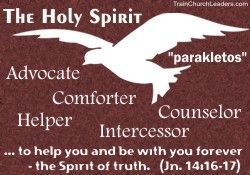
Holy Spirit Helps Us in MinistryWhile much more could be written about the ways the Spirit helps us, the following acrostic provides six roles the Holy Spirit takes showing how He works in and through us. He truly is our Paraclete, the One who lives within us and comes alongside of us with the help we need (Jn. 14:16-17).

S – Spiritual-Gifter: empowers and equips us for ministry

Now to each one the manifestation of the Spirit is given for the common good. To one there is given through the Spirit a message of wisdom, to another a message of knowledge by means of the same Spirit, to another faith by the same Spirit, … All these are the work of one and the same Spirit, and he distributes them to each one, just as he determines. (1 Cor. 12:7-11)

P – Peace-Maker: develops peace within us so we can be at peace with one another

The mind governed by the flesh is death, but the mind governed by the Spirit is life and peace. (Rom 8:6)

For the kingdom of God is not a matter of eating and drinking, but of righteousness, peace and joy in the Holy Spirit. (Rom. 14:17)

But the fruit of the Spirit is love, joy, peace … (Gal. 5:22)

I – Interceder: prays for us when we are weak

In the same way, the Spirit helps us in our weakness. We do not know what we ought to pray for, but the Spirit himself intercedes for us through wordless groans. And he who searches our hearts knows the mind of the Spirit, because the Spirit intercedes for God’s people in accordance with the will of God. (Rom. 8:26-27)

R – Revealer: makes known to us the heart and mind of God

But when he, the Spirit of truth, comes, he will guide you into all the truth. He will not speak on his own; he will speak only what he hears, and he will tell you what is yet to come. He will glorify me because it is from me that he will receive what he will make known to you. All that belongs to the Father is mine. That is why I said the Spirit will receive from me what he will make known to you. (Jn. 16:13-16)

these are the things God has revealed to us by his Spirit. The Spirit searches all things, even the deep things of God. For who knows a person’s thoughts except their own spirit within them? In the same way no one knows the thoughts of God except the Spirit of God. (1 Cor. 2:10-11)

I – Illuminator: enlightens our hearts so we can understand what God has for us

I keep asking that the God of our Lord Jesus Christ, the glorious Father, may give you the Spirit of wisdom and revelation, so that you may know him better. I pray that the eyes of your heart may be enlightened in order that you may know the hope to which he has called you, the riches of his glorious inheritance in his holy people, and his incomparably great power for us who believe. (Eph. 1:17-19)

What we have received is not the spirit of the world, but the Spirit who is from God, so that we may understand what God has freely given us. (1 Cor. 2:12)

T – Teacher: teaches us so we can teach others

But the Advocate, the Holy Spirit, whom the Father will send in my name, will teach you all things and will remind you of everything I have said to you. (Jn. 14:26)

This is what we speak, not in words taught us by human wisdom but in words taught by the Spirit, explaining spiritual realities with Spirit-taught words. (1 Cor. 2:13)

With this kind of Helper, why would we even attempt to do ministry without the power of the Spirit at work within and through us? Let’s turn the reigns over to the Holy Spirit to fill us so we effectively do God’s will with joy and thanksgiving in our hearts (Eph. 5:15-20).

Learn More: Resources About the Holy Spirit

Share:

Our Critical Need of the Holy Spirit in Ministry

Share:

Ministry can get quite difficult and messy at times. It doesn’t always go the way we hope it would. Yet, with the Holy Spirit in ministry, these realities do not have to discourage, disillusion, or overwhelm us.

12 Ministry Realities Showing our Critical Need of the Holy Spirit in Ministry

Contrast the trying situations we might face in ministry with the work of Spirit. Our need for he Holy Spirit is undeniable.

  1. Ministry can be a lonely place sometimes.  Because of the Holy Spirit within us, we are never alone.  (Jn. 14:16)
  1. Ministry brings us in conflict with a relativistic world.  Because of the Holy Spirit, we can have peace knowing that we have faithfully presented God’s Word and it is up to the Spirit of Truth to convince people of it.  (Jn. 14:17)
  1. Ministry quickly shows us that we do not have all the answers.  Because of the Spirit, we can still step out in confidence, knowing that He will help us, guide us, and teach us.  (Jn. 14:26; 16:13)
  1. Ministry often comes with a set of critics, even when we are doing everything right.  Because of the Spirit, we can believe that God will still use us as we do what we know HE wants us do to.  We can be okay knowing that it is the Spirit’s job to work in their hearts.  (Jn. 15:26; Rom. 15:13; Eph. 4:1-4)
  1. Ministry doesn’t always yield immediate results.  Because of the Spirit, we don’t have to feel like failures if we are lining up with Him.  It is His job to convict people of their need to change.  We can be easily fooled by appearances, but the Spirit knows what is in people’s hearts and can meet them there.  (Jn. 16:7-8)
  1. Ministry has a learning curve.  Because of the Spirit, we have the potential of learning what we need to know. Because of His guidance, God will be glorified.  (Jn. 16:13-14)
  1. Ministry opens many unfamiliar doors.  Because of the Spirit, we can have power to walk through those doors and show people how the Gospel meets all their needs.  (Acts 1:8)
  1. Ministry brings us face to face with issues about which we don’t know what to do or even how to pray.  Because of the Spirit, God has us covered.  He will pray for us when we can’t.  (Rom. 8:26-27)
  1. Ministry can be perplexing.  Because of the Spirit, we can receive insight into the heart and mind of God to know how to apply His Word to a given situation.  (1 Cor. 2:10-12)
  1. Ministry stands in contrast to the ways of the world.   Because of the Spirit, we can stay true to God’s ways, leaving the results to Him.  We can come to terms with the fact that not everyone will accept what we do or say because they do not have the Spirit within them.  Some will see it as pure foolishness.  (1 Cor. 2:13-14)
  1. Ministry can be demanding and can quickly drain us if we aren’t careful.  Because of the Spirit, we have a power source outside of ourselves that enables us to persevere under pressure.  (Eph. 3:16; 1 Cor. 12:7-11)
  1. Ministry comes with its own set of temptations.  Because of the Spirit, we can say no to the flesh and respond in Christ-like ways.  (Gal. 5:16-25)

In light of this, are you relying on the Holy Spirit? Are you walking in the Spirit?

The Holy Spirit and My Teaching Devotional
Are you a teacher of God’s Word? The Holy Spirit and Your Teaching Devotional applies truths about the Holy Spirit specifically to teaching.
Share: