Valentine’s Day Is . . .

Share:

On Valentine’s Day holiday we express love to others and that is good, often a romanticizing of love but sometimes just a friendly acknowledgment of people we care about. How does that compare to God’s love?

Holiday Reflections for Valentine's Day
In the Holiday Reflections resource you’ll find a discipleship guide to help think through these expressions compared to God’s love. It includes the points listed below with a few additional thoughts and some questions to guide your reflection about His love and how you love others.


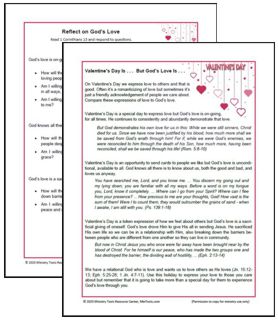
Valentine’s Day Is . . . But God’s Love Is . . .

Compare the way we express ourselves on this holiday to God’s love.

Valentine’s Day is a special day to express love but God’s love is on-going, for all times. (Rom. 5:8-10)

Valentine’s Day is an opportunity to send cards to people we like but God’s love is unconditional, available to all. (Ps. 139)

Valentine’s Day is a token expression of how we feel about others but God’s love is sacrificial, giving of oneself. (Eph. 2:13-14)

Use this holiday to express your love to those you care about but remember that it is going to take more than a special day for them to experience God’s love through you.

Share:

Christmas Is . . .

Share:

Christmas teaches us much about God’s ways. Of course, we’re not talking about all of the holiday decorations, Santa Claus, gift giving, and the like. We’re talking about God so loving the world that He sent Jesus (Jn. 3:16) in human form so He could die in our place to take on the punishment our sin deserves (Phil. 2:6-8).

Consider How Christmas Is about God’s Ways

Holiday Reflections on Christmas and God's Ways
The Holiday Reflections resource includes a discipleship guide that considers the following truths about God’s ways in light of the real significance of Christmas. It briefly expounds on each of these points and provides Scripture and questions to help us reflect on each truth. (This resource also includes guides for thirteen other holidays.

  • Christmas is God’s way of getting our attention.
  • It’s His way of letting us know that there are some things that can’t be ignored, like sin.
  • Christmas is God’s way of getting personal with us.
  • And, it’s His way of saying, “I will be with you always.”

Let’s prepare our hearts so the holiday season doesn’t drag us away from these realities as we get busy and more easily distracted.

Notice how each of the above points deal with Christmas as God’s ways. Christmas is not the world’s holiday. The first Christmas began with God sending Jesus. Let’s remember!

Adult Christmas Curriculum to Help You Remember:

Share:

Thanksgiving Is …

Share:

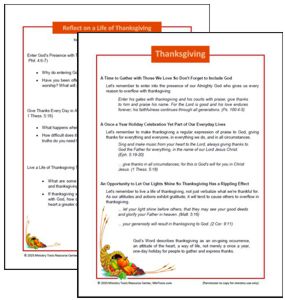
Holiday Reflections on ThanksgivingThanksgiving is so much more than a one day holiday for people to express thanks. God’s Word describes thanksgiving in ways that suggest it be an on-going occurrence, an attitude of the heart, a way of life. Reflect on three important truths about living a life of thanksgiving in the Holidays Reflections discipleship guide on Thanksgiving. (This resource includes guides for a total of fourteen different holidays.)

According to the Bible, Thanksgiving is . . .

  • an offering to the Lord (Lev. 7:13, 15)
  • an accompaniment of praise (Ezra 3:11; Neh. 12:24, 46; Ps. 69:30; 100:4)
  • a means of glorifying the Lord (Ps. 69:30; 2 Cor. 4:15)
  • a melodious refrain (Neh. 12:8, 27, 46; Jer. 30:19; Isa. 51:3)
  • a way to come before the Lord (Ps. 95:2; 100:4; Phil. 4:6)
  • a reaction evoked in others to your good deeds (2 Cor. 4:15; 9:11)
  • a character trait in His people (Eph. 5:4)
  • a form of prayer (1 Tim. 2:1)
  • a response to the Creator for His goodness (1 Tim. 4:3-4)

Giving thanks is so much more than words of gratitude. We can express our gratitude and appreciation to God in a variety of ways that include our words but also our attitudes and actions.

Share:

Halloween Is …

Share:

Many Christians struggle with the Halloween holiday because of its association with the occult and pagan world, witch craft, demons, death, and darkness. Regardless of where you stand on the issue of celebrating Halloween, why not use it as an opportunity to lovingly dialog with others, even unbelievers, about how God is greater than all these evils. Focus on our great God more than how you feel about Halloween and you just might walk away from this holiday encouraged rather than dismayed.

Be very careful, then, how you live – not as unwise but as wise, making the most of every opportunity, because the days are evil. (Eph. 5:15-16)

Think of it this way:

Halloween Is … but God ….

Halloween is a reminder that we live in a dark, evil world but God brings light and goodness to us. (Jn. 1:4-5)

Halloween is a dance around death but God Himself is life and gives eternal and abundant life to all who believe. (2 Tim. 1:10)

Halloween is an acknowledgement of the spirit world but God is stronger and greater than all of them combined. (Col. 2:15)

Halloween is cloaked in superstitions but God is sovereign and faithful and worthy of our undivided devotion and trust. (Col. 2:8-10)

Holiday Reflections on Halloween

Use the Holiday Reflections Discipleship Guides to help those in your sphere of ministry think through the Greatness of God versus evil. It includes the content on this page plus more Scripture to examine along with questions to reflect on how God is greater than all of the above and what that means for us.

(This resource also includes guides for thirteen other holidays.)

Share:

Must Christians Celebrate Christmas?

Share:

Celebrate ChristmasLast Christmas someone asked if it is mandatory for Christians to celebrate Christmas. I couldn’t provide references in support of Christmas or against it. Consequently, it is one of those issues for which we must develop personal convictions. And, since there are no definitive Scripture verses either way, we must apply the principles of Romans 14. We must respect and accept one another with convictions different from ours, not condemn, remembering that “each of us will give an account of himself to God” (Rom. 14:12).

When I can’t find Bible verses about an issue, I then look for relevant principles and/or precedence.

Principles Related to the Celebration of Christmas:

What we can biblically support with certainty is that any celebration must not fall into the category of idolatry (Ex. 20:1-5; 1 Cor. 10:1-14; 1 Jn. 5:21) or lack of stewardship (Prov. 22:3; 1 Cor. 4:2; Eph. 5:15; 1 Tim. 6:7-9; Heb. 13:5).

Precedence Related to Holiday Celebrations:

God instituted various feasts or holidays for Israel to celebrate important events in their history as ways of remembering what He did (i.e., Passover). Jesus’ coming to this earth is a very important event, so would it be out of line to celebrate it?

Problems Related to the Celebrating Christmas:

The problem many Christians through the ages have had with Christmas is its origins and some of the traditions that go with it.  Some say the date we celebrate is not even when Jesus was born. And, it is believed that Christmas appears to have started as a pagan festival that was later claimed by the Christian church as a time to celebrate Jesus’ first coming to earth. They suggest that the original intent seems to have been to take something pagan and turn it to the glory of God. The question we must ask is if we are indeed doing that through our celebrations at Christmas.

Colossians 4:5 says, “Be wise in the way you act toward outsiders; make the most of every opportunity.” To be sure Christmas provides added opportunities to share Jesus, a time when people tend to be more open to go to church and hear about Jesus.

Yet, we must constantly re-focus on the Savior because all the glitz and glitter of the season can distract us from the real reason we have to celebrate.  We need to work at keeping Jesus a priority during the Christmas season.

Share:

Bible Verses about Bosses

Share:

Boss' Day
In the U.S. we celebrate Boss’ Day October 16th each year or the nearest work day. Employees recognize and express appreciation to those who supervise them. But, what does Scripture say about the ongoing relationship of bosses and employees?

The Bible verses used for this study pull in the relationship between a slave and his master, governing authorities and their citizens, as well as church leadership and the rest of the Body. The verses are combined as the same instructions seem to hold through similarly for all.

This suggests that we need to maintain the same standards and character whether in the church, government, or workplace … whether we have a Christian or unbelieving boss or employees … whether they are good and considerate or harsh and disrespectful.

Bible Verses about Bosses to Employees:

  • Treat them the way you expect them to treat you (Eph. 6:9)
  • Do not use threats as a tactic to get them to comply. (Eph. 6:9)
  • Be a servant, under God, for the good of others. (Matt. 20:25-28; Rom. 13:4, 6; 1 Pet. 5:2)
  • Be attentive to their needs. Watch over them. (Heb. 13:17; 1 Pet. 5:2)
  • Understand your own accountability. (Heb. 13:17)
  • Enable people to enjoy working for you, not feel like it’s a burden. (Heb. 13:17)
  • Be fair in the wages you offer. Don’t defraud people but do right by them. (Lev. 19:13; Mal. 3:5; Col. 4:1; James 5:4)
  • Get beyond obligations toward them to truly caring and wanting to be there for them. (1 Pet. 5:2)
  • Keep everything you do above board Get what you get honestly, with integrity. (1 Pet. 5:2)
  • Don’t be controlling. (Matt. 20:25-26; 1 Pet. 5:3)
  • View people under you as an entrustment from God. (1 Pet. 5:3)
  • Be an example. (1 Pet. 5:3)
  • Look for your reward from God. (1 Pet. 5:3-4)
  • Demonstrate humility. (1 Pet. 5:5)

Observations: God is concerned about how you treat people. Being a boss doesn’t give you a right to be bossy.

Bible Verses about an Employee to His/Her Boss:

  • Listen to them (obey). (Eph. 6:5-6; Col. 3:22; Titus 3:1; Heb. 13:17)
  • Submit to them (subject to). (Rom. 13:1; Titus 2:9; Heb. 13:17; 1 Pet. 2:13-14, 18; 5:5)
  • Seek to please them. (Titus 2:9)
  • Be respectful toward them (respect and fear). Honor them. (Eph. 6:5; 1 Tim. 6:1; 1 Pet. 2:17)
  • Maintain honesty and integrity toward them (sincerity of the heart). (Eph. 6:5; Col. 3:22)
  • Serve them out of reverence for the Lord. (Rom. 13:2; Eph. 6:5-6; Col. 3:22; 1 Pet. 2:13-14)
  • Work wholeheartedly not just for them but because of the Lord. (Eph. 6:7-8; Col. 3:23-24)
  • Acknowledge God’s sovereignty in who is over you, knowing that God is using this person for your good. (Jn. 19:11; Rom. 13:1-2, 4)
  • Do not rebel against their authority. (Rom. 13:2)
  • Seek to do what is right. Rise above the fray. Keep your conscience clean. (Rom. 13:3, 5)
  • Represent the Lord in the workplace (so His name and teaching not slandered) (1 Tim. 6:1; Titus 2:9-10)
  • Don’t take advantage of believing bosses but be all the more motivated to serve well. (1 Tim. 6:2)
  • Look for your reward from God. (Eph. 6:7-8; Col. 3:23-24)
  • Be humble. (1 Pet. 5:5)
  • Stay calm if the one over you rises against you (anger). (Eccl. 10:4)
  • Hold your tongue, not talking back at them. (Titus 2:9)
  • Be trustworthy, not stealing from them time, money, or other. (Titus 2:9-10)
  • Pray for them. (1 Tim. 2:1-4)

Observations: God is as much concerned about our heart attitude toward our bosses as outward compliance. We should be concerned about being a testimony and honoring to the Lord not just pleasing the boss or getting a paycheck.

Click Here for More: Boss’ Day Resources

Share: