We Proclaim Jesus, Not Ourselves

Share:

We Proclaim Jesus, Not Ourselves

Scripture makes it clear that outreach is about Jesus and what He did, not about us and what we do.

For what we preach is not ourselves, but Jesus Christ as Lord, and ourselves as your servants for Jesus’ sake. (2 Cor. 4:5)

The Person We Proclaim is Jesus Christ as Lord, Not Ourselves

Consider these important truths:

Jesus is the One who saves. HE is the message. — We’re His messengers.

Christ is the Messiah. HE is the anointed One. — We’re His servants.

Jesus is Lord. HE is the One people should follow. — We’re proclaimers for Jesus’ sake, not to gain a personal gathering.

The Perspective Needed to Keep the Focus of Outreach on Jesus, Not Ourselves

The verses leading up to 2 Corinthians 4:5 help us maintain perspective. The word “for” with which verse five begins, suggests we look at the context.

v. 1 – “Therefore, since through God’s mercy we have this ministry, we do not lose heart.”

We have this ministry of proclaiming Jesus as Lord through God’s mercy, not because of how great we are. We therefore persevere when others fail to acknowledge our part in outreach or when we don’t see results. We mustn’t let proclaiming God’s Good News turn into something that puffs us up.

v. 2 – “Rather, we have renounced secret and shameful ways; we do not use deception, nor do we distort the word of God. On the contrary, by setting forth the truth plainly we commend ourselves to everyone’s conscience in the sight of God.”

Proclaimers of Jesus need lives filled with truth, integrity, and pure motives. Selflessness, not self-centeredness, matches the message we bring. We mustn’t look for personal benefit or acclaim but proclaim the Good News in such a way that everything points to and goes to Jesus.

v. 3-4 – “And even if our gospel is veiled, it is veiled to those who are perishing. The god of this age has blinded the minds of unbelievers, so that they cannot see the light of the gospel that displays the glory of Christ, who is the image of God.”

We have a message that not everyone will believe because they have been blinded by the “god of this world.” Expect some opposition. We mustn’t take rejection personally as it is not about people following us but Jesus Christ as Lord.

These verses teach that proclaiming Jesus needs to be about Him, not us. Let’s keep this perspective! We proclaim Jesus Christ as Lord, not ourselves.

For this very reason, the sub-title for the Outreach Ministry Manual is “Turning the Spotlight on Jesus” — how we should view outreach. (Click on the link to check out that resource.)

Share:

We Proclaim Jesus Christ as Lord

Share:

For what we preach is not ourselves, but Jesus Christ as Lord, and ourselves as your servants for Jesus’ sake. (2 Cor. 4:5)

We Proclaim Jesus Christ as Lord

About the Outreach of Proclaiming

Before thinking this post only pertains to those who preach from a pulpit, consider these truths:

1) The Apostle Paul wrote this post. He did not serve in the manner of a typical preacher in a church as we know today.

2) The word “preach” in this verse means “to proclaim after the manner of a herald” (Thayer’s Greek Lexicon). A herald brings important news — a messenger.

We have the same Good News (the Gospel) to proclaim as the Apostle Paul. — “that Christ died for our sins according to the Scriptures, that he was buried, that he was raised on the third day according to the Scriptures, and that he appeared …” (1 Cor. 15:3-5)

We Proclaim a Person of Great Significance

The message we proclaim is a Person, not a creed or dogma. And, be sure to note that Person isn’t us. We’re merely the messengers. — “For what we preach is not ourselves, but Jesus Christ as Lord” (2 Cor. 4:5) — We proclaim Jesus Christ as Lord, not merely as a good person or prophet.

The names attributed to this Person not only describe who He is but also point to what He did for us.

Jesus: The angel told Joseph, “you are to give him the name Jesus, because he will save his people from their sins” (Matt. 1:21). This name means “Jehovah is salvation” and thus points to Him as God come in the flesh to be our Savior. This is of great significance because the death of a mere human would not satisfy the just demands of a holy God.

Christ: This name points to Jesus as the anointed One, prophesied as the Messiah who would come to carry out God’s plan of salvation (Lk. 2:11; 24:46; Jn. 11:27; 20:31; Acts 26:23). How significant that Jesus fulfilled all the prophecies pointing to the Messiah, thus substantiating His claims.

Lord: “He is the head of the body, the church; he is the beginning and the firstborn from among the dead, so that in everything he might have the supremacy.” (Col. 1:18) Certainly to be able to save and do what He said He would do, Jesus has to have full authority and power.

Is this the message we proclaim? Do we point people to Jesus Christ as Lord?

Read More in This Series:


Outreach Resources by Ministry Tools Resource Center

Share:

Are Your Decisions Biblically or Personality Based?

Share:

God’s Word informs us of what we need to do to ensure that we make wise and godly decisions. (Be sure to read: Biblical Tips for Decision-Making) The question we must ask is if our personalities are getting in the way of biblically-based decisions. We need to get beyond ourselves when making decisions and align with God and His Word.

Decisions Biblically Based rather than Personality Have a Lamp to Guide the Way

Let’s heed the warning, “Do not be wise in your own eyes” (Prov. 3:7). Rather, “in all your ways submit to him, and he will make your paths straight” (Prov. 3:6-7). We do that as we come under the guidance of His Word which “is a lamp for my feet, a light on my path” (Ps. 119:105).

Understand How Your Personality Can Affect Decision-Making

When we understand how our personalities might sway decision-making, we can take a step back and recalculate where needed.

  • Are you very analytical? (melancholic, C in DISC)

If so, your decisions will tend to be well thought through but you could slow down the process by too much deliberation and frustrate others because of it if not careful.

  • Are you more intuitive, going by feelings or circumstances? (sanguine, I in DISC)

If so, you might not be getting all the facts in making decisions and miss the mark.

  • Do you tend to make rash decisions? (choleric, D in DISC)

If so, your decisions might at times be a bit premature, sometimes what God wants eventually, but not always, and you could ignore the wise input of others if not careful.

  • Do you tend to put off making decisions? (phlegmatic, S in DISC)

If so, your procrastination could make decisions a bit late for averting unnecessary problems or more work than necessary.

  • Do you tend to look for creative alternatives? (melancholic, C in DISC)

If so, you can bring some fresh ideas to the table but must learn to release those ideas to God and not sulk if they aren’t used.

  • Do you tend to look for what works in the moment? (sanguine, I in DISC)

If so, you might be missing the big picture effect of your decisions.

  • Do you tend to look for what conforms to what you’ve done in the past? (phlegmatic, S in DISC)

If so, you might get stuck in traditions and miss out of where God wants to take you.

  • Do you tend to want to take risks? (choleric, D in DISC)

If so, you might experience new and innovative ideas but need to make sure it’s a faith risk guided by God.

  • Do you tend to want to play it safe? (phlegmatic, S in DISC)

If so, you might avoid conflict and danger but you might also be failing to exercise faith in God’s ability to do the extraordinary.

  • Do you tend to aggressively stand up for your decisions, debating any who oppose you? (choleric, D in DISC)

If so, you might get your way but in the process alienate people.

  • Do you tend to quickly cave in to those who oppose you? (phlegmatic, S in DISC)

If so, you might be putting people’s desires above God’s in your compromising.

Decisions Aligned with God and His Word are So Much Better

We need to acknowledge how our personalities might negatively or positively affect the decision-making process and follow a process that is biblically based. That kind of decision making aligns with God and His ways. He assures us that “as the heavens are higher than the earth, so are my ways higher than your ways and my thoughts than your thoughts” (Isa. 55:9). Our ways may seem good but His ways are so much better.

What are you using as a grid for making decisions? What guides your decision-making process?

More in the Train Church Leaders Practicum: Decision-Making

Share:

Biblical Principles for Decision-Making

Share:

We make a lot of decisions each day. How can we know if we’re making the right decisions? — When we follow principles laid out in God’s Word, we have the help we need for decision-making.

An Acrostic Filled with Biblical Principles to Help with Decision-Making

Conclusions about making decisions can be drawn through the following Scripture verses leading to principles we can apply to the decision-making process.

D – Depend on the Lord to guide you, not on your own understanding. (Prov. 3:5-6; Ps. 28:7; Phil. 2:13)

E – Evaluate the effect your decision will have on others, not just on yourself. (Rom. 14:19-23; 1 Cor. 8:9; 10:23; Eph. 4:1-3; Phil. 2:3-4; Heb. 13:16)

C – Conform to the Lord, not to the world or what you think. (Josh. 24:15; Prov. 14:12; 16:25; Matt. 6:24; Rom. 12:1-2; 1 Jn. 2:15)

I – Insist that all be done to the glory and honor of the Lord, not simply what is convenient or pragmatic. (Matt. 5:16; 1 Cor. 10:31; Col. 3:17)

S – Submit to the Spirit’s working, not your own efforts or desires. (Jn. 16:13; Gal. 3:3; 5:16-23; Eph. 4:30; 5:15-18; 1 Thess. 5:19)

I – Imitate and promote the goodness, love and integrity of Christ, not even giving the appearance of evil. (Rom. 13:8, 10; Eph. 5:1-4; Phil. 1:20; 2:14-15; 1 Thess. 5:22-23; Titus 2:7-8; 1 Jn. 4:11)

O – Obey what has already been written in God’s Word, not compromising and going contrary to Truth. (Ps. 1:1-2; 119:105; 2 Tim. 3:16-17; Heb. 4:12; 5:14)

N – Nurture your walk with the Lord so He has first place in your life, not living merely to please yourself or other people. (Prov. 1:7; 9:10; 14:27; 19:23; 23:17; 2 Cor. 10:5)

S – Seek after God for wisdom, exercising faith in Him and His ways, not interpreting life through your own grid or comfort zone. (Prov. 2:1-11; Phil. 4:6-7; Col. 1:9-10; Heb. 11:6; James 1:5; 1 Jn. 5:14)

How Confident are You in the Decisions You Make?

Decision-Making Principles
The more we apply the above principles to our everyday lives, the more confident we can become that we will make the right choices. To help, print this PDF and take time to read through the Scripture for each point. Revisit it regularly, particularly if you struggle to make the right decisions. You can even use it to guide your prayers, asking the Lord for help, especially with the principles you struggle to follow.

Also Check out the TrainChurchLeaders.com Practicum: Decision-Making

Share:

Scripture Memory Resources to Hide God’s Word in Our Hearts

Share:

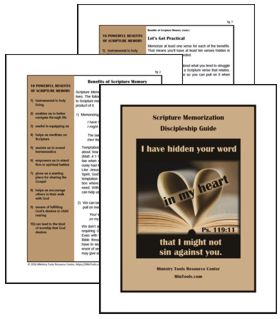
Scripture Memorization Discipleship Guide
Hiding God’s Word in our hearts (Ps. 119:11) through intentional Scripture memorization strengthens our walk with Him and equips us to navigate life with wisdom and confidence. The Scripture Memorization Discipleship Guide highlights ten powerful benefits of memorizing Scripture, offers seven practical tips to help you retain what you learn, and provides fourteen methods to make memorization easier and more meaningful.

You’ll also find guidance in the guide for keeping Scripture memory age-appropriate, with insights into how developmental needs and age-level characteristics help us choose relevant Bible verses for the various stages of life. This resource is designed to enrich your own spiritual growth and to support you in discipling others in memorizing God’s Word.

General Info about Scripture Memory

Use the following resources and tools to help with Bible memory.

While seeking to choose doctrinally sound resources, we make no claim to total endorsement of any listing. Where possible, links go to merchants with whom we have an affiliate relationship, such as being an Amazon Associate from whom we earn from qualifying purchases. These sites may use cookies to track activity to ensure that Ministry Tools Resource Center gets commissions from any sales. Links open in new pages to keep the list available.

Articles:

Books:

Resource:

Age-Appropriate Memorization of the Word

Children

… from infancy you have known the Holy Scriptures, which are able to make you wise for salvation through faith in Christ Jesus. (2 Tim. 3:15)

Articles:

Books:

Tools:

Teens

How can a young person stay on the path of purity? By living according to your word. … I have hidden your word in my heart that I might not sin against you. (Ps. 119:9-11)

Articles:

Tools:

Adults

Your word is a lamp for my feet, a light on my path. (Ps. 119:105)

Articles:

Teaching for Scripture Memorization

Articles:

Books & More:

Tools to Help with Bible Memory:

Apps:

Cards:

Journals:

Misc. Tools:

To Top

Share:

Scripture Memory Has Powerful Benefits

Share:

The psalmist said, “I have hidden your word in my heart that I might not sin against you” (Ps. 119:11). The word “hidden” means to store up or treasure. While the verse doesn’t specifically mention memorizing Scripture, that could certainly be a way of storing, or hiding, it in our hearts. Notice that the psalmist suggests one of the benefits of Scripture memory.

Scripture Memorization Discipleship GuideYou’ll find the following benefits of memorizing God’s Word in the Scripture Memorization Discipleship Guide, also with some brief input about each point. The resource adds six more benefits, showing how Scripture memory truly is powerful. In addition, the resource provides some tips and means of memorizing, along with some ways to keep it age-appropriate.

Scripture Memory is a Powerful Tool that Benefits Our Lives

The verses used for each point may not directly imply Scripture memorization but certainly would be a by-product.

  1. Memorizing the Word is instrumental to holy living.

I have hidden your word in my heart that I might not sin against you. (Ps. 119:11)

The law of their God is in their hearts; their feet do not slip. (Ps. 37:31)

  1. We can better navigate through life when we can pull on memorized verses.

Your word is a lamp for my feet, a light on my path. (Ps. 119:105)

  1. Scripture memory empowers us to stand firm in spiritual battles.

Take the helmet of salvation and the sword of the Spirit, which is the word of God. (Eph. 6:17)

  1. Having Scripture memorized helps us with apologetics and sharing the Good News of salvation.

But in your hearts revere Christ as Lord. Always be prepared to give an answer to everyone who asks you to give the reason for the hope that you have. But do this with gentleness and respect … (1 Pet. 3:15)

(Order the Scripture Memorization Discipleship Guide to explore six more benefits.)

If memorizing God’s Word does all of the above,  plus more, surely Scripture memory is a powerful tool. It leads to victorious Christian living and enables us to better serve others. So, what are some ways to memorize Scripture?

Click other resources, go to: Where can you get help with Scripture Memory?

Share: