What Does the Bible Say About Self-Protectiveness?

Share:

Sometimes when we compare ourselves and come up short, we may do things to protect ourselves from coming under ridicule or feeling bad about ourselves. As seen in previous posts, we may get into self-striving to become better or self-exaltation to appear better. We may put up walls, particularly when we’ve been hurt and don’t want it to happen again. We seek to protect ourselves from further harm and hurt. But, what does the Bible say about self-protectiveness?

The Bible Warns Against Self-Protectiveness

We can find at least four biblical reasons trying to protect ourselves isn’t the best course of action, no matter how hurt we’ve been.

  1. Self-protective measures aren’t necessary when we have a God who is for us. This doesn’t mean bad things will never happen to us, but they will always have a greater purpose than harming us.

What, then, shall we say in response to these things? If God is for us, who can be against us? He who did not spare his own Son, but gave him up for us all—how will he not also, along with him, graciously give us all things? Who will bring any charge against those whom God has chosen? It is God who justifies. Who then is the one who condemns? No one. Christ Jesus who died – more than that, who was raised to life – is at the right hand of God and is also interceding for us. Who shall separate us from the love of Christ? Shall trouble or hardship or persecution or famine or nakedness or danger or sword? (Rom. 8:31-35)

And we know that in all things God works for the good of those who love him, who have been called according to his purpose. (Rom. 8:28)

  1. Building walls around ourselves goes against one of God’s purposes in sending Jesus to die. Walls separate us from God and others. God, however, sent Jesus so we can be in fellowship, not just with Him but with one another. Who are we to erect walls Jesus died to break down?

… For he himself is our peace, who has made the two groups one and has destroyed the barrier, the dividing wall of hostility, by setting aside in his flesh the law with its commands and regulations. His purpose was to create in himself one new humanity out of the two, thus making peace, and in one body to reconcile both of them to God through the cross, by which he put to death their hostility. (Eph. 2:11-16)

  1. It’s foolishness to think we’re strong enough to take care of ourselves, especially when we have a God who is fully able.

A horse is a vain hope for deliverance; despite all its great strength it cannot save. But the eyes of the Lord are on those who fear him, on those whose hope is in his unfailing love, to deliver them from death and keep them alive in famine. (Ps. 33:17-19)

Unless the Lord watches over the city, the guards stand watch in vain. (Ps. 127:1)

Do not be afraid of those who kill the body but cannot kill the soul. Rather, be afraid of the One who can destroy both soul and body in hell. (Matt. 10:28)

  1. It’s foolishness for us to think we’re wise enough to know how to best bring about justice. God wants us to leave vengeance to Him, not to take matters into our own hands, which is where self-protective measures may take us. He has the wisdom to do what is right.

Do not take revenge, my dear friends, but leave room for God’s wrath, for it is written: “It is mine to avenge; I will repay,” says the Lord. … (Rom. 12:19-21)

Scripture Encourages Us to Trust God Instead

No Need for Self-Protectiveness with God as our Protector
We can trust God rather than seek to protect ourselves because He promises to be our …
helper (Ps. 121:1-2),
shield (Ps. 18:30),
deliverer (Ps. 3:8),
sustainer (Ps. 3:5),
and hiding place (Ps. 32:7).

Consider these truths about God’s protection:

  • He’s powerful enough to protect us from anyone or anything. If He could create all things out of nothing, certainly He can take care of that which He created.

I lift up my eyes to the mountains – where does my help come from? My help comes from the Lord, the Maker of heaven and earth. (Ps. 121:1-2)

  • He’s so wise He always knows what’s best.

As for God, his way is perfect: The Lord’s word is flawless; he shields all who take refuge in him. (Ps. 18:30)

He who watches over you will not slumber. (Ps. 121:3)

Rather Than Put Protective Walls Around Ourselves, Let’s Do This

Remember, there’s a spiritual battle waging around your soul that no amount of self-protection will overcome. Jesus prayed for our protection from the evil one (Jn. 17:15). Jesus is the overcomer (Jn. 16:33). — “… be strong in the Lord and in his mighty power. Put on the full armor of God, so that you can take your stand against the devil’s schemes. For our struggle is not against flesh and blood, but against the rulers, against the authorities, against the powers of this dark world and against the spiritual forces of evil in the heavenly realms. Therefore put on the full armor of God …” (Eph. 6:10-18)

Keep your eyes on what you have in Him rather than your circumstances, troubles, hurts, etc. We can learn to be content, and live the life God intends for us because we can do all things through Christ who strengthens us (Phil. 4:11-13). In Him, we can have peace, no matter what (Phil. 4:6-7; Jn. 16:33). His peace will guard our hearts even when our circumstances don’t change.

Call on the name of the Lord when feeling vulnerable. Jesus prayed for our protection by the power of His name (Jn. 17:11-12).
Share:

What Does the Bible Say About Self-Exaltation?

Share:

Self-Exaltation is about our need to make ourselves look good. It may stem from comparing ourselves to others. Perhaps we do excel in some areas but feel the need to make sure others know it. Maybe, however, we think we’re not as good as others and so we try to make ourselves appear better by talking and acting like we’re better. Whatever the cause, we’re bragging about ourselves.

The Bible Warns Against Self-Exaltation

God’s Word clearly informs us of His opposition to pride and arrogance. Even if it’s true that we are as good as we say, we’re moving into the dangerous territory of pride which God hates. And, if we aren’t as good as we make ourselves out to be, we’re moving into the manipulative territory of deceit.

To fear the Lord is to hate evil; I hate pride and arrogance, evil behavior and perverse speech. (Prov. 8:13)

Pride goes before destruction, a haughty spirit before a fall. (Prov. 16:18)

Jesus warned His disciples about pride and wanting to be in a place of honor. He said it’s better to let others recognize and honor you, rather than exalt yourself (Lk. 14:8-11).

For all those who exalt themselves will be humbled, and those who humble themselves will be exalted. (Lk. 14:11)

Jesus taught that we shouldn’t worry about being first or best or always right because that’s when we lose.

Then Jesus said to his disciples, “Whoever wants to be my disciple must deny themselves and take up their cross and follow me. For whoever wants to save their life will lose it, but whoever loses their life for me will find it.” (Matt. 16:24-25)

But many who are first will be last, and many who are last will be first. (Matt. 19:30)

Scripture Encourages Us to be Humble Instead

We need to get the focus off of ourselves and put it on God. Who we are and what we have in Him is enough. We can trust Him.

Wisdom’s instruction is to fear the Lord, and humility comes before honor. (Prov. 15:33)

We don’t need to be anxious about what others think. When life is all about Him, making ourselves look good becomes less and less important. God will take care of us.

God Opposes Self-Exaltation, Gives Grace to the Humble
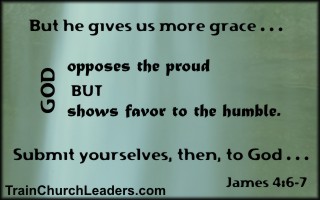
But he gives us more grace. That is why Scripture says: “God opposes the proud but shows favor to the humble.” Submit yourselves, then, to God. Resist the devil, and he will flee from you (James 4:6-7)

Humble yourselves, therefore, under God’s mighty hand, that he may lift you up in due time. Cast all your anxiety on him because he cares for you. (1 Pet. 5:6-7)

Rather Than Exalt Yourself, Do This

Follow the example of Christ who came to serve others rather than be served. Humility, rather than self-exaltation, exemplifies Christlikeness. With the focus off ourselves, and onto God, we’re freed to serve.

… whoever wants to become great among you must be your servant, and whoever wants to be first must be slave of all. For even the Son of Man did not come to be served, but to serve, and to give his life as a ransom for many. (Mk. 10:43-45)

Do nothing out of selfish ambition or vain conceit. Rather, in humility value others above yourselves, not looking to your own interests but each of you to the interests of the others. In your relationships with one another, have the same mindset as Christ Jesus: Who, being in very nature God, did not consider equality with God something to be used to his own advantage; rather, he made himself nothing by taking the very nature of a servant, being made in human likeness. … (Phil. 2:3-11)

Share:

What Does the Bible Say About Self-Striving?

Share:

Self-striving is about our human effort to make something happen or to become who we should be. Sometimes it stems from comparing ourselves to others and finding ourselves to be inferior. Our insecurities may drive us to self-striving to try to measure up rather than find our significance in the Lord. Whatever the cause, we’re basically over-estimating our own abilities to change or make things happen and under-estimating God’s ability. And so, self-striving equals self-reliance.

The Bible Warns Against Self-Striving

God makes it clear that no amount of striving will save us.

For it is by grace you have been saved, through faith – and this is not from yourselves, it is the gift of God – not by works, so that no one can boast. (Eph. 2:8-9)

He also exhorts, “So then, just as you received Christ Jesus as Lord, continue to live your lives in him, rooted and built up in him, strengthened in the faith as you were taught, and overflowing with thankfulness” (Col. 2:6-7). We continue to live by grace, which in essence, is God doing for us what we can’t do for ourselves. — “being confident of this, that he who began a good work in you will carry it on to completion until the day of Christ Jesus.” (Phil. 1:6)

Scripture also describes self-striving in our day-to-day physical lives as meaningless. It just leads to anxiety and stress.

Unless the Lord builds the house, the builders labor in vain. In vain you rise early and stay up late, toiling for food to eat – for he grants sleep to those he loves. (Ps. 127:1-2)

What do people get for all the toil and anxious striving with which they labor under the sun? All their days their work is grief and pain; even at night their minds do not rest. This too is meaningless.(Eccl. 2:22-23)

Scripture Exhorts Us to Cease Striving

Cease from Self-StrivingGod said, “Cease striving and know that I am God” (Ps. 46:10, NASB).

As we “behold the works of the Lord” and acknowledge that “the Lord Almighty is with us” (Ps. 46:7-8), we realize that we have an “ever-present help” (Ps. 46:1). We don’t have to rely on ourselves when the One of whom there is none greater is with us. No one can truly fathom His greatness and understanding (Ps. 145:3; Isa. 40:28). That’s what makes Him God. It only makes sense to heed the instruction in Proverbs 3:5-6 to “trust in the Lord with all your heart and lean not on your own understanding; in all your ways submit to him”.

The Hebrew word for “cease striving”, according to Strong’s concordance, suggests that we sink down or relax. When we sink down into God’s sovereignty as the Lord Almighty, we can relax knowing He’s in control and that He is fully capable to take care of all that pertains to us. When we rely on the Almighty God rather than our own strength, we find peace (Phil. 4:6-7) and contentment (Phil. 4:11-13)

While we do find places in Scripture that seem to suggest we strive for certain things, it’s still not self-striving but rather God working in and through us. We must interpret Scripture with Scripture.

Therefore, my dear friends, as you have always obeyed – not only in my presence, but now much more in my absence – continue to work out your salvation with fear and trembling, for it is God who works in you to will and to act in order to fulfill his good purpose. (Phil. 2:12-13)

To this end I strenuously contend with all the energy Christ so powerfully works in me. (Col. 1:29)

Rather Than Strive, Do This

Do you want to change and get better? Do you want to do what really matters? — Cease striving. Know that He is God.

Here’s the starting point: Trust God instead of worrying. “Seek first his kingdom and his righteousness” (Matt. 6:25-34)  As you do, pull on His power. It isn’t necessary to strive when the Almighty God is with us. Pull on His power by …

  • walking in the Spirit (Gal. 5:16-26),
  • relying on His grace (Titus 2:11-12),
  • abiding in Christ (Jn. 15:4-5),
  • and finding your strength in the Lord (Phil. 4:13; Isa. 40:31).

For more on various means through which He empowers us, go to: The Source of the Church’s Power

Share:

Prayer That Reflects Who God Is

Share:

Prayer That Reflects Our Great God
Think about when you pray. Are your prayers truly reflecting the kind of God we have? If so, they’ll demonstrate a wholehearted trust in Him. You’ll approach Him with a sense of awe, yet also intimacy.

An Acrostic Showing Prayer That Acknowledges Who God Really Is

For each word in this acrostic, think about what qualifies God to be the One to whom we turn in prayer in these ways.

P – Pleading – trusting in God

We can “approach God’s throne of grace with confidence” because He is merciful and gracious, ready to help in our time of need. (Ps. 121:3; Prov. 3:5-6; Rom. 8:28; Phil. 4:19; Heb. 4:16)

R – Relating – communing with God

We can talk with God as a Friend because in His love He reconciled us to Himself through Jesus’ death on our behalf. (Ps. 66:20; Jn. 15:13-15; Rom. 5:8-10; Col. 1:20)

A – Aligning – cooperating with God

We can seek His counsel and will for what to do since He is holy, all-knowing, and all-wise, making His ways higher and best. (Isa. 55:8-9; 1 Jn. 5:14)

Y – Yearning – seeking after God above all else

We can look to God to satisfy our deepest need as He is totally sufficient, unlike anything or anyone else. (Ps. 42:1-2)

E – Exalting – worshiping God

We can express His worth as the Lord God of whom there is none greater. (Ps. 34:1-4; 46:10; 57:11)

R – Revering – honoring God

We can defer to Him even when we don’t understand because we know He is sovereign. (Ps. 33:6-11, 16-20; 50:15; 111:10; Prov. 3:7-10)

Resources to Help with Praying

For more on prayer, visit the Prayer Ministry Training section of this site.

Also consider these resources:

Share:

Want Something More Than Mere Religion?

Share:

Biblical Christianity Has Jesus at the Center and Throughout ScriptureA lot of different religions exist in this world. What makes biblical Christianity so different is the Person of Jesus Christ at the center of it. Even the Old Testament of the Bible, not just the New Testament, points to Jesus throughout its pages (Lk. 24:27, 44; Jn. 5:39; 1 Pet. 1:10-13). He makes Christianity so much more than a mere religion. What He offers goes way beyond a religious experience.

Jesus is So Much More Than Mere Religion

If everything revolves around Jesus, then He must be someone great enough to truly make a difference in people’s lives.

  1. Jesus is more than a religious figure like a prophet. He is God come in the flesh (Matt. 1:23; Jn. 1:1-5; Phil. 2:6-7; Heb. 1:3), — a divine Person.
  1. He did more than come and live on this earth once upon a time. He died and rose again and is now seated at the right hand of the Father in the heavenly realms (Eph. 1:19-21; Col. 3:1), — a living Person.
  1. Following Jesus is more than adhering to a creed, certain moral principles or ideals. We follow a Person, Jesus Christ, whom we can get to know and love (Jn. 1:10-13; 17:3; 1 Jn. 4:13-19;  Rev. 3:20), — a Person with whom we can relate.
  1. Jesus is more than a good example to pattern our lives after. He is a Savior, the One who died on the cross to take our sin upon Himself so we can be made right with God (Isa. 53:5; Jn. 14:6). He is the Sovereign Lord who ascended back to heaven after His resurrection from the dead, the One to whom every knee will one day bow (Phil. 2:10), — making Him a Supreme Being to whom we owe not only our eternal destiny but also our love, service, obedience, and worship now.

Jesus Offers So Much More Than a Religious Experience

While Jesus does give eternal life to those who believe in Him (Jn. 3:16; 1 Jn. 5:13), He offers so much more. Jesus IS eternal life (Jn. 14:6), not just something He promises we will one day possess. He extends Himself to us, not just a promise or possession so we can be in a relationship with Him.

He wants us to live in the fullness of who He is (Eph. 4:13), abiding in Him and bearing fruit (Jn. 15:1-8). He offers us Himself so we can walk with Him in a love relationship. We obey His commands because we love Him (Jn. 14:15, 21; 1 Jn. 5:3; 2 Jn. 1:6), not to earn His favor (Eph. 2:8-9).

Jesus offers more than a future hope to us. He gives us purpose and meaning to live right now, considering us His co-workers (1 Cor. 3:9). He came to give us an abundant life, one to the full (Jn. 10:10).

All of this is so much more than a mere religious experience. It’s a relationship with a real Person who is ours now and through eternity.

Share:

Something Stunting Your Spiritual Growth?

Share:

God wants us to “grow in the grace and knowledge of our Lord and Savior Jesus Christ” (2 Pet. 3:18). We never will arrive at fully knowing that grace for He keeps giving us more and more grace (Jn. 1:16; James 4:6). Nor will we ever stop growing in our knowledge of our Lord for the “Son is the image of the invisible God” (Col. 1:15). Our finite minds can’t fully comprehend an infinite God. If we could, He would cease to be God for He would be no greater than us. No wonder the Apostle Paul wrote, “Not that I have already obtained all this, or have already arrived at my goal, but I press on to take hold of that for which Christ Jesus took hold of me” (Phil. 3:12). Yet, some Christians seem to be stunted in their spiritual growth.

What Might Be Stunting Spiritual Growth

The following list, which is not exhaustive, gives some possible reasons we fail to press on. This post cannot examine each of these reasons so click on the article(s) for help with it.

boredom

busyness

circumstances of life

comparisons

compartmentalizing

conflict with others

discontentment

faulty beliefs

fears

hurts/suffering

impatience

insecurities

lack diligence

legalistic, performance-based approach

lost first love

misaligned priorities

sin, bad habits, unhealthy attitudes

spiritual warfare

stuck in a rut

unrealistic expectations

God Has Provided What We Need to Grow

Our Great God as Our Father from A to ZNo matter what the reason may be, the one thing that applies to all is that our God is greater than all that pertains to you. It’s going to take more than good intentions and self-effort to grow spiritually. We need reliance on our Great God who has provided a variety of means to help us grow. Get to Him better in the Our Great God from A to Z Discipleship Tool.

Spiritual Growth Takes Getting Spiritually FItGod uses what has been termed “spiritual disciplines” to foster growth. Just as we engage in physical activities to strengthen our muscles, boost our energy level, and improve our overall health, so engaging in certain spiritual activities can do the same for our walk with God. The Getting Spiritually Fit: Engaging in Spiritual Disciplines Discipleship Tool primarily looks at five key activities that will help you become more spiritually fit.

Sowing Good into Our Lives That Helps Us Grow SpirituallyIt will, however, take more than routine discipline. Our attitudes, motives, and perspective in it make a big difference. The Sowing Good into Our Lives Discipleship Acrostics looks at traits that need to be sown into our hearts as we engage in various spiritual activities. A walk with God that stems from the heart tends to keep growing.

Share: