Just a Nursery Worker? Ouch!

Share:

Nursery Baby

Having had to do a lot of recruiting when I worked in a church, I am well aware of common attitudes toward being a nursery worker. For some it was an easy way to get involved … just babysitting. For others it was viewed as a hardship … they did their time and didn’t want to be stuck in the nursery.

Hurtful Perceptions About Being a Nursery Worker

I quickly picked up on three hurtful perceptions about being a nursery worker that needed to be overcome:

1) These young children were not seen as an important age group to serve. Ouch!

Babies can’t learn the Bible, it is argued, so they aren’t an important age to invest into ministry-wise.

Here’s why this perception is hurtful:

  • Infants and toddlers are not too young to learn. They might not be able to do an exegetic study of a Bible verse but they are getting a sense of the kind of God we have and how good it is to be a part of His Church. Why wouldn’t we want to be strategic in making sure they are getting the right impressions?
  • Jesus thought little children were valuable enough to take time for them out of His busy schedule (Matt. 19:13-15). If Jesus viewed them as precious and in need of His touch, why wouldn’t we feel the same today? Some of the attitudes toward serving in the nursery must grieve His heart.

Let’s value infants and toddlers in the Church. Let’s invest not only our time and effort into training these young ones but also our hearts.

2) Being a nursery worker was not seen as an important role to fill. Ouch!

Change a few diapers, play with them a little, feed them a bottle, and put them down for a nap. That doesn’t sound like ministry, some might think, just care-taking.

In part, I believe people feel this way because they don’t understand the role they can have. They view themselves as babysitters, someone to free the parents up to attend classes or services. Even if that is all that’s to it, they would have an important role to fill.

But, nursery workers have a much more important role than that if they see themselves as foundation builders who prepare children for what is to come, affecting their attitudes toward God and His Church. Laying a foundation is extremely important as seen in the construction of a building. Jesus told a parable contrasting the effects of a storm on an edifice built on a firm foundation and one that was not (Matt. 7:24-27).

Lest you think being a foundation builder isn’t important, take a look at Scripture. God’s “own hand laid the foundations of the earth” (Isa. 48:13). The Church was built on a foundation (Eph. 2:19-22). Our future home, the heavenly city, is built on a foundation (Heb. 11:10; Rev. 21:14,19). If God views foundation building as critical, why wouldn’t we see the potential of this kind of role in the nursery as important?

Let’s expect more than mere babysitting. Let’s elevate the role of being in the nursery to true ministry.

3) Serving in the nursery merely fills an immediate need. Ouch!

Somebody has to do it so we don’t have crying babies in the worship service, right? Parents need to go to their own classes so somebody needs to take care of their children, right? While nursery workers do fill an immediate need, this motivation for working in the nursery is hurtful because it is so short-sighted.

As we’ve already seen, nursery workers have the potential of laying a good foundation in the lives of these children which can affect their future relationship with God and His Church. Think of John the Baptist who had the important ministry of preparing the way for the Lord Jesus. He was not the Savior but was used by God to develop pliable hearts ready to be introduced to the One who would save them.

The foundation laid in the nursery will be built upon by teachers to whose classes these young children will eventually be promoted. It’s a similar concept to what we read 1 Corinthians 3:10 — “By the grace God has given me, I laid a foundation as a wise builder, and someone else is building on it. But each one should build with care.”

Let’s approach the nursery with a view to the future. Let’s “build with care” and lay the foundation in these young lives “as a wise builder.”
Share:

Just a Teacher’s Helper? Ouch!

Share:

When members of the church body say, “I’m just a …” it is suggesting that they are unimportant or at least not as important as someone else. A Teacher’s Helper might say,

“I’m not as important as a teacher. He/she is doing what really matters, what truly counts for eternity.”

Ouch!

Here’s why the perception hurts:

In God's Design for Body Life Everyone's Important and Needed, Even Teacher's Helpers
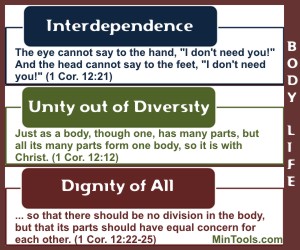
Think about the heart of God who designed the church to be interdependent, meaning that each person is needed and important (1 Cor. 12:18-27). Do you really think God made a mistake with you? How that perception must grieve Him!

Think about what’s being taught, the life-changing Word of God (2 Tim. 3:16-17). If you aren’t pouring yourself wholeheartedly into this ministry because you are just a teacher’s helper, will students receive the best learning experience they could? That potentially can hurt the spiritual growth of students.

Think about teachers without a their assistance trying to minister to more students than they can adequately attend to, having to sometimes zero in on individual issues or details that causes them to lose the attention of the remainder of the class. This can hurt their effectiveness.

How a Teacher’s Helper Benefits the Teaching-Learning Process

People who make good teacher’s helpers often have the spiritual gift of helps. They are used by God to assist in ways that free teachers up to focus their attention on actual teaching. Teacher’s helpers have a vital role in the teaching-learning process!

  • A teacher’s helper can better look around and observe what is going on in the classroom and prevent problems from occurring. To say you are just a teacher’s helper suggests that it would be better for a teacher to have to stop the lesson and discipline than help students understand God’s Word. Ouch! While disciplining can, and should, be turned into teachable moments, the clock ticks on when a teacher must stop to turn attention to an individual and risk losing attention of the whole.
  • These helpers often can identify individual students who need extra help in understanding the lesson. To say you are just a teacher’s helper suggests it wouldn’t matter if students remained confused, doubtful, or developing a mistruth about God’s Word because they didn’t receive clarification. Ouch!
  • A teacher’s helper can usually take time to hone in on individual needs and thus free up students to learn. To say you are just a teacher’s helper suggests it is better to ignore special needs or challenges students have that can distract them or hold them back from growing in grace and in the knowledge of God (2 Pet. 3:18). Ouch!
  • Helpers are able to form relationships with students in ways teachers often can’t because the teacher’s focus is on the big picture. To say you are just a teacher’s helper suggests that being able to show the love of God to individual students doesn’t matter. Ouch! Jesus Himself stressed the priority of love (Matt. 22:39-40; Jn. 15:9-13).

Teacher’s helpers are needed. They have a vital role in the teaching-learning process, helping students know and love God better. — You are not “just” a teacher’s helper.

Share:

Mentoring of Younger Fathers

Share:

In a previous post we looked at qualities an older man should possess in order to mentor younger men as suggested in Titus 2:2.

Older Men Mentoring Younger Fathers

Click to enlarge image on Pinterest & repin.

After an interlude of a few verses about older women mentoring younger women, it picks up with men again in verse 6 saying, “Similarly, encourage the young men to be self-controlled. In everything set them an example by doing what is good.”

What’s interesting is that women are to specifically be instructed in regard to their role as mothers and wives but the verse about men does not specify similar teaching for young men of their roles as husbands and fathers.  Perhaps the word “similarly” can encompass these areas.  While both young men and young women need to be taught self-control, Titus 2 adds additional qualities for women.

I would suggest that the reason Paul mentions only self-control for men is that it is such a major issue for young men that the majority of focus in a mentoring relationship needs to be geared toward reigning in their impulses.  If a young man is going to be a good husband and father, he needs to learn qualities that engender self-control.  Men who are not married or who do not have a family are not exempt.  They too need guidance in this area to be godly men.

Mentoring Young Fathers Toward Qualities Vital to Being Good Fathers

Consider the following qualities younger men need to be good fathers, loving their children as they should. Note how each of these qualities takes self-control.

Faithfulness

One of the best lessons fathers can pass on to their children is that of being a loving husband, faithful to their mother and the marriage relationship.  This requires learning self-control because every marriage will have its trials and temptations.

Affirmation

Men need to communicate worth to both their spouses and children.  Learning to be respectful is one of those qualities children desperately need to learn. Speaking respectfully and treating people with dignity when pushed to one’s limit takes self-control.

Teachable

Fathers, especially young fathers, will not always do things right.  More than a perfect parent, what children need is a father who can admit when he makes a mistake, who asks for forgiveness, and who is willing to learn.  To push through that manly pride takes self-control.

Honesty

A father who is a man of integrity, is a good example for his children.  When children see him lie or cheat, it gives them license to do the same.  To maintain consistency in such a level of honesty takes self-control.

Empathy

Children want parents who understand.  They will accept decisions and discipline they don’t like better when they at least feel understood.  Men don’t tend to be as feelings based or process-oriented.  They tend to want to just move on or fix it. If fathers are going to understand where a child is coming from or simply be there for the child, they need the self-control it takes for them to step back and let go of the need to control the situation.

Reliability

Kids need a father who keeps his promises to them.  When a father gets so busy he doesn’t spend the promised time with his children or misses yet another of the child’s soccer games, plays or concerts, it communicates that the child isn’t worth the father’s time. To always be there when he should is going to take self-control in saying no to other pressing demands of life.

Effectively mentoring young men to attain to the above qualities which require self-control would not only positively affect their own marriages and families but also society.

Read More: Mentoring as a Shepherding Ministry

Also Check Out: Men’s Ministry Resources

Share:

Mentoring by Older Men

Share:

Titus 2, often used for older women mentoring younger women, appears to also include older men mentoring younger men.

Older Men Mentoring Younger Men

Click to enlarge image on Pinterest & repin.
Verse 2 begins, “Teach the older men to be temperate, worthy of respect, self-controlled, and sound in faith, in love and in endurance.”

Then in verses 3-5 we have an interlude where it takes us to the mentoring role of older women with younger gals.

Verse 6 gets back to men — “Similarly, encourage the young men to be self-controlled. In everything set them an example by doing what is good.”

The first word in verse 6, similarly, continues the thought from verse 2.  God is not asking older women to mentor younger men similar to how they teach younger women.  Rather, older men are to mentor “similarly” to the way older women teach younger women.

As seen in the post, Mentoring by Older Women, mentoring isn’t just about passing on the “how-to” based on their life experiences but rather teaching qualities essential to godliness.  Just as we saw in those verses, similarly, men need to possess and pass on needed qualities younger men.  Guys need an example of what it takes, similarly to how younger women need a model.

Qualities Needed in Older Men to be Good Mentors

For an older man to be the kind of example that makes him a good mentor, he needs to demonstrate the following:

1)  He must be temperate.

Just as older women are to be taught to not be “addicted to much wine,” so older men are to be free from addictions as well.  How will he be an example of self-control, whether that be with alcohol, pornography, or any other kind of vice, if he himself is in bondage?  Mentoring requires time spent with another person.  While an older man might fool acquaintances, it will be difficult to hide the traits that lead to intemperance from those with whom he is closer and spends more time.

2)  He must have earned respect.

For a younger man to be inspired by the life of someone else and want to learn from that person, the person must be “worthy” of that respect. He must have proved himself by being honorable.  This is a man filled with integrity.

3)  He must exercise self-controlled.

Young men can easily let impulses govern them … sexual and otherwise.  To be taught self-control from someone who has himself learned to control those impulses, will go much further than sermons targeted at young men or books he can read on the subject.

4)  He must be sound in faith, love, and endurance.

If a young man is going to curb his natural desires, it is going to take more than a bunch of do’s and don’ts passed on to him.  He needs the legacy of faith, love, and endurance which will provide a higher motivation to be self-controlled.  He needs a reason to persevere.  A qualification for an older man being a mentor, therefore needs to be that the mentor himself is on solid ground in what he believes and where he places his trust.  He needs to be guided by the pure motivation of agape love.  And, he needs a constancy in this.

Proverbs 27:17 says, “As iron sharpens iron, so one person sharpens another.”  If the mentor is going to truly be able to sharpen the other person, he must have certain qualities … to be made of spiritual iron.

Questions to Ask for a Mentoring Ministry

If you have, or want to begin, a mentoring program at your church for men, we must ask the same questions we did for developing a women’s mentoring program.

– What criteria should be in a mentor?

Remember, more goes into mentoring than passing on life experiences so don’t make it about merely pairing up men based on who has been through similar life experiences or has similar interests. The mentor, according to Titus 2, should display certain qualities.  Think through how you will know when an older man is ready to be a mentor.

– How will you recruit mentors?

Not all older men are qualified to join in such an endeavor.  Think through how you present this opportunity to the older men of your church so you are not in an awkward position of turning some men away.

– What training should be required of mentors?

Some older men are already godly or “worthy of respect” so they might not need as much teaching but should still go through training to remind them of what mentoring is all about.  Think through what to include in that basic plan.

Older men who do not meet the criteria of Titus 2 probably will not drastically change as the result of a few training sessions. Bondages are usually not easily or quickly broken. Think through how to extend prolonged teaching, perhaps counseling or they themselves being mentored, to help them become more godly.

Read More:  Mentoring as a Shepherding Ministry

Also Check Out: Men’s Ministry Resources

Share:

Don’t Hijack Your Small Group

Share:

Perhaps you have a lot of needs or struggles in your life. You need someone to minister and speak into your life. Small groups, which are supposed to provide safe environments for sharing, seem like a good place to unload … right? To that I would need to answer both yes and no.

Small groups should be a place where you can open up and honestly share about your hardships. Yet, the word “group” suggests that it is intended to be about more than one person. A small group ministry provides one of the best places for a church to live out body life to its fullest.

Body Life - One AnothersClick on image to enlarge in Pinterest & repin.

For God to use the same word, allelon, over and over highlights His intent for our life together as believers to be mutual or reciprocal, not unidirectional.

Guidelines for Sharing So You Don’t Hijack Your Small Group

Here is what you need to remember when sharing your needs and struggles in a small group:

1) You are not the only one in the group with needs and struggles.

2) A small group is not a support group and even if it was a support group, the above, number one, still applies.

3) When group members share their struggles, it should be for the purpose of engaging in fellowship, not to “dump” on others.

4) Guard against setting expectations that others meet your needs. God is the ultimate source of comfort, peace, wisdom, and “everything we need for life and godliness” (2 Pet. 1:3), not people. God will use people, but you must never expect them to be your all in all.

5) Look for opportunities to minister to other group members rather than coming solely to have them minister to you. True healing and growth happen when we live within God’s intent. Sowing into someone else’s life has a way of putting our own needs into perspective.

If you’re a leader, don’t let your small group be hijacked.

Share:

Don’t Let Your Small Group Be Hijacked

Share:

I’ve been to small groups where the leader opened our time for sharing and praying for one another and the time focused on one person and his/her needs. While that may be appropriate at times, if it is always happening, especially if it is with the same person, the group is being hijacked.

These Groups Fail to Fulfill God’s Design

Of almost any setting in the church where God’s design for mutual, reciprocal ministry one toward the other can happen, it is in a small group.

Body Life - One AnothersClick on image to enlarge in Pinterest & repin.

If attention almost always goes unidirectional toward that one person, what you have is co-dependence rather than the interdependence.

Preventing the Small Group from Being Hijacked

Small group facilitators, or leaders, need to be trained in group dynamics to be prepared for possible takeovers and know how to redirect the focus before it is too late.

In addition, the purpose of small group ministry should always be kept before the group. This could be through teaching on God’s design for interdependence and the one another passages but also through modeling it.

You might need to communicate guidelines for being an “allelon” group on occasion, especially when you have newcomers.

Intentionally structure sharing and praying times to open the doors of opportunity for everyone to actively participate.

Work toward building an “allelon” culture within the group. When that happens, group members will so value this core quality that they too will work toward the prevention of a hijack. For example, when someone shows signs of a takeover, a member of the group might volunteer to meet one-on-one after group time rather than leaving it up to the group leader to determine how to handle it.

Hijacked Groups Need to be Rescued

If the small group has been hijacked you need to rescue it before irreparable harm comes to it such as the purpose for small group ministry getting lost and other members becoming frustrated, disillusioned, and possibly stop coming.

The rescue attempt should always be to protect everyone involved, not to violently take down the hijacker which invitably could lead to the person feeling embarrassed or rejected and possibly leaving the group.

To be sure, as in physical rescues, as much as you try to protect everyone, it does not always end well. You cannot control the person’s reactions. Yet, you must be able to stand before God and say that you made “every effort to do what leads to peace and to mutual edification” (Rom. 14:19; also see Eph. 4:3, Heb. 12:14). You must always “speak the truth with love” (Eph. 4:15) applying both grace and truth.

The next post will speak directly to the potential hijacker with truths they need to remember. You can share that post with your group as guidelines for group sharing. From time to time you might communicate these guidelines, in private, specifically with members who have a tendency to hijack your meetings. Encase the truths in gentleness, respect, and a humble and caring attitude.

More on Small Groups:

Shepherding Ministry Venue: Small Groups
Small Groups Resources

Share: