Developing Future Church Leaders: The Training Process

Share:

Once you commit to making the development of future church leaders a priority and have identified potential leaders, you need a process for training them. Consider making the following aspects of training a part of your strategy for developing future leaders.

Relational Aspect in Training for Future Church Leaders

One of the most effective ways of developing future leaders is to have a current leader come along side of them in a mentoring, discipleship, coaching, or apprenticeship type of relationship because it provides the following:

  1. observation of a role model
  2. interaction through asking questions and discussion
  3. support through feedback, encouragement and prayer both for and with one another

Think of Jesus’ example: His disciples spent three years observing Jesus and learning from Him. They were with Him nearly 24/7. Mark 3:14 tells us that “He appointed twelve that they might be with him and that he might send them out to preach.”

If we want to develop effective leaders, we need to be patient with the process and take the time to be with them not merely provide formal, academic instruction.

Academic Aspect in Training for Future Church Leaders

The basis for interaction with current leaders is what they observe in that leader but also what they learn academically about leadership. So, provide reading material and classroom instruction.

Think of Jesus’ example: In the process of the disciples being with Jesus, they received much instruction. Some was with the masses of people but often He would explain or expound on it with the disciples later.

This kind of mentoring set up, being discipled by someone 24/7, is unlikely to happen today. We therefore need to put intentional strategies in place to combine the relational and academic aspects.
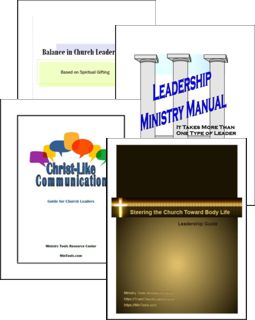
Leadership Training ResourcesIn addition to specific skills, make sure to provide a big picture perspective on church leadership. Help them see how the basics of life in Christ should govern how they lead.

Resources:

Applicational Aspect of Training for Future Church Leaders

True learning comes when we take what we have learned and observed and put it into practice. An effective training process must therefore also include hands-on experience.

Think of Jesus’ example: He not only spent time with His disciples, teaching them as they went along, but He also sent them out on assignments. When they returned, they had a time of debriefing with Jesus. (Mk. 3:14; 6:7-13; Lk. 10:1-20)

Give potential leaders small, yet significant and not petty, assignments that involve leadership opportunities. Gradually increase the level of responsibility. With those assignments should come some freedoms to take initiative and be creative. Micromanaging or holding a tight noose around them will not permit risk-taking and failures through which they can greatly learn. You will be able to provide honest feedback as you debrief them to help the person learn from the experience.

Seeing the potential leader in action can also provide an opportunity to confirm leadership gifting. The goal of leadership development training is not to turn someone into a leader who is not gifted or called to it but rather to fan it into flame in those who are (2 Tim. 1:6). Be careful, however, not to write someone off after a few failures. Look at Peter, one of Jesus’ disciples, who fumbled quite a bit and yet became one of the primary early church leaders. Stop and pray more about God’s desires for this person and to be honest if leadership does not appear to be the right fit. Help the person discern what might be a better fit.

Resource:

Personal Aspect of Training for Future Church Leaders

In a previous post we noted how heart qualities matter to the Lord, not merely leadership skills. These qualities are developed as a fruit of the Spirit’s work in our lives. Consequently, we must encourage the development and nurturing of a potential leader’s walk with God. God’s power, flowing out through us is what will make a difference. We can do all things “through Christ” who strengthens us (Phil. 4:13) which requires abiding in Him (Jn. 15:1-5). — “His divine power has given us everything we need for a godly life through our knowledge of him who called us by his own glory and goodness.” (2 Pet. 1:3)

Think of Jesus’ teaching: He said, “apart from me you can do nothing” (Jn. 15:5).

If a leader’s personal walk with the Lord is not part of your leadership development, you are short-circuiting the process. The Church needs leaders used by God to make a difference, not those who will merely maintain status quo or function like a secular leader.

Resource:
Share:

Developing Future Church Leaders: The Identification Process

Share:

We Merely Determine Who God, the Potter, Chooses
To develop future church leaders, we obviously need to know who has leadership potential. This post’s title purposely uses the phrase “identification process” because that’s what we’re to do. We identify those whom God desires to be in leadership. We shouldn’t be the ones determining who gets to be a leader and who doesn’t. God is the Potter (Rom. 9:20-21; Isa. 64:8), the One with the rights to form us for how He intends to use us.

Identifying Those with Heart Qualities to be a Leader, Not Merely Leadership Skill Potential

As seen in the example of Samuel anointing a king for Israel, God’s choice isn’t always whom we might choose. We tend to look at the external qualifications but God has different criteria.

But the LORD said to Samuel, “Do not consider his appearance or his height, for I have rejected him. The LORD does not look at the things people look at. People look at the outward appearance, but the LORD looks at the heart. (1 Sam. 16:7)

Leadership skills can be developed and honed but the heart is something quite different. People can externally look the part but the heart might not be right. Only God sees the heart and He weighs the motives of the heart (Prov. 16:2).

God’s wisdom far exceeds our ability to choose who should be leaders. Look at the twelve disciples Jesus chose — many unlearned fishermen.

Brothers and sisters, think of what you were when you were called. Not many of you were wise by human standards; not many were influential; not many were of noble birth. But God chose the foolish things of the world to shame the wise; God chose the weak things of the world to shame the strong. God chose the lowly things of this world and the despised things – and the things that are not – to nullify the things that are, so that no one may boast before him. (1 Cor. 1:26-29)

Identifying Those God has Empowered to be Leaders, Not Merely Those with Natural Leadership Abilities

God designed the Body of Christ to operate within the sphere of spiritual gifting. Spiritual gifts are God’s special divine empowerment for us to do ministry in His strength, not our own. God, through His Spirit, is the One who assigns our gifts (1 Cor. 12:4) so our task then is to identify those whom He has gifted for leadership.

Some people have personalities that lend themselves toward leadership, what we often hear referred to a naturally born leaders. Since God created our inmost being and knit us together in our mother’s womb (Ps. 139:13), we can only conclude that our personalities would have some part in how we serve. Yet, God would not have supernaturally gifted people to serve in certain ways if our natural abilities were enough.

Whether leading by gifting or personality, all must come under the control of the Spirit. We must be yielded to and pulling on God’s power, not our own, if we are going to bear spiritual fruit through our ministry efforts (Jn. 15:1-5). Hence, a person’s walk with God is critical to being an effective leader.

Identifying Those Whom God Has Chosen, not Merely Filling Positions

Just because a person appears to have a yielded heart that loves the Lord and has leadership gifting still doesn’t mean he/she is the person of God’s choosing for a particular leadership position. God’s choice of the prophet Jeremiah to be His spokesperson in that particular time and place provides us with a good example. God told the prophet Jeremiah, “Before I formed you in the womb I knew you, before you were born I set you apart; I appointed you as a prophet to the nations” (Jer. 1:5). In God’s omniscience and sovereignty, He knew who Jeremiah would be and that he was the right person for that specific mission.

But, how will we know those whom God has chosen? In addition to observing who fits within the first two points mentioned above, we must spend much time in prayer. Consider Jesus’ example in His selection of the twelve whom He would develop into future leaders of His Church.

… Jesus went out to a mountainside to pray, and spent the night praying to God. When morning came, he called his disciples to him and chose twelve of them, whom he also designated apostles … (Lk. 6:12-13)

Share:

Developing Future Church Leaders: The Priority

Share:

How many times have churches needed new elders or someone to fill some other leadership position only to find no one who seems qualified, ready, or willing?

The solution? Build within your church a culture in which leadership development is an ongoing priority. Identify and intentionally offer potential leaders opportunity to learn and grow and develop into godly leaders, ready to be used by God to make a difference when the time is right. Preparing people for leadership takes time, something fulfilling a last minute need does not afford.

Pragmatically, then, it only makes sense to make leadership development a priority, not optional. But, it’s also a biblical priority.

Precepts for Developing Future Leaders Suggest It Be a Priority

God’s Word commands the discipleship of people into fully devoted followers of Jesus Christ. While Matthew 28:18-20 goes broader than developing believers for specific roles within the Body, it does provide a basis for helping to develop and equip people that comes from the vestment of Jesus’ authority and requires His presence within the process.

Then Jesus came to them and said, “All authority in heaven and on earth has been given to me. Therefore go and make disciples of all nations, baptizing them in the name of the Father and of the Son and of the Holy Spirit, and teaching them to obey everything I have commanded you. And surely I am with you always, to the very end of the age.” (Matt. 28:18-20)

God takes discipleship beyond salvation and our walk with God. We are also to be preparing people for ministry. In Ephesians 4 we read that He provides the Church with those who have the responsibility of equipping “his people for works of service.”

So Christ himself gave the apostles, the prophets, the evangelists, the pastors and teachers, to equip his people for works of service, so that the body of Christ may be built up until we all reach unity in the faith and in the knowledge of the Son of God and become mature, attaining to the whole measure of the fullness of Christ. (Eph. 4:11-13)

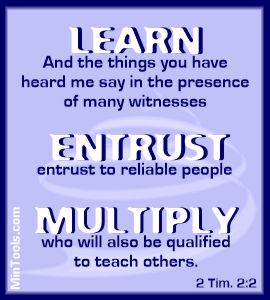
Developing Future Leaders is a Ministry of MultiplicationGod used the Apostle Paul to develop Timothy who was in turn to equip others. This multiplication process is an intentional effort that should carry on into what we do in the Church today.

And the things you have heard me say in the presence of many witnesses entrust to reliable people who will also be qualified to teach others. (2 Tim. 2:2)

More about the Development of Future Leaders

Be sure to learn more about developing future church leaders:

1) The Identification Process of Future Leaders Who Need to be Developed

2) The Training Process for Developing Future Leaders

3) The Biblical Precedence for Developing Future Leaders

Share:

Characteristics of an Effective Ministry Worker

Share:

We might hear a variety of responses if we were to ask the question, “What is the most important characteristic in an effective ministry worker?”.

Traits Found in Effective Ministry Workers

Possible suggestions could be:

Intentional: We need to know our purpose and make deliberate efforts to follow the process for getting there. Intentionality is important because people need to believe that where we’re going will make a difference in their lives.

Honest: We need to be authentic, transparent, real. Honesty is important because people need to sense that they can trust us.

Consistent: We need to practice what we preach, always be fair, and bring some sense of stability into this chaotic world. Consistency is important because people need to know that they can count on us.

Sensitive: We need to understand and accept that not everybody is at the same place in their walk nor do they have the same needs. Sensitivity is important because people need to feel that they matter to us.

The Most Important Characteristic in Ministry Workers

The importance of the above mentioned traits isn’t merely to make us more effective or make us look good to others. Rather, it’s the effect we have on the people we serve. The message these traits relay to the people we serve matters. If we aren’t connecting with people, all our smooth-running programs or eloquent words will lack the full impact they could have. So, the most important characteristic for ministry workers is  …

Love: We need to give of ourselves to others in ways let them see how devoted we are to them. That includes all of the above traits and more. Love matters because people need to know we truly care about them.

Love the Greatest Characteristic in Effective Ministry WorkersIf I speak in the tongues of men or of angels, but do not have love, I am only a resounding gong or a clanging cymbal. If I have the gift of prophecy and can fathom all mysteries and all knowledge, and if I have a faith that can move mountains, but do not have love, I am nothing. If I give all I possess to the poor and give over my body to hardship that I may boast, but do not have love, I gain nothing. (1 Cor. 13:1-3)

Share:

Perspective for When Ministry Doesn’t Go as Expected

Share:

In a previous post we considered possible reactions to when ministry goes wrong. Let’s be honest. We don’t always have the healthiest reactions. Proper reactions stem from maintaining a good perspective.

When ministry doesn’t go as expected, ask yourself questions like the following and reflect on God’s Word:

Whose ministry is it?

You are still worldly. For since there is jealousy and quarreling among you, are you not worldly? Are you not acting like mere humans? For when one says, “I follow Paul,” and another, “I follow Apollos,” are you not mere human beings? What, after all, is Apollos? And what is Paul? Only servants, through whom you came to believe – as the Lord has assigned to each his task. I planted the seed, Apollos watered it, but God has been making it grow. So neither the one who plants nor the one who waters is anything, but only God, who makes things grow. (1 Cor. 3:3-7)

To whom am I responsible?

Nothing in all creation is hidden from God’s sight. Everything is uncovered and laid bare before the eyes of him to whom we must give account. (Heb. 4:13)

To whom are others responsible?

So then, each of us will give an account of ourselves to God. Therefore let us stop passing judgment on one another.  (Rom. 14:12-13a)

Having the Right Perspective Matters

When you have the right perspective going into ministry, you will know what to do. — You will faithfully do your part and trust God with the results. You might help others do their part by providing on-going training, equipping, or mentoring. But, you will recognize their responsibility before God as well and trust Him to keep working in and through them.

Ministry will not always go as expected. Then what? Do you have the kind of perspective that will enable you to be faithful in doing your part and then react properly both about yourself and toward others no matter what happens? Think about it!

40 Day Challenge to Maintain Perspective When Ministry Doesn't Go as Expected
If you struggle with perspective, check out the 40 Day Challenge to Help You Maintain a Healthy Perspective. Go even deeper with the Foundational Pillars of Truth Discussion Guides.

Share:

Your Reaction When Ministry Doesn’t Go as Expected

Share:

Sometimes ministry doesn’t go as expected. Then what?

Paper Cup Exercise for Reaction to Ministry Gone WrongSuppose you were given you a paper cup and asked to do something with it to represent your typical reaction when ministry goes wrong, or not as expected.

What would you do with the cup?

  • Would you squash it to represent feeling deflated, like you see it as a failure?
  • Perhaps you’d rip the sides down like beams from the sun to represent looking only at the bright side rather than the negatives.
  • Maybe you’d poke holes through the sides and bottom of the cup to look like a sieve, meaning that you let things pass right through you, not thinking much about it or letting it affect you.
  • Would you want to throw the cup as hard as you could at someone else?
  • Or, would you cut around the bottom so it flipped up like a lid, signifying your desire to peer inside to see what you can learn from the situation?

Types of Reactions to Ministry Not Going as Expected

Basically, however you would shape the cup, it would depict one of the following reactions:

a pessimistic reaction

an optimistic reaction

an apathetic reaction

a projected reaction

a realistic reaction

(Click on a link above for thoughts on that reaction.)

How Would God Want Us to React?

As humans, we tend to have default reactions to when things go wrong. As we lean into God’s power and grace, our natural tendencies come more and more under His control. Our reactions then become more realistically in line with God’s character and ways. We will still acknowledge that the “cup” is the cup (something gone wrong). We will, however, tend to find ourselves peering inside to see what God has for us for “we know that in all things God works for the good of those who love him, who have been called according to his purpose” (Rom. 8:28).

The next post provides some questions we can ask to regain perspective when ministry doesn’t go as expected.

Share: