God’s Word & Prayer Go Hand in Hand

Share:

We find verses in the Bible which reference both God’s Word and prayer. Certainly there must be a connection between the two.

prayer-WordTake the helmet of salvation and the sword of the Spirit, which is the word of God. And pray in the Spirit on all occasions with all kinds of prayers and requests. With this in mind, be alert and always keep on praying for all the Lord’s people. (Eph. 6:17-18)

If anyone turns a deaf ear to my instruction, even their prayers are detestable. (Prov. 28:9)

The Connection Between The Word and Praying

God speaks to us through His Word (2 Tim. 3:16-17) and through prayer we respond to Him which results in true communion (Ps. 145:18; Jn. 15:7).

God’s Word enables us to pray in keeping with God’s will. How will we know what His will is unless we are in His Word? (John 14:13–14, 1 John 5:14-15)

Scripture shows us our sinfulness so we can confess it (1 Jn. 1:9) and helps prevent us from sinning (Ps. 119:11) so we are able to keep in fellowship with the Lord which involves talking with Him in prayer (Ps. 66:18).

How to Personalize This Truth About God’s Word and Prayer

Do you lack focus in prayer? – Turn what you read in the Word into prayer.

Are you unsure of how to pray? – Look at the examples of praying in the Bible.

Do you lack confidence in praying? – Hold forth the promises found in God’s Word as you pray. (Ps. 119:58, 82, 116, 154, 170; Heb. 4:16)

Do you have a hard time studying or understanding God’s Word? – Ask God for help (James 1:5).

God’s Word and Prayer Go Hand in Hand!

For More, Go To:

If You’re a Church Leader, Go To:

Share:

Exhortation Versus Criticism

Share:

Recently I was looking at the website stats and saw that someone found the site when searching the question, “What is the difference between exhortation and criticism?” I would suppose this site came up in the search results due to the training on the spiritual gift of exhortation. Nonetheless, it got me to thinking about it.

What’s the Difference Between Exhortation and Criticism

Exhortation is about Encouraging and Building Each Other Up Which Doesn't Usually Happen with Criticism

  • Exhortation is a spiritual gift God has given some people to serve. (Rom. 12:8)
  • Criticism is not a spiritual gift.
  • Exhortation is a command all believers are to engage in with one another. (1 Thess. 5:11; Heb. 3:13)
  • Criticism is not commanded.

That pretty well sums it up.

Is Being Critical of Others Ever Right?

Obviously we are not to ignore the wrongdoings or mistakes of others. Sometimes it would help for them to know what they are doing wrong, not just what they are doing right. The Bible does indeed tell us to speak the truth but in that same verse we are instructed to do so “in love” (Eph. 4:15). 2 Timothy 2:24-25a says, “The Lord’s bond-servant must not be quarrelsome, but be kind to all, able to teach, patient when wronged, with gentleness correcting those who are in opposition.” We must never lay aside the qualities of love (1 Cor. 13:4-7) when confronting someone about the error of their ways.

We must always consider our motivations as well as the way we approach someone. That is what truly makes the difference between exhortation and criticism.

  1. Exhortation builds up whereas criticism often tears down. (Eph. 4:29)
  1. Exhortation comes from a standpoint of coming alongside of the person (paraklesis) whereas criticism usually comes from an aloof or superior position.
  1. Exhortation tends to bring hope and encouragement whereas criticism tends to lead to despair and discouragement. (1 Thess. 4:18; 2 Pet. 3:3-4)
  1. Exhortation helps people become what God wants them to be whereas criticism tends to emphasize what people should not be. (Heb. 10:24)
  1. Exhortation is built upon caring concern whereas criticism stems from judgmentalism and disapproval. (Matt. 7:1-5; Col. 3:13; Gal. 6:1)
  1. Exhortation should lead to conviction whereas criticism can bring condemnation. (Heb. 3:13)

So, the next question is:  Why criticize when exhortation is so much more effective?

Share:

Are You For or Against?

Share:

Seek Peace Not Winning a DebateOn occasion I will get a contact in which I can tell the person is trying to force an issue, start a debate, or coerce me into taking a side … all the while making it clear they are right and everyone else is wrong. And, they may indeed be right in some cases but their approach leaves me cringing. Where is the love of Christ in this kind of divisive approach? What about verses like Ephesians 4:2-3? — Be completely humble and gentle; be patient, bearing with one another in love. Make every effort to keep the unity of the Spirit through the bond of peace.

Is it little wonder so many in the world around us look at Christians as intolerant, as people who stand against so much?

Where to Put the Focus

Here are some suggestions:

Let’s focus on what we stand for, not what we stand against.

Let’s focus on what we have in common, not our differences.

Let’s focus on what we can agree on, not our disagreements.

Let’s focus on the real enemy, not one another.

What to Do When We Feel We Must Take a Stand Against Something

For where we are different, disagree, and have to respond by taking a stand, let’s do the following:

Let’s still show the love of Christ rather than hostility.

Let’s learn from one another rather than totally dismiss the person.

It is possible to gain favor without compromising truth. It’s not about rolling over on doctrinal beliefs or moral issues. Notice that I wrote, “Let’s FOCUS on” what we have in common and can agree on. “Let’s FOCUS on” what we stand FOR, not what we stand against. When we FOCUS on something, that gets most of our attention but it does not mean we ignore everything else.

We can’t turn a blind eye for we are “the church of the living God, the pillar and foundation of the truth” (1 Tim. 3:15). God exhorts us to “Stand firm then, with the belt of truth buckled around your waist” (Eph. 6:14).

Remember, We’re All Personally Accountable

Convictions are good but we will all stand before God for what we believe and what we do with that belief, not for someone else’s personal convictions. Know what you stand FOR and stand for it in ways that respect others as God’s Word clearly instructs us.

  • Speak the truth in love. (Eph. 4:15)
  • Always pursue peace not the need to be right. (Eph. 4:3; James 3:17; 1 Pet. 3:8-12)
  • Be ready to defend and give an account of what you believe to anyone who asks, yet with gentleness and respect. (1 Pet. 3:15)
  • Correct an erring brother with gentleness and respect. (Gal. 6:1-5)
  • Be kind, as the Lord’s servant, not quarrelsome. (2 Tim. 2:24)
  • Show care for one another rather than divide. (1 Cor. 12:26)
Share:

Did GOD Lay It on Your Heart … or Was It … ?

Share:

When we talk about God laying something on our hearts, I think of Ezra 1:5. God moved, or stirred, the hearts of some of the exiled Jews to go back to Jerusalem to rebuild the house of the Lord. The ones who went had some sort of inward compulsion or prompting from God in their spirits to go. In a previous post we pulled out some principles about serving from that verse. An observation was made in a comment about how some Christians claim God laid something on their hearts but then “do an about face.” How do we know if it was God who laid it on our hearts or something else?

Overused Christian Jargon

I do agree that the use of the phrase “God laid it on my heart …” can be overused and even misused. It can get confusing when people insist on God’s moving and then don’t follow through or if they do but things go obviously wrong. Let’s remember that God is not a God of confusion (1 Cor. 14:33).

We, as Christians, need to be careful of the words we use. We also need to be careful with being so emphatic in how we express ourselves that it paints us into a corner of having to justify ourselves, and even worse, trying to justify God, like He is to blame.

Sometimes Misused Christian Jargon

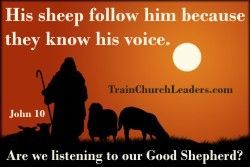
Sheep Know His VoiceTo be sure, there is a very real sense in which God, through His Spirit, moves or stirs our hearts. Think of Jesus’ words in John 10:4-5 — “His sheep follow him because they know his voice. But they will never follow a stranger; in fact, they will run away from him because they do not recognize a stranger’s voice.”

Yet, sometimes when we Christians say “God has laid it on my heart to ….”, we would be better saying the following:

This is what I feel comfortable doing.

This is what I want to do.

This is what I think I should do.

This is what I feel like I am expected to do.

These words, “God laid it on my heart,” could more so reflect our personalities, our own will, feelings, desires, or thought processes. Sometimes they might even stem from the culture of the church or ministry of which we are a part.

We might have good intentions and be sincere but the influence of self and others can be ever so subtle that we think it is of God but isn’t.  We will be more likely to get it right when we realize the influence God’s Word must have that supersedes the pull of ourselves or others.

A Connection Between God Laying Something on Our Hearts & His Written Word:

  1. God will never contradict His Word. If what you think God has laid on your heart doesn’t line up with God’s Word, He is not the source of what you want to do. It must be consistent with the commands and principles found in the Bible as well as the character and ways of God as described in His Word (2 Tim. 2:13).
  1. If we are not regularly spending time with God in His Word, we better not trust our perceptions of what we think He has laid on our hearts. Jesus said His sheep know His voice so well that they can differentiate His voice from others (Jn. 10:4-5). How are we going to get to know His voice above all, including our own, if we do not spend time with Him in His Word?
  1. Discernment comes through the “constant use” of God’s Word, chewing on the meat of what we read (Heb. 5:14). A casual and inconsistent approach to God’s Word that stays on the surface will not bring the spiritual maturity needed to differentiate between what He has laid on our hearts and what our own feelings, desires, or thought processes dictate.
Share:

Our Greatest Purpose in Life Made Clear by Jesus

Share:

When responding to a question about the greatest commandment, Jesus gave a two-fold response. First and greatest, “Love the Lord your God with all your heart and with all your soul and with all your mind” (Matt. 22:37-38). Second, “Love your neighbor as yourself” (Matt. 22:39). What greater purpose could we have in life than fulfilling the greatest commandments, especially since “all the Law and the Prophets hang on these two commandments” (Matt. 22:40).

Church Purpose

Click to enlarge image on Pinterest & repin.

Understanding Our Greatest Purpose in Life as Jesus Explained in Matthew 22:36-40

If we break down the words of Matthew 22:37-40, we come to understand that these commandments should consume our hearts and minds as well as what we do with our time. All we do should be measured against the fulfillment of these commandments. Surely we have no greater purpose in life than to love the Lord and love others.

  • “Jesus replied”

Our greatest purpose in life isn’t a mere human sentiment but comes with divine authority.

  • “Love (agape) the Lord your God . . . Love (agape) your neighbor . . .” (agape = divine love … the highest form of love)

Our greatest purpose in life, love for God and love for people, isn’t natural but rather something supernatural.

  • “Love the Lord your God with all your heart and with all your soul and with all your mind.”

Our greatest purpose in life isn’t a sporadic or half-hearted endeavor but rather all-consuming, putting all of who we are completely into loving Him.

  • “Love your neighbor as yourself.”

Our greatest purpose in life isn’t unidirectional but rather multi-faceted in first and foremost loving God but also then ourselves and others.

  • “This is the first … commandment. And the second is like it …”

Our greatest purpose in life isn’t a low priority but rather the top, chief priority in terms of time, place, and rank.

  • “This is the … greatest commandment …”

Our greatest purpose in life isn’t insignificant but rather measures beyond any other command … the “mega” commandment.

  • “commandment”

Our greatest purpose in life isn’t an option but rather a matter of obedience.

  • “All the Law and the Prophets hang on these two commandments.”

Our greatest purpose in life isn’t a sub-point but is at the top as the main point with everything else coming under it.

All of these truths take the command to love God and love people to a higher level than anything else in life. Nothing can be more important. Nothing should ever take its place. Nothing can be a greater purpose in life than to love the Lord and love others.

Consequently, helping the Body fulfill these priorities should be an active pursuit of church leaders. The Steering the Church Toward God’s Purposes Leadership Guide includes the content in this post and also poses a question under each of the above points to help leaders reflect on how their practices align with the Greatest Commandments.

Share:

Encouragement Needed: Why

Share:

Encourage One Another to be the Light of the WorldWe live in a dark world where we can easily get lulled to sleep spiritually and come under the control of negative influences. The Day of the Lord will come but during the interim God calls His people to live as lights in this dark world.

You are the light of the world. A city on a hill cannot be hidden. Neither do people light a lamp and put it under a bowl. Instead they put it on its stand, and it gives light to everyone in the house. In the same way, let your light shine before men, that they may see your good deeds and praise your Father in heaven. (Matt. 5:14-16)

We Need Encouragement to Remain Alert

Rather than become lulled to sleep spiritually, we need to remain alert (1 Thess. 5:6). But, we need encouragement to counteract natural tendencies that tend to cover over our light rather than fuel it to keep it brightly shining.

Sometimes we sleep because or tiredness. Doing good in a dark world can be exhausting and we don’t always see results.

Let’s keep our eyes open and on Jesus “who for the joy set before him endured the cross” (Heb. 12:2). Encouragement comes in knowing a better day lies ahead. We don’t have to “become weary in doing good, for at the proper time we will reap a harvest if we do not give up.”(Gal. 6:9). Looking at the big picture, we can conclude that all efforts and hardships will be worth it in the end.

Sometimes we sleep because of depression. If we focus on the circumstances around us, we will lack peace and joy. Escaping from it all will seem like a viable option.

Let’s remember Jesus’ words: “In this world you will have trouble. But take heart! I have overcome the world.” (Jn. 16:33) We find encouragement in knowing that in Jesus we can rise above the dreariness and apathy of this dark world. Looking at the real picture, we can conclude that life will not be easy but we will be okay in the end.

Sometimes we sleep because of illness. When we become like the dark world, we will want to sleep “for those who sleep, sleep at night” (1 Thess. 5:7). Living in sin and fellowshipping with the world rather than the Lord robs us of the power we need to stay awake.

Let’s understand the effects of sin on a holy God but also remember that we have a gracious God who offers a way to become healthy again. “If we confess our sins, he is faithful and just and will forgive us our sins and purify us from all unrighteousness.” (1 Jn. 1:9) We can be encouraged knowing that though we are faithless, He remains faithful (2 Tim. 2:13). Looking at the whole picture, we can conclude that change is possible.

We Need to be Encouraged to Remain Self-Controlled

Rather than come under the control of negative influences, we need to be self-controlled. We need encouragement to help us say no to the lures of this world in order to remain free from its intoxicants that dim our lights.

The Apostle Paul likens it to drunkenness, stating that “those who get drunk, get drunk at night” (1 Thess. 5:7). Here’s what happens when we come under the negative influences of a dark world.

1) We lose our ability to think sharply. Consequently, we fail to interpret life properly. We lack discernment which can lead to a host of problems.

Instead, be encouraged because we don’t have to be conformed “to the pattern of this world.” Rather, be “transformed by the renewing of your mind. Then you will be able to test and approve what God’s will is–his good, pleasing and perfect will” (Rom. 12:2).

2) We lose our inhibitions. Consequently, we can slip back to our old human nature, acting like who we were before accepting Christ into our lives. We let our guard down which can lead to a hindered testimony.

Instead, be encouraged because we don’t have to remain in this wretched condition, not doing the good we know we should be doing. Rather, we can find deliverance in Jesus (Rom. 7:15-25) and live by the Spirit rather than “gratify the desires of the sinful nature” (Gal. 5:16-25).

To be that light in a dark world that reflects and glorifies our Lord we need to remain alert and self-controlled. The Apostle Paul’s solution? – “Therefore encourage one another and build each other up.” (1 Thess. 5:11)

In this post we looked at “why” we need encouragement. Other posts look at “who” needs encouragement and “how” to be encouraging.

Share: