God’s Word & Prayer Go Hand in Hand

Share:

We find verses in the Bible which reference both God’s Word and prayer. Certainly there must be a connection between the two.

prayer-WordTake the helmet of salvation and the sword of the Spirit, which is the word of God. And pray in the Spirit on all occasions with all kinds of prayers and requests. With this in mind, be alert and always keep on praying for all the Lord’s people. (Eph. 6:17-18)

If anyone turns a deaf ear to my instruction, even their prayers are detestable. (Prov. 28:9)

The Connection Between The Word and Praying

God speaks to us through His Word (2 Tim. 3:16-17) and through prayer we respond to Him which results in true communion (Ps. 145:18; Jn. 15:7).

God’s Word enables us to pray in keeping with God’s will. How will we know what His will is unless we are in His Word? (John 14:13–14, 1 John 5:14-15)

Scripture shows us our sinfulness so we can confess it (1 Jn. 1:9) and helps prevent us from sinning (Ps. 119:11) so we are able to keep in fellowship with the Lord which involves talking with Him in prayer (Ps. 66:18).

How to Personalize This Truth About God’s Word and Prayer

Do you lack focus in prayer? – Turn what you read in the Word into prayer.

Are you unsure of how to pray? – Look at the examples of praying in the Bible.

Do you lack confidence in praying? – Hold forth the promises found in God’s Word as you pray. (Ps. 119:58, 82, 116, 154, 170; Heb. 4:16)

Do you have a hard time studying or understanding God’s Word? – Ask God for help (James 1:5).

God’s Word and Prayer Go Hand in Hand!

For More, Go To:

If You’re a Church Leader, Go To:

Share:

Want to Be More Discerning? – Get Into the Word

Share:

God's Word Needed to be Discerning
People who rarely get into the Word tend to be rather shallow in their understanding of God and His ways.  Consequently, they are not quick to use Him as the standard in making decisions.  Their own experience or feelings often form the basis for interpreting life because that is what they know.

The Need for Getting into God’s Word to be Discerning

Biblically illiterate and anemic Christians have little base for making sound judgments, for being discerning.

In the first post of this series, you were told to look to God if you want to be more discerning.

Where are you going to learn about God? — from His Word

In the second post, you were told to start from the inside out if you want to be more discerning.

What does God use to test our hearts and minds? — His Word “for the word of God is living and active. Sharper than any double-edged sword, it penetrates even to dividing soul and spirit, joints and marrow; it judges the thoughts and attitudes of the heart” (Heb. 4:12).

In the third post, you were told to learn to love more.

If you want to learn to love, you have to get to know the God of the Bible.  The Word is God’s love story.

Discernment and Training Through God’s Word Go Hand in Hand

Perhaps you want to get into God’s Word but find it too hard.  I’m not going to try to convince you that it is easy.  But, if you want to be more discerning, which is essential to living wisely in today’s world, you must get into God’s Word.  If this process was going to be easy, Hebrews 5:14 wouldn’t refer to it as training. — But solid food is for the mature, who by constant use have trained themselves to distinguish good from evil.   (Heb. 5:14)

1)  Training takes hard work, often sacrifice.

2)  Training requires devotion, a commitment.

3)  Training demands consistency (“constant use”).

Think about people who follow a training regime.  In the beginning it is very hard.  In time, if they persevere, though it is still work, it seems easier and often more enjoyable.  In the end it is worth it.

If you are not feeding on the Word, you are feeding on the world.  That will only lead to poor, unhealthy, and harmful choices.  What in reality is evil will look good because you will not have by constant feeding on the meat of God’s Word trained yourself to distinguish good from evil.

Here’s a Helpful Resource: New to Bible Reading Discipleship Tool

Share:

God’s Word: Power for Ministry

Share:

Psalm 119 - Power of God's Word Psalm 119 has long been a strategic chapter of the Bible for me because it is packed with so much truth about the Word, showing its power for us. If we skim through this psalm for descriptive words about Scripture, we’ll find implications for ministry. Another post will show how a list on benefits of the Word seen in this psalm.


Descriptive Words about Scripture in Psalm 119 Show Its Power for Ministry

testimony (shows His ways and wonders) – God’s Word is a record of who God is and what He does.

Ministry Workers: Are you pointing people to the God behind all the wonderful Bible stories?  God is the power source behind the parting of the Red Sea, not Moses.  God is the power source behind the slaying of Goliath, not David.  Etc.

law, precepts, statutes, commandments, judgments, ordinances, truth – God’s Word is a rule for life, a standard to live by.

Ministry Workers: Are you remembering that you will be accountable for following God’s ways as recorded in Scripture?  We measure what we do against His Word, not our own or other people’s opinions.

truth, righteous, good, faithful, settled in heaven forever, upright, very pure, everlasting – God’s Word is a reliable resource.

Ministry Workers: Are you lining up what you do with God’s Word rather than the ways of the world or your own thinking?  In the final analysis, only God’s Word is trustworthy, consistent, and constant.

Responding to God’s Powerful Word

With an understanding of what God’s Word is, may our prayer be:

Open my eyes, that I may behold wonderful things from Your law.  (Ps. 119:18)

Make me understand the way of Your precepts, so I will meditate on Your wonders. (Ps. 119:27)

Establish Your word to Your servant, as that which produces reverence for You.  (Ps. 119:38)

And, may our reaction be:

Your testimonies are wonderful; Therefore my soul observes them.  (Ps. 119:129)

More for Church Leaders:  God’s Power for the Church – The Word of God

Share:

Our Beliefs About the Bible Have Implications

Share:

What we believe about the Bible, specifically about its authority and main focus, has implications. As we will see, it affects our personal relationship with the Lord and also has implications for the way we serve.

Our Beliefs about the Bible Affect our Relationship with God

The following issues will affect the kind of relationship we have with God.

The Authority of the Bible – Can the Bible be trusted?

If the Bible truly is inspired by God and can be trusted, then we should find ourselves believing what it says, obeying its precepts, and following the principles laid out in it.

If we think the Bible is not completely God’s Word and cannot be fully trusted, then we have the option of following what it says and can pick and choose what to believe.

Focus & Theme of the Bible – What is the Bible about?

If we think the Bible is a religious book about man’s efforts to reconcile with God, then we will tend to take a more legalistic approach and depend more on ourselves than on Him.  Life will be more centered around us and our accomplishments.

If we see the Bible as a love story about God’s efforts to reach man, then we will better understand grace and trust Him to work for our good even when we don’t understand life’s circumstances.  Life will be centered more around God and His purposes.

What We Believe about the Word Has Implications for Ministry

These same issues will affect the way we serve in our various ministries and how we help other people find God.

The Authority of the Bible – Can the Bible be trusted?

Those sold out to the authority of the Bible have a standard that is reliable and that must be used as a filter in all decisions.  Otherwise, ministry can quickly become everybody doing what is right in their own eyes which can only lead to inconsistencies and ineffectiveness.

Focus & Theme of the Bible – What is the Bible about?

Those seeing the focus of the Bible as God’s working will tend to get beyond the stories and commands to the God of Scripture who is the source and sustainer of life and the Savior of the world. Otherwise ministry could become about helping people to simply know what the Bible says and to follow a bunch of rules and regulations.  We will have religion over relationship.

What Bible Teachers Need to Know About the Bible - Finding God

Click Below to Learn About a Worksheet for Bible Teachers:

What Bible Teachers Need to Know About God’s Word To Help Students Find God in the Scriptures

Share:

Ways for Adults to Memorize Scripture

Share:

In a previous post giving a personal testimony about Scripture Memorization I wrote that I would give some ideas for how adults can memorize Scripture.  Here’s a list of some ideas.  You should be able to find something that fits you … your learning style, personality, etc.  Incorporating variety into the way you memorize Bible verses should help keep it from getting boring, from being mere routine.

Ideas to Help Adults Memorize Scripture Verses

  1. Use a Scripture memory system like the Navigators’ Topical Memory System or  The MacArthur Scripture Memory System.  (links will take you affiliate store)
  1. Use music.  There are plenty of Scripture memory songs for children out there. (The link will take you to our affiliate store.)  Although designed for children, this music could be an easy way for us adults to learn as well.  Scripture Release offers some free downloads of songs based on Scripture verses that are geared more for adults. Get creative and make up your own song using a Scripture verse for the lyrics.
  1. Get some how-to books used for children’s ministry and make it fun for yourself using some of the game ideas suggested in them.  One book in our affiliate store is 52 Ways to Teach Memory Verses.  Who said adults can’t memorize verses using games and other activities?
  1. Find an app for Scripture memorization for your phone or computer.
  1. Put some rhythm into it.  Say it with emphasis on different words or syllables, clapping or tapping to each word, etc.
  1. Make symbols or draw pictures to represent words or phrases, either literally on paper or with mental images.  Use these images to guide you through recall of the verse.

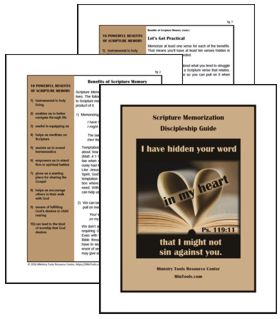
Scripture Memorization Discipleship Guide includes Means of Memorizing
You’ll find eight more ways to memorize God’s Word in the Scripture Memorization Discipleship Guide. This resource also explores ten benefits of memorizing Scripture, as well as some tips, and also help making it age appropriate.

Share:

Scripture Memorization: A Personal Testimony

Share:

Scripture Memorization Discipleship Guide
If you grew up going to church and/or Bible clubs, you’ve undoubtedly had some experiences with Scripture memorization. Following is my personal testimony of memorizing Scripture. It’s included in the Scripture Memorization Discipleship Guide along with some tips for memorizing Gods Word. That resource also explores benefits and means of Scripture memory.

The Experiences I Had with Memorizing Scripture

I remember the Scripture memory contests in Sunday School when I was a child.  I recall many times cramming right before class so I could go in, say the verse, and get the prize.  That’s as far as my memory goes on those verses.  I also remember times when teachers were more creative in their approach and made it fun to learn the verses.  We did it together, in class, sometimes for prizes but often not.  Those are the verses I still remember.

Consequently when I began teaching children’s classes, and writing lesson plans incorporating Scripture memorization, like Children Learn to Worship using Psalm 100, I wanted to do it in ways that built positive attitudes toward memorizing Bible verses.

Ten helpful principles for teachers to do that are in the Effective Scripture Memorization Worksheet.

As I grew older physically into adulthood but also spiritually, I began to memorize verses that related to my life situations, sort of as a spiritual discipline, but more because I simply wanted to know them.  I memorized for the intrinsic value of it, not for some extrinsic reward.  What a difference!

The Means I Have Used to Memorize Verses

I have found that variety works best for me.  And I like to have fun doing it.  Why can’t memorizing Scripture be fun?  I do believe the best way to memorize Scripture is to do what fits you … your learning style, your personality, etc.  I’ll give some ideas in another post for how adults can memorize Scripture.

But, let me say that what helps me the most, and what I believe we all need to do, is to understand the meaning of the passage and not merely memorize the words. And, of course, much repetition and review has also been necessary.

Share: