Pastors are Also Sheep, Not the Chief Shepherd

Share:

Training Category: Shepherding Ministry
Pastors not the Chief Shepherd

Sometimes in the Church we elevate pastors and other leaders, above everyone else. Is that biblical? Two points must be considered:

  1. Pastors are also sheep, members of the body, with responsibilities different from the rest of the sheep.
  1. Pastors are not the Chief Shepherd so we must be careful of placing them on a pedestal.

Implications of Pastors Also Being Sheep and Not the Chief Shepherd

Since pastors are not the head of the body, pastors must be careful of using phrases like “my church” when talking about the church. It is not their church. The sheep are not their flock. All belongs to the Chief Shepherd — Jesus Christ (1 Pet. 5:4), who is the Head of the Church (Eph. 1:22; 4:15). Pastors and elders are to function as His assistants. Scripture designates only one Person to be the Head of the church, Jesus Christ.

Churches through the ages have divided because people have taken possession of that which only belongs to Christ. The church of Corinth was called worldly because of such attitudes (1 Cor. 3:1-11). Hierarchical structures find their origin in the world, not in God’s design for the Body. Remember that Jesus Himself said “You know that those who are regarded as rulers of the Gentiles lord it over them, and their high officials exercise authority over them. Not so with you. Instead, whoever wants to become great among you must be your servant, and whoever wants to be first must be slave of all. For even the Son of Man did not come to be served, but to serve, and to give his life as a ransom for many” (Matt. 20:25-28).

This does not mean the church is devoid of organization. Nor does it mean that the church shouldn’t have people with the responsibility of leading. Effective functioning requires knowing who is responsible for the accomplishment of various tasks. People need to be held accountable for doing their part. Organization and leaders, however, are there to serve and not to control. Power corrupts. Serving brings life.

(The above paragraphs are taken from the Shepherding Ministry Manual where it looks as pastoring as one of many venues in the Church where shepherding can take place.)

With all this in mind, let’s remember that we are to acknowledge and honor pastors for the work they do, holding them in high regard (1 Tim. 5:17; 1 Thess. 5:12-13 ). But that is different from setting them above everyone else in the Body like they’re the spiritual elite. God says, “On the contrary, those parts of the body that seem to be weaker are indispensable, and the parts that we think are less honorable we treat with special honor” (1 Cor. 12:32-33). From Christ “the whole body, joined and held together by EVERY supporting ligament, grows and builds itself up in love, as each part does its work” (Eph. 4:16). Everybody matters! Everybody has a part!

For more understanding of what the Bible says about pastors, go to: Shepherding Ministry Venue: Pastors
Share:

3 Things People Want from Their Church Leaders

Share:

Sometimes people put unrealistic expectations on their church leaders. Here, however, are three things people want that have some biblical merit.

What do people want from their Church Leaders?

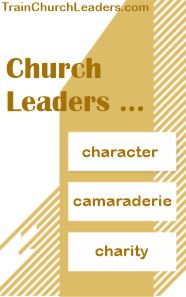
3 Things People Want from Their Church Leaders1) People want church leaders with character marked by integrity and authenticity.

People have seen enough moral failing and political compromising in those who are supposed to be looking out for their welfare that authentic church leaders with integrity truly stand out. Leadership skills still matter, but people tend to want true servants of the Lord, not those who enjoy the limelight and desire power and control. They want leaders who aren’t hypocritical, saying one thing and doing another. They want leaders who really care and aren’t merely pursuing selfish ambition.

Let’s remember that God has always looked at the heart.

The LORD does not look at the things people look at. People look at the outward appearance, but the LORD looks at the heart. (1 Sam. 16:7)

2) People want church leaders with whom they can sense a camaraderie.

People have seen enough divisiveness in the world. They want leaders who are team-oriented rather than lone rangers out to accomplish their own agendas. They want leaders who promote true unity in the Church and who truly value the input and contribution of others.

Let’s remember that God designed the church to be interdependent.

Just as a body, though one, has many parts, but all its many parts form one body, so it is with Christ. … Even so the body is not made up of one part but of many. … so that there should be no division in the body, but that its parts should have equal concern for each other. … Now you are the body of Christ, and each one of you is a part of it. (1 Cor. 12:12-27)

From him the whole body, joined and held together by every supporting ligament, grows and builds itself up in love, as each part does its work. (Eph. 4:16)

Submit to one another out of reverence for Christ. (Eph. 5:21)

3) People want charity in their church leaders.

People don’t want to feel condemned when they attend a church. They want church leaders to be agents of God’s grace not merely dispensers of truth or justice. To be sure, some people don’t really want to hear truth but they will tend to more readily accept it from leaders they feel truly care about them and speak the truth in love.

Let’s remember that Jesus came full of both grace AND truth. He exhibited that in how He responded to the Samaritan woman caught in sin.

For the law was given through Moses; grace and truth came through Jesus Christ. (Jn. 1:17)

… Jesus straightened up and asked her, “Woman, where are they? Has no one condemned you?” “No one, sir,” she said. “Then neither do I condemn you,” Jesus declared. “Go now and leave your life of sin.” (Jn. 8:3-11)

Share:

Training Begins with Leadership

Share:

We ask others to participate ministry training but so often as leaders fail to avail ourselves of sufficient training opportunities. Yet, we too need to keep growing. Whether in our walk with God, or ministries, we need to believe the words of the Apostle Paul about ourselves:

Not that I have already obtained all this, or have already arrived at my goal, but I press on to take hold of that for which Christ Jesus took hold of me. (Phil. 3:12)

How can we help others keep growing if we’ve stopped growing? Jesus said, “The student is not above the teacher, nor a servant above his master” (Matt. 10:24). Someone who stops growing soon has little to offer those he/she leads.

Personal Training Needed But Also Training Together as a Leadership Team

While some of our training as leaders will happen on a personal level, some should also be done together with our leadership team. That could include attending a leadership conference together, reading and discussing a book, watching a video presentation, along with other possibilities. It could also include a brief training segment at regular staff or board meetings.

Leadership needs to be on the same page regarding the ultimate purpose and basic philosophy of ministry and how best to implement that approach in their ministries. This takes coming together to learn and grow as a ministry team. When leaders each have their own agendas and don’t come under a broad umbrella, it can be confusing for the remainder of the Body if there’s a discrepancy between what they’re learning and seeing around them.

Training that Begins with Leadership Sets an Example for Others

Success in convincing others of the importance for ministry training will likely increase the more they see a hunger for continued growth in their leaders. Whether attending training events, reading books, or online training, let people see and hear your excitement in learning something new or being reminded of key truths.

  • Request prayer for your leadership team when engaging in training.
  • Take time to share short snippets of what you’ve learned from the pulpit, in staff meetings, on social media, newsletters, or one-on-one with others.
  • Pass on links to online articles, titles of books, etc., prefacing it with how you learned from it and thought it might be helpful to them.

For Leadership to Share Training at Ministry Tools Resource Center


If you’ve learned from the Ministry Tools Resource Center, you can pass it on using the tools at this link: Helps for Informing Others

Bottom line: To learn from your example, people need to be aware of what you do. They won’t know if you don’t share it in some way.

For Some Leadership Training:

Leadership Section on MinTools.com
TrainChurchLeaders.com
Additional Resource for Church Leaders

Share:

What Kind of Leader Are You?

Share:

Training Category: Leadership Ministry

Perhaps you sense God calling you to be a leader. The kind of leader you will tend to be could grow out of the spiritual gifts He has given you and/or your personality. For more about finding your best fit, read: Ministry Profile Overview

Kind of Leader Based on Spiritual Gifts

You will find three different spiritual gifts most frequently used by God in those He calls to be leaders in His Church. (Click on links to learn more about the gifts.)

People with the spiritual gift of leadership tend to be visionary leaders (goal-oriented).

People with the spiritual gift of administration tend to be administrative leaders (task-oriented).

People with the spiritual gift of pastor tend to be shepherding leaders (people-oriented).

Personality Can Affect the Kind of Leader You Are

To learn more about the different types of personalities mentioned below, go to: Ministry Profile: How Your Personality Fits

  • If you have a more goal-oriented bent of the Choleric temperament (D of DISC), you could tend to be a visionary leader.
  • If you have the discipline and resourcefulness of the choleric (D of DISC) or the organized efficiency of the phlegmatic (S of DISC) or the attention to detail of the melancholic (C of DISC), you could tend to be an administrative leader.
  • If you have the people-oriented ways of the sanguine (I of DISC) or phlegmatic (S of DISC) temperaments, you could tend to be a shepherding leader.

God May Use You to Provide More Than One Type of Leadership

A person could have a combination of the typical leadership gifts hence suggesting that God could want him/her to be involved in leadership capacities that require a blend of two or even the three types of leadership.

A person could have a spiritual gift that takes him/her into one type of leadership and a personality that enables him/her to do another type of leadership, suggesting that God could want him/her to be involved in leadership capacities that require a blend of two or even three types of leadership.

God May Want You to Look to Others to Bring More Balance

If you don’t have a combination of spiritual gifts or personality that bring in the dynamic of each type of leadership, the ministry could lack balance.

Kinds of Leaders Work Toward Balanced Church Leadership
The Leadership Ministry Manual looks at what happens in a broad sense when one of these types of leadership is missing.

The Balance in Church Leadership Based on Spiritual Gifting considers what happens in specific leadership tasks and responsibilities.

(These resources can be ordered separately by clicking on the links above but the Balanced Church Leadership Bundle will provide a more comprehensive sense of the balance that can come when these leaders all work together.)

Share:

Kinds of Leadership a Ministry Needs

Share:

Training Category: Leadership Ministry

While the various ministries in our churches target different objectives and use different approaches, there are some essentials each needs if we’re going to experience balance, health, and growth. Different types of leaders are needed to meet all these needs.

What Almost Any Kind of Ministry Needs & The Kind of Leadership That Will Tend to Provide It

Almost any kind of ministry needs direction and development.

Visionary leaders are best at providing this kind of leadership.

Almost any kind of ministry needs planning and coordination of the programs and procedures.

Administrative leaders are best at providing this kind of leadership.

Almost any kind of ministry needs someone responsible for making sure the needs of its staff and people are attended to and met.

Shepherding leaders are best at providing this kind of leadership.

The balance, health, and growth of each ministry requires all types of leadership working in unity.

Learn more: Leadership Ministry: Types of Leaders

In the next post we’ll ask, What Kind of Leader Are You?, with consideration given to spiritual gifting and personality most commonly found in these different types of leaders.

Balance, Health, and Growth Comes When All These Needs are Met

Balanced Church Leadership When Kinds of Leaders Work TogetherCheck out the Leadership Ministry Manual for how these different leaders affect church life in general.

Check out the Balance in Church Leadership Based on Spiritual Gifting resource for how they affect specific leadership tasks and responsibilities.

(These resources can be ordered separately by clicking on the links above or as the Balanced Church Leadership Bundle.)

Share:

Balancing Pastoral Duties

Share:

Juggling Pastoral Responsibilities

In many churches a lot of pressure can be put on pastors to do almost everything from preaching to counseling, visitation, administration, and more. Recently the question was posed on how the pastor, as a shepherd, can balance it all. What kind of limits should be established? The question needs to be answered with other questions.

Questions Pastors Should Ask in Seeking to Balance Pastoral Duties:

1) What is the biblical role of a pastor?

The term pastor means to shepherd. Hence, a pastor tends to sheep. Jesus told Peter to feed his sheep (Jn. 21:15-17). Certainly preaching and teaching the Word is a major responsibility. (For more read: Shepherding Ministry Priorities) But, sheep also need to be cared for, guided, and protected. (For more read: Duties of a Shepherd) The question, however, is whether the person in the position of pastor has to do it all. If so, how does this person juggle it all?

2) What are the pastor’s spiritual gifts?

Not all people in the position of pastor have the spiritual gift of pastor. Consequently, the person in this position may gravitate toward certain aspects of shepherding more than others depending on gifting. For a better understanding of how the different gifts might be reflected in someone in the role of pastor, read: Shepherding Ministry Venue – Pastors

3) What were the expectations when first hired to be the pastor?

A pastor’s priorities, in part, can be determined by the job description provided at hiring. If counseling, visitation, and the like were not emphasized in it but you find people expecting too much of you now, perhaps it is time to sit down with other church leaders and review your job description. Even if you believe the expectations originally provided to you do not reflect the biblical role of a pastor or if you have found that they do not fit your gifting, you need to be respectful and remember that you accepted the position under those conditions. Meet with church leaders to discuss it with them to see if any changes can be made but certainly do not divide the church over it.

4) What responsibilities should be priorities?

People do not always truly grasp that a pastor can’t do it all. They need to learn that the answer to the first three questions must guide the pastor’s priorities. But, regardless of the role the pastor takes, regardless of one’s gifting and job description, all the varying aspects of feeding, caring for, protecting, and guiding the sheep still need to be accomplished. This is where an understanding of the priesthood of all believers comes in, everybody doing their part so the Body grows (Eph. 4:16). Part of the pastor’s role needs to be to equip people to serve in these ways so the church has a network of shepherds and not one person trying to do it all. (For more read: Shepherding Venue – Equipping) For some churches, this might require a cultural shift which can take time and much patience.

5) Who can come alongside to assist in shepherding the flock and in what capacities?

If you currently have others who can share the counseling load, then as lead pastor, you can go lighter on that aspect in your shepherding role. If you don’t, while equipping others to fulfill that role, you may find yourself with a heavier counseling or visitation load or having to refer people to counselors outside of your church. People may not, however, have the money for professional counseling. Until others within your church are equipped in this way, can the church help people financially, if needed, to go outside of the church?

The needs of people are great. Pastors cannot meet all of those needs. If you try to do it all, other important responsibilities will not get accomplished, at least not as well as they could or should. Counseling, visitation, and other practical meeting of needs can take a lot of time.

Part of finding the balance is for the leadership of the church to determine what your church most needs in a pastor and then plan around those priorities. The less counseling, visitation, and the like the pastor does, however, the more you need to be sure to equip others to do so. That doesn’t mean the pastor has to do all the training but that you at least set a process in motion for them to be trained. Ephesians 4:11-12 says that God gave “… pastors and teachers, to equip his people for works of service, so that the body of Christ may be built up.” The bottom line should be that needs are getting met, not who meets them.

Looking for help with managing your time, go to: Time Management Resources

Share: