Leading Types of Spiritual Gifts

Share:

God has gifted some to communicate His Word, some to do acts of service, and others to lead them. Here we will look at the leading types of spiritual gifts which include the following. Click on the gifts to learn where these gifts are listed in Scripture and possible definitions. (Use the browser’s back button to return to this post.)

Leading Types of Spiritual Giftsadministration
leadership
pastor

Each of these leading types of spiritual gifts have a different orientation and therefore provide a different kind of leadership.

The Ministry Handbook: Spiritual Gifts in Use will help you understand these leadership types of gifts better. It will give insight into other gifts as well and will help you know who to recruit for various ministries based on gifting.

For a look at the practical outworking of these different kinds of leaders based on spiritual gifting, check out these articles:

Leaders & Change Management
Leaders & Church Discipline
Leaders & Church Growth

God’s instruction for those with leading types of gifts:

Regardless of a leader’s spiritual gifting, all must yield to God’s power and guidance. None are exempt from the instructions for elders in 1 Peter 5:1-4 to be “shepherds of God’s flock that is under your care, watching over them –

  1. not because you must, but because you are willing, as God wants you to be; — joy in serving, not complaining
  2. not pursuing dishonest gain, but eager to serve; — selfless, not self-serving
  3. not lording it over those entrusted to you, but being examples to the flock. — leading by example, not control

For Help Using Leading Types of Spiritual Gifts:

Share:

A Church Leader’s Wish List

Share:

While each church leader’s wish for the church might differ, here are a few points that could make the list.

  • Church Leader's Wish ListWouldn’t it be amazing if ministry workers consistently exhibited the joy of the Lord?
  • Wouldn’t it be helpful if everyone served according to their best fit in ministry?
  • Wouldn’t it be life-changing if people focused on who they are as much as what they do?
  • Wouldn’t it be wonderful if people spent time in God’s Word because they want to grow?
  • Wouldn’t it be great if people with hurting or afflicted hearts found the comfort and healing they need?
  • Wouldn’t it be impacting if we communicated with those we serve and live among in a Christ-like manner?
  • Wouldn’t it be awesome if we all wholeheartedly and unashamedly lived for the sake of His name?

Notice the descriptive words in the above questions: amazing, helpful, life-changing, wonderful, great, impacting, awesome

When the above realities regularly happen in our churches, we can’t help but get excited.

Power Church Leaders Need to Accomplish a Wish List of Eternal Merit

Perhaps this is your experience. Then Praise God for His Power at work within your Body! Maybe you can only say, “I wish.”

I could possibly point you to articles on each of the above to help but the bottom line is that we need to pull on the Power of the Almighty God as individuals and as a Church to not only do what we should do but also to be the kind of people who make a difference, to have the kind of Church where people want to both attend and serve. — “His divine power has given us everything we need for a godly life through our knowledge of him who called us by his own glory and goodness.” (2 Pet. 1:3)

Church leaders, let me encourage you to work your way through this section on the TrainChurchLeaders.com site: God’s Power for the Church

The section is under Leadership Basics, because it is something church leaders need to keep coming back to over and over. God’s power is both foundational and an on-going need for us to grab hold of if the above wish list is to become a reality.

We need God’s power in every aspect of church life:

the more administrative areas (budgeting & finances, committees/boards/teams, decision-making, facilities, job descriptions, policy making, records & reporting, safety, scheduling, staff evaluations)

the more pastoral and leadership aspects (change, discipline, church growth/health)

And so, in the Train Church Leaders Practicum, we’ve begun to look at the practical outworking of God’s power in these areas for leaders. As you work your way through the section on God’s power, be sure to look for related posts in the practicum.

Share:

3 Ways for Church Leaders to Be Prepared

Share:

We’ve previously noted how these are tumultuous days for the Church. The best way for pastors and other ministry leaders to help the Church navigate these times is for themselves to be prepared in ways that matter.

Church Leaders Prepared to Navigate These Times

While this post could go in many directions, we will focus in on three ways to be prepared that form a definite starting point for navigating the times in which we live.

  1. Prepared by gaining a thorough understanding of leadership basics. They need to have a good grasp of the real essence of the Church in order to help us be the Church in these difficult days. More than trying to develop some kind of complex or elaborate plan to function as the Church, we need to get back to the basics of God’s intent. People today do not need another institution that requires high maintenance to keep it running. They need a living organism with the Lord Jesus as the Head who transforms lives and makes all things new.

Check out: Church Leadership Basics

  1. Prepared by focusing on being the kind of person God is pleased to use. A leader whose heart is right with God will take the Church much further in turbulent times than someone highly skilled and trained to lead on the cutting edge but whose heart is not in tune with God’s. It takes the right kind of attitudes and qualities to be a leader who truly makes an eternal difference. This person will be characterized as an example, guide, servant, and shepherd who understands that it is all about God and not oneself.

Check out: Church Leadership Qualities

  1. Prepared by honing leadership skills in ways that line up with God and His ways. Let’s not equate reaching the world with becoming like the world. Leaders must function with godly wisdom and divine power. The Word of God must be the grid through which a church leader operates. God’s character as defined in Scripture must be the standard. In God’s economy, the end does not justify the means. Process matters.

Check out: Church Leadership Skills

Be Prepared - Alert and Sober-MindedThe end of all things is near. Therefore be alert and of sober mind so that you may pray. Be alert and of sober mind. Your enemy the devil prowls around like a roaring lion looking for someone to devour. (1 Pet. 5:7-8)

Be very careful, then, how you live—not as unwise but as wise, making the most of every opportunity, because the days are evil. Therefore do not be foolish, but understand what the Lord’s will is. (Eph. 5:15-17)


Share:

Developing Future Church Leaders: The Training Process

Share:

Once you commit to making the development of future church leaders a priority and have identified potential leaders, you need a process for training them. Consider making the following aspects of training a part of your strategy for developing future leaders.

Relational Aspect in Training for Future Church Leaders

One of the most effective ways of developing future leaders is to have a current leader come along side of them in a mentoring, discipleship, coaching, or apprenticeship type of relationship because it provides the following:

  1. observation of a role model
  2. interaction through asking questions and discussion
  3. support through feedback, encouragement and prayer both for and with one another

Think of Jesus’ example: His disciples spent three years observing Jesus and learning from Him. They were with Him nearly 24/7. Mark 3:14 tells us that “He appointed twelve that they might be with him and that he might send them out to preach.”

If we want to develop effective leaders, we need to be patient with the process and take the time to be with them not merely provide formal, academic instruction.

Academic Aspect in Training for Future Church Leaders

The basis for interaction with current leaders is what they observe in that leader but also what they learn academically about leadership. So, provide reading material and classroom instruction.

Think of Jesus’ example: In the process of the disciples being with Jesus, they received much instruction. Some was with the masses of people but often He would explain or expound on it with the disciples later.

This kind of mentoring set up, being discipled by someone 24/7, is unlikely to happen today. We therefore need to put intentional strategies in place to combine the relational and academic aspects.
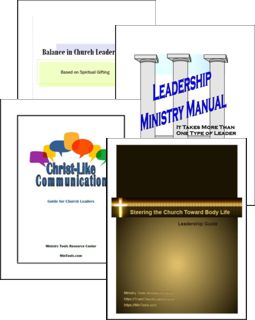
Leadership Training ResourcesIn addition to specific skills, make sure to provide a big picture perspective on church leadership. Help them see how the basics of life in Christ should govern how they lead.

Resources:

Applicational Aspect of Training for Future Church Leaders

True learning comes when we take what we have learned and observed and put it into practice. An effective training process must therefore also include hands-on experience.

Think of Jesus’ example: He not only spent time with His disciples, teaching them as they went along, but He also sent them out on assignments. When they returned, they had a time of debriefing with Jesus. (Mk. 3:14; 6:7-13; Lk. 10:1-20)

Give potential leaders small, yet significant and not petty, assignments that involve leadership opportunities. Gradually increase the level of responsibility. With those assignments should come some freedoms to take initiative and be creative. Micromanaging or holding a tight noose around them will not permit risk-taking and failures through which they can greatly learn. You will be able to provide honest feedback as you debrief them to help the person learn from the experience.

Seeing the potential leader in action can also provide an opportunity to confirm leadership gifting. The goal of leadership development training is not to turn someone into a leader who is not gifted or called to it but rather to fan it into flame in those who are (2 Tim. 1:6). Be careful, however, not to write someone off after a few failures. Look at Peter, one of Jesus’ disciples, who fumbled quite a bit and yet became one of the primary early church leaders. Stop and pray more about God’s desires for this person and to be honest if leadership does not appear to be the right fit. Help the person discern what might be a better fit.

Resource:

Personal Aspect of Training for Future Church Leaders

In a previous post we noted how heart qualities matter to the Lord, not merely leadership skills. These qualities are developed as a fruit of the Spirit’s work in our lives. Consequently, we must encourage the development and nurturing of a potential leader’s walk with God. God’s power, flowing out through us is what will make a difference. We can do all things “through Christ” who strengthens us (Phil. 4:13) which requires abiding in Him (Jn. 15:1-5). — “His divine power has given us everything we need for a godly life through our knowledge of him who called us by his own glory and goodness.” (2 Pet. 1:3)

Think of Jesus’ teaching: He said, “apart from me you can do nothing” (Jn. 15:5).

If a leader’s personal walk with the Lord is not part of your leadership development, you are short-circuiting the process. The Church needs leaders used by God to make a difference, not those who will merely maintain status quo or function like a secular leader.

Resource:
Share:

Developing Future Church Leaders: The Identification Process

Share:

We Merely Determine Who God, the Potter, Chooses
To develop future church leaders, we obviously need to know who has leadership potential. This post’s title purposely uses the phrase “identification process” because that’s what we’re to do. We identify those whom God desires to be in leadership. We shouldn’t be the ones determining who gets to be a leader and who doesn’t. God is the Potter (Rom. 9:20-21; Isa. 64:8), the One with the rights to form us for how He intends to use us.

Identifying Those with Heart Qualities to be a Leader, Not Merely Leadership Skill Potential

As seen in the example of Samuel anointing a king for Israel, God’s choice isn’t always whom we might choose. We tend to look at the external qualifications but God has different criteria.

But the LORD said to Samuel, “Do not consider his appearance or his height, for I have rejected him. The LORD does not look at the things people look at. People look at the outward appearance, but the LORD looks at the heart. (1 Sam. 16:7)

Leadership skills can be developed and honed but the heart is something quite different. People can externally look the part but the heart might not be right. Only God sees the heart and He weighs the motives of the heart (Prov. 16:2).

God’s wisdom far exceeds our ability to choose who should be leaders. Look at the twelve disciples Jesus chose — many unlearned fishermen.

Brothers and sisters, think of what you were when you were called. Not many of you were wise by human standards; not many were influential; not many were of noble birth. But God chose the foolish things of the world to shame the wise; God chose the weak things of the world to shame the strong. God chose the lowly things of this world and the despised things – and the things that are not – to nullify the things that are, so that no one may boast before him. (1 Cor. 1:26-29)

Identifying Those God has Empowered to be Leaders, Not Merely Those with Natural Leadership Abilities

God designed the Body of Christ to operate within the sphere of spiritual gifting. Spiritual gifts are God’s special divine empowerment for us to do ministry in His strength, not our own. God, through His Spirit, is the One who assigns our gifts (1 Cor. 12:4) so our task then is to identify those whom He has gifted for leadership.

Some people have personalities that lend themselves toward leadership, what we often hear referred to a naturally born leaders. Since God created our inmost being and knit us together in our mother’s womb (Ps. 139:13), we can only conclude that our personalities would have some part in how we serve. Yet, God would not have supernaturally gifted people to serve in certain ways if our natural abilities were enough.

Whether leading by gifting or personality, all must come under the control of the Spirit. We must be yielded to and pulling on God’s power, not our own, if we are going to bear spiritual fruit through our ministry efforts (Jn. 15:1-5). Hence, a person’s walk with God is critical to being an effective leader.

Identifying Those Whom God Has Chosen, not Merely Filling Positions

Just because a person appears to have a yielded heart that loves the Lord and has leadership gifting still doesn’t mean he/she is the person of God’s choosing for a particular leadership position. God’s choice of the prophet Jeremiah to be His spokesperson in that particular time and place provides us with a good example. God told the prophet Jeremiah, “Before I formed you in the womb I knew you, before you were born I set you apart; I appointed you as a prophet to the nations” (Jer. 1:5). In God’s omniscience and sovereignty, He knew who Jeremiah would be and that he was the right person for that specific mission.

But, how will we know those whom God has chosen? In addition to observing who fits within the first two points mentioned above, we must spend much time in prayer. Consider Jesus’ example in His selection of the twelve whom He would develop into future leaders of His Church.

… Jesus went out to a mountainside to pray, and spent the night praying to God. When morning came, he called his disciples to him and chose twelve of them, whom he also designated apostles … (Lk. 6:12-13)

Share:

Developing Future Church Leaders: The Priority

Share:

How many times have churches needed new elders or someone to fill some other leadership position only to find no one who seems qualified, ready, or willing?

The solution? Build within your church a culture in which leadership development is an ongoing priority. Identify and intentionally offer potential leaders opportunity to learn and grow and develop into godly leaders, ready to be used by God to make a difference when the time is right. Preparing people for leadership takes time, something fulfilling a last minute need does not afford.

Pragmatically, then, it only makes sense to make leadership development a priority, not optional. But, it’s also a biblical priority.

Precepts for Developing Future Leaders Suggest It Be a Priority

God’s Word commands the discipleship of people into fully devoted followers of Jesus Christ. While Matthew 28:18-20 goes broader than developing believers for specific roles within the Body, it does provide a basis for helping to develop and equip people that comes from the vestment of Jesus’ authority and requires His presence within the process.

Then Jesus came to them and said, “All authority in heaven and on earth has been given to me. Therefore go and make disciples of all nations, baptizing them in the name of the Father and of the Son and of the Holy Spirit, and teaching them to obey everything I have commanded you. And surely I am with you always, to the very end of the age.” (Matt. 28:18-20)

God takes discipleship beyond salvation and our walk with God. We are also to be preparing people for ministry. In Ephesians 4 we read that He provides the Church with those who have the responsibility of equipping “his people for works of service.”

So Christ himself gave the apostles, the prophets, the evangelists, the pastors and teachers, to equip his people for works of service, so that the body of Christ may be built up until we all reach unity in the faith and in the knowledge of the Son of God and become mature, attaining to the whole measure of the fullness of Christ. (Eph. 4:11-13)

Developing Future Leaders is a Ministry of MultiplicationGod used the Apostle Paul to develop Timothy who was in turn to equip others. This multiplication process is an intentional effort that should carry on into what we do in the Church today.

And the things you have heard me say in the presence of many witnesses entrust to reliable people who will also be qualified to teach others. (2 Tim. 2:2)

More about the Development of Future Leaders

Be sure to learn more about developing future church leaders:

1) The Identification Process of Future Leaders Who Need to be Developed

2) The Training Process for Developing Future Leaders

3) The Biblical Precedence for Developing Future Leaders

Share: