Leaders & Church Growth

Share:

The three different types of leaders in the church, based on spiritual gifting, will have different perspectives or approaches to church growth. Read through the Leadership Ministry Training to gain a better understanding of these leaders.

Types of Church Leaders
Click to enlarge image in Pinterest & repin.

Not all leaders will fit precisely into one of these types due to the combination of others gifts and/or their personalities. Yet, many leaders can see themselves in one of these categories. When that is the case, they should seek to network with other types of leaders to broaden their perspective so they approach church growth from God’s intent.

How Different Types of Leaders Approach Church Growth

Visionary Leaders tend to want to grow the church by developing new approaches.

Administrative Leaders tend to work at fine-tuning or fixing what we’re currently doing to be ready for growth.

Pastoral Leaders tend to focus on meeting people’s needs more than being concerned with church growth efforts.

Developing new ministry initiatives that could lead to growth is important. Properly maintaining the good currently being done is important. Meeting people’s needs is important. — Is it little wonder God so gifted the church that there are three different types of leaders? He intends for the church to do all three of these important tasks but we must work interdependently with one another. We need each other if the church is to grow.

Church Growth is one of 15 leader responsibilities looked at in the Balance in Church Leadership Based on Spiritual Gifting. In addition to the tendencies of the different kinds of leaders mentioned in this post, it also suggests what they must be careful of in order to keep the needed balance when it comes to church growth.

For more:  Church Leaders Practicum on Church Growth

Share:

Turning Team Leaders into Team Builders

Share:

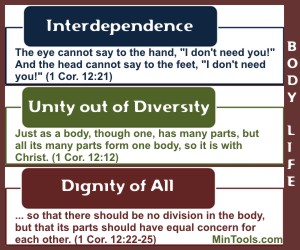
God Designed the Body of Christ to Function Like a Team:

For just as each of us has one body with many members, and these members do not all have the same function, so in Christ we, though many, form one body, and each member belongs to all the others. (Rom. 12:4-5)

As with a physical body, the Body of Christ must work together interdependently, as a team, to function with the kind of unity described in the above verses.

Functioning like a team does not happen automatically just because we are Christians, part of His Church. Team members need certain qualities built within them that help them truly engage in such fellowship. Consequently, team leaders must promote these qualities. But, what will it take for team leaders to turn into team builders?

Equipping Team Leaders to Become Team Builders:

Tools

While providing practical ideas is always good, team leaders need to be reminded of the tools they already have constantly available to them — the cross of Jesus which brings us together into one body, the Word which instructs us on how to live within God’s design, and the Spirit who enables us.

Ministry Tools to Equip

Click on image to enlarge in Pinterest & Repin.

Example

Jesus’ example of servanthood is the best pattern we will ever have for functioning as a team (Jn. 13:3-15; Phil. 2:1-11). When we learn such selflessness, willing to lay aside our rights for the good of others, then we too can be an example. We will be able to say, as the Apostle Paul said, “Follow my example, as I follow the example of Christ” (1 Cor. 11:1).

Also Read: Church Leadership Qualities – Be an Example

Assurance

Knowing the tools it will take for us to be the Body God intends us to be and having good examples of it doesn’t always translate into living it out. We need to have such a trust in God that His ways are always right and that He is great enough and powerful enough to change us and those we serve, that it moves us to action.

Resource: Ministry Worker’s Devotional: A Mighty Fortress Is Our God

Mentoring

Sometimes it helps to be able to interact with someone in whom God has developed the qualities essential to teamwork. We can learn from their experiences but also from their heart.

Also Read: Mentoring

Click on the following link for more:  Church Leadership Skills: Team Building

Share:

Leaders & Church Discipline

Share:
Types of Church Leaders
Click image to enlarge in Pinterest & repin.

God’s Word presents three different kinds of leaders based on spiritual gifting. Each leader brings a different perspective to issues faced in the church such as how to handle church discipline. Consequently, a network of these types of leaders would bring the most balance and health into a situation.

Not all leaders will fit precisely into one of these types. Their gift-mix or personality could also affect their leadership style. God uses all of who we are in serving Him. If you fit primarily within one of these types of leaders, network with other kinds of leaders. If you don’t network, you will have to work at bringing the needed balance.

Concerns different types of leaders might have in their approach to church discipline:

Visionary Leaders want to move on and progress so they seek to expedite what needs to be done.

Administrative Leaders seek to make things right by following a step by step process to bring correction.

Pastoral Leaders want to be sure we’ve tried everything to bring wholeness to people’s lives.

You can see how a network of these different types of leaders working in tandem will bring balance and health. Unresolved discipline issues can hold a church back. We do need to take measures to ensure that we handle it in ways that are beyond reproach. And, we do need to always have the person’s best interests at heart.

Church Discipline is one of 15 leadership responsibilities covered in the Balance in Church Leadership Based on Spiritual Gifting. In addition to what you find about the different leaders in this post, it also points out tendencies each of the leaders may have when it comes to church discipline and suggests a biblical truth to remember to help bring health and balance to the process.

For more:  Church Leaders Practicum on Church Discipline

Share:

Responsibilities of Team Leaders

Share:

Team Leaders Responsibilities to Promote God's Design for Body Life
Unified teams, that function according to God’s design for Body Life, need team members with the right kind of qualities. Team leaders have the responsibility of promoting these kinds of qualities in members of the team.

Acrostic of Team Leaders’ Responsibilities in Promoting Teamwork

Here’s what team leaders should provide to help team members become a unified group:

T – Training

Don’t assume the team will be unified and accepting of each other’s differences. Rather, provide pre-team training of what it takes to be on a team as well as continued trust-building exercises.

Leadership Skills Required: communication, modeling

E – Empowerment

Don’t expect people to merely attend meetings and give occasional input. Rather, truly give them authority to do their parts.

Leadership Skills Required: delegation

A – Accountability

Don’t let self-centered attitudes fester. Rather, point to the attitude and servant heart of Jesus as the standard for the team.

Leadership Skills Required: coordination, conflict management

M – Motivation

Don’t forget the big picture and get lost in all the details. Rather, promote the development of perspective and an expectancy toward what God will do for the whole.

Leadership Skills Required: vision-casting

When team leaders fulfill these responsibilities, it tends to build the qualities needed in team members to work as a unified group.

Click on this link for more on this leadership skill: Team Building

Share:

Breaking Through the Walls

Share:

People have built walls between them and the institutionalized church. We need to get beyond the idea that certain types of programs, technology, facilities, and other such efforts will break through the fears and disillusionment people have toward the church. Rather, we must break through those walls with the love of Christ.

Train Church Leaders

Click to enlarge image on Pinterest & repin.

Remember, “perfect love drives out fear” (1 Jn. 4:18).

What might it look like for churches to break through the walls with the love of Christ?

To break through with the love of Christ, we must reach people where they are. When we consider what people want and need, we’re then able to discern the best approach.

  1. restoring Jesus to His rightful place as Head of the church, our primary message and source of hope … people are spiritually-oriented, wanting to be in a relationship over religion
  2. retooling programs and worship services to get away from an “us” and “them” approach … people are socially-oriented, wanting to learn from each other not merely a leader, teacher or pastor
  3. relationally communicating so people can respond and not just listen … people are social media-oriented, wanting to collaborate
  4. recognizing the contribution each person has to make … people are significance-oriented, wanting to be a part of something bigger
  5. reaching out to our communities in tangible ways with the love of Christ … people are service-oriented, wanting to make a difference where they live

The Role of Church Leaders in Breaking Through

Church leaders have a critical role in guiding the church toward this objective. It will take more than telling people to do this. Leaders must model it in their own lives and align their leadership practices with it. Their own heart attitudes and motivations will significantly affect what the church does so “above all else, guard your heart, for everything you do flows from it” (Prov. 4:23).

Their leadership must be …

  • about people, not merely the administration of programs.
  • to minister, not merely complete tasks.
  • to advance God’s purposes, not merely church as usual.
  • motivated by love, not merely to accomplish their goals.
Share:

10 Reasons Leaders Don’t Delegate

Share:

Delegation Following God's Design for the Body
God designed the Church to function interdependently with everybody doing their part (Eph. 4:16). Delegation helps promote Body Life.

Though delegation has many benefits, leaders may still fail to delegate when they can. If we understand what’s really behind our excuses, perhaps we’ll reconsider.

Reasons Leaders May Give for Not Delegating

If honest when asked why a leader doesn’t delegate, here is what the person might say:

  1. I enjoy what I do and don’t want to give it up.
  2. I feel like I would be admitting failure or limitations.
  3. I think it makes me look important to be busy.
  4. I like to maintain control.
  5. I don’t know if I can trust other people to do it right.
  6. I am afraid the person might try to do more than asked.
  7. I don’t want to risk someone quitting before the job is completed.
  8. I am unwilling for things to be done differently than what I might do them.
  9. I don’t want to invest time and effort into training someone else.
  10. I fear the person might do a better job than me and consequently make me look bad.

Notice the word “I.” Lack of delegation is about keeping things all about me … usually an outgrowth of pride or insecurities. But, what about the opportunities and growth it would provide for others?

Struggling with Delegation?

If you struggle with delegating responsibilities, think about the basis and benefits of getting others involved. Align with the basics of who we are in Christ and the above reasons for not delegating will begin to disappear. Click below for a few thoughts to guide the way you delegate:

Share: