3 Tips for Any Kind of Ministry Online

Share:

Online ministry has become a way of life these days. Some of it will continue on for years to come so it is important we remember key factors that relate to how God wants us to do ministry.

Tips That Serve as Reminders for Any Kind of Ministry Online

1) Remember that love “always protects” (1 Cor. 13:7).

Any kind of online ministry needs to be done safely, with cyber security in mind. In addition we must always guard people’s privacy, time, contact preferences, etc. so as to respect and protect. We need to build parameters into the kind of interactions allowed so as to minimize negative and destructive commenting, etc. which tends to happen more freely when hidden behind screens.

Online Ministry2) Remember that behind every screen is a live person.

  • Meeting their needs matter. Sometimes it’s easier for people to mask what’s really happening in their lives through online platforms. How will you discern needs? If we rely on people to take the first step, many needs will undoubtedly go unmet.
  • Relationships matter. We cannot rely solely on streaming a worship service to follow God’s design for Body life. That takes relationships. Even if you have a platform wherein people can interact, how much relationship building really happens? What are you doing to follow up with people who attend digitally? How are relationships fostered?
  • Encouraging matters. We meet with the purpose of “encouraging one another” according to Hebrews 10:25. Is that happening through your online ministry? How do you know?

(Be aware that churches can fall short on the above even when meeting in person. We must always strategically work at meeting needs, building relationships, and encouraging one another but it becomes even more challenging with online ministry.)

3) Remember that it isn’t the same as meeting in person.

While meeting online might be considered connecting with other believers, the full intent of God’s command to meet together (Heb. 10:25) is that we physically gather. There are benefits of in-person that cannot happen as easily, as unencumbered, and sometimes never online. Ministry online can bridge some gaps and provide a temporary means of connecting but should not completely and permanently substitute for in-person meeting with one another.
Share:

3 Tips for Ministry & Church Newsletters

Share:

Many churches and ministries rely on newsletters of some sort to communicate.

Tips for Ministry & Church Newsletters

While there are many suggestions that could be given about using newsletters, here are three tips to give some broad perspective. The MinTools.com newsletter will be used as an example.

  1. Have a purpose for your newsletter.

Develop a newsletter for a good reason, not just because other churches or ministries do it. When you have an overall, broad objective you’ll have clearer direction for what content to include in it.

Ministry Newsletter
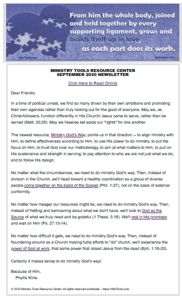
Click image to read the current month’s MinTools.com Newsletter.

MinTools.com Example:

At the start of every new month at MinTools.com an e-mail newsletter is sent to those who sign up for it. I praise God for the many people from around the world who have subscribed to it. These newsletters have multiple purposes:

  • They provide an update of new material on this site, as well as the sites devoted to training for Bible teachers and Church leaders.
  • They address a spiritual issue or ministry need relevant to believers in the Church.
  • They seek to encourage or challenge us to think about how well we are lining up with the character of God and principles from His Word, the Bible, in that area.

Please take time to read this month’s newsletter. You can subscribe to it on that same page. Please know that your e-mail address is used for no other purpose.

  1. Strategically determine the newsletter’s format and means of distribution.

If you have a primarily online ministry, a digital format of some sort may be the way to go for you too. But, if a church or ministry is not primarily online or worldwide, postal mail may be more of the way to go. If you decide to hand them out in person (i.e., at the doors on their way out, in their church mailboxes, etc.) to save money, you’ll need to accept the reality that many newsletters may not actually make it home and get read. You’ll also need to be aware that very likely not everyone will have attended the meeting during which you distributed them.

Remember, budget alone should not be the determining factor for the format you use. Always consider your readers. What will the people you minister to/with be most likely to read? A combination of e-mail/online and hardcopy might be necessary if you want to increase the number of people who read it.

MinTools.com Example:

Since Ministry Tools Resource Center targets believers around the world, the best format to date has been to use e-mail as the medium. Not only would the cost be prohibitive to send a hardcopy newsletters through the postal service, but it also would not be as conducive to directing people to updates on the site, one of the key purposes for doing the newsletter. In an e-mail newsletter, people can easily click on links to new posts and/or new resources. The newsletter can also be found online as well. You can freely sign up to receive these e-mail newsletter updates generally sent once a month.

  1. Don’t assume everyone will read it.

One thing you quickly learn in ministry is that no matter how purposeful and strategic you might be in using a newsletter update, not everyone will read it. And, while some may thoroughly read it, others will merely glance over the highlights.

If you’re using a newsletter to communicate something you don’t want people to miss, be sure to use other formats of communication. Also, figure out a way to highlight that information in the newsletter so it will less likely be missed.

MinTools.com Example:

In looking at the statistics about the MinTools.com newsletter, I realize that not everyone reads it — very common with e-mail newsletters. Sometimes the e-mail goes into people’s junk/spam folder. Sometimes the e-mail may not even get to people’s e-mail account at all. And, sometimes when it makes it, it still doesn’t get read, in large part because people are just so busy and/or they get so much e-mail they can’t look at it all. But, I also note that enough people do receive it and read it to make the newsletters worth the time and effort. At times people respond with positive feedback about how God used it to encourage and spur them on.

Of course, there are many other factors to consider (how often, who will develop it, layout, name, etc.). Rather than just do a newsletter the way you’ve always done it, seek God’s wisdom on how you can be more purposeful and strategic, increasing the potential of more people actually reading it.

Share:

3 Tips for Ministry Use of X (Twitter) and Other Social Media Platforms

Share:

Be Salt & Light in Ministry Use of Social Media

As believers, we’re called to be salt and light in this world (Matt. 5:13-16), which should encompass the whole of our lives … even the kinds of posts and comments we make on social media platforms. The same holds true for churches and ministries. We need to consistently promote and model Christ-like attitudes and ways.

Tips for Strategic Use of Social Media by Churches and Ministries

Here are three tips churches and ministries, in particular, need to consider whether using X (Twitter), Facebook, or some other social media platforms.

  1. Be purposeful in the use of social media.

As churches and ministries, we have too much to do to merely jump on the bandwagon of social media just because everybody else it doing it. Why should YOU use it?

Obviously the idea behind “social” media is that we connect or interact with people. But, even this goal needs to be better defined. What kinds of connections do you hope to establish? Will it be a platform for merely airing opinions and thoughts or will it be used for discipleship and fellowship purposes?

Social media can also be used to inform and update. But, even this goal needs to be narrowed down. What kinds of events or content merits a post?

In addition, social media can be a means of encouraging and challenging people. But, even this goal needs to be thought through. How personal should you get to people’s needs and circumstances in an open setting?

Determine your primary purpose in using social media for your church or ministry and it will help you determine the main types of posts you will make.

  1. Build parameters into the use of social media.

Seriously think through the type of content you will post. Guard against that which is inappropriate, demeaning, or destructive. Also establish commenting policies that keep your church or ministry aligned with the parameters of true Body Life.

In addition, determine the amount of time you should put into social media. How easy it can be to get so consumed in it that other important responsibilities get neglected. We need to be wise in where we invest our time (Eph. 5:15; Col. 4:5) by setting some time parameters.

  1. Don’t rely on social media alone to connect and communicate.

To use X (Twitter), Facebook, and/or other social media platforms as your sole means of connecting, informing, encouraging, etc. could be a problem.

Not everyone may utilize the platform you do. You may need to use multiple platforms to increase potential reach.

Some don’t get on social media at all. Be sure to connect, inform, update, and encourage through other means as well.

Posts may not always reach everyone’s feed. You may need to instruct people on what to do to be more likely to see your posts. You may need to set up special groups or lists within the different platforms for people to join.

Share:

Joining God Where He is Working

Share:

Years ago my church worked through Experiencing God by Henry & Richard Blackaby and Claude King. We used it in our home fellowship groups, taught on it in Sunday School and from the pulpit, and encouraged people to do the workbook on their own. Through all that investment into this book, the one idea that keeps coming back to me the most is: “Watch to see where God is working and join Him.”

Biblical Basis for Joining God Where He is Working

Blackaby and King used John 5:17, 19-20 as the Scriptural basis for this concept. The idea is that because God is always working, we just have to discern where and join Him.

In his defense Jesus said to them, “My Father is always at his work to this very day, and I too am working.” (Jn. 5:17)

Jesus gave them this answer: “Very truly I tell you, the Son can do nothing by himself; he can do only what he sees his Father doing, because whatever the Father does the Son also does. For the Father loves the Son and shows him all he does. Yes, and he will show him even greater works than these, so that you will be amazed.” (Jn. 5:19-20)

Personal Reflections on John 5:17, 19-20

In reflecting on these verses, I come to the following conclusions:

  1. Sometimes joining God where He’s working may mean flying in the face of tradition. But, it will never contradict the character and ways of God as described in His Word.

It’s important to understand why Jesus spoke these words. He said them “in His defense” of having healed an invalid on the Sabbath. The Jewish leaders claimed Jesus violated the law. But, it wasn’t “the” law He violated, it was “their” law.

  1. Joining God requires getting ourselves out of the way. Personal agendas and human efforts will not be the way to get there. They will just cloud our vision from seeing where God is working.

Even Jesus didn’t follow His own agenda but rather aligned with the Father. If the Son could “do nothing by himself”, how could we ever possibly make true ministry happen on our own?

Personal Example of Seeing Where God Was Working and Joining Him

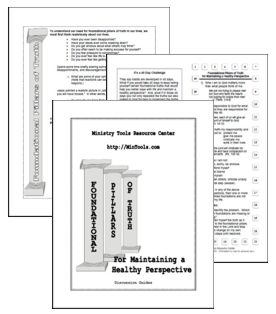
Foundational Pillars of Truth because of Joining God Where He is WorkingIn a much earlier post I wrote about how God used a 40 Day Challenge I developed to help a friend. I continued to see or learn of God working through that tool in the lives of many more people. I asked God what more He wanted me to do as it was obvious this was one of those situations where God was at work. The result of praying about it? — Foundational Pillars of Truth for Maintaining a Healthy Perspective Discussion Guide to be used in conjunction with the 40 Day Challenge, a tool God has used to help many.

Since God is always working in and through our individual lives, ministries, churches, and in the world, we’ll always have some way we can join Him to accomplish His purposes and mission. Do we have the spiritual eyes to see and the yielded heart to follow?

Share:

Communicating The Same Message Using Different Means

Share:

Part of thinking outside of the box is coming up with different means of communicating the same message. Just because we’ve always done it a certain way, doesn’t mean we must continue communicating that way. Read through the Bible and you’ll find that even God has communicated His message in different ways at different times.

Why We Might Need to Change to Different Means of Communicating

If we don’t grasp good reasons for changing our methodology, we will probably struggle with using different means of communicating. Here are a few broad reasons:

external conditions

We may need to do something different due to the times in which we live. The cultural setting in which we find ourselves may require a different approach. Even a change in ministry staff, with a different set of spiritual gifting, may require a break from the way ministry used to happen. If we don’t adapt, people may get frustrated and stop listening altogether.

changing needs and interests

People don’t stay at the same place. They progress through different levels in both their physical age and spiritual development which brings a new set of needs and interests. If we don’t progress with them, we may soon find our ministry having minimal impact in people’s lives.

realities about the human condition

When something becomes common place, people can become inoculated to it. Boredom can set in. The message heard in the same way starts to fall on deaf ears. If we don’t do something different, at least on occasion, we may find it hard to get and keep people’s attention.

Objective for Using Different Means in Communicating the Same Message

Adapting in Communicating to Reach All
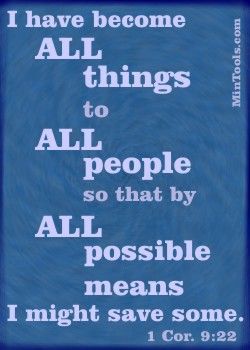
We’re not talking about changing just for the sake of changing. Our objective in adapting must always be to truly reach and impact lives. — “I have become all things to all people so that by all possible means I might save some.” (1 Cor. 9:22)

Share:

The Need for Heart Preparation

Share:

Value Heart Preparation Because God Looks at the Heart
In the Old Testament we read about the prophet Samuel’s quest to anoint a new king for Israel. Samuel leaned toward one of Jesse’s sons who looked the part. “But the LORD said to Samuel, ‘Do not consider his appearance or his height, for I have rejected him. The LORD does not look at the things people look at. People look at the outward appearance, but the LORD looks at the heart.'” (1 Sam. 16:7)

Because God prioritizes the heart, we should guard our hearts (Prov. 4:23), preparing our hearts so we are fit for ministry. Before considering how we do that, we should learn more about our need for heart preparation.

Lessons from the Bible Showing the Need for Heart Preparation

Page through the Old Testament and you’ll clearly see the hazards of not preparing your heart and the value of heart preparation. Here are a few example:

The Israelites of old provide an example of what happens when people’s hearts are not prepared. Though God made a covenant with them, protected and provided for them in miraculous ways, the people forgot God and persistently failed to follow Him. Then, instead of experiencing God’s blessing, they received His discipline. Psalm 78:8 gives the reason for their unfaithfulness. — “A stubborn and rebellious generation, a generation that did not prepare its heart …” (NASB)

God chose David as their king who “shepherded them with integrity of heart” (Ps. 78:70-72) because of his heart, not because of his stature or other outward signs of accomplishment (1 Sam. 16:7). — “God testified concerning him: ‘I have found David son of Jesse, a man after my own heart; he will do everything I want him to do.'” (Acts 13:22). — David wasn’t perfect but with a heart so bent toward God, it didn’t take long for him to repent of his sin, get right with God, and be back on track.

Rehoboam gives us an example of an individual leader, a king, who started out well but after just a few years, lost His way (2 Chron. 11:17). 2 Chronicles 12:14 provides the reason. — “And he did evil, because he prepared not his heart to seek the LORD.” (KJV) — Rehoboam did humble himself before the Lord and was spared some of the severity of God’s judgment but still faced negative consequences (2 Chron. 12:5-8).

In both of the more negative examples, the same Hebrew word, kuwn, is used about not preparing their hearts to follow, or seek the Lord. If, in our hearts, we are not firmly established, or set on following after the Lord, we too could find ourselves turning away from God and His ways. We must value heart preparation, not just “going to church” or doing ministry. We must focus on what’s inside, not just learning new skills. If we don’t, we could find ourselves in the same predicament.

How to Prepare Our Hearts

We prepare our hearts is by making regular and consistent interaction with God in His Word a priority. Learn from the above examples:

The safeguard for the Israelites not becoming “like their ancestors” (Ps. 78:8) would be that they make learning about Him and His ways a priority for both themselves and the generations to come (Ps. 78:1-7).

What led to Rehoboam’s heart failure was that “After Rehoboam’s position as king was established and he had become strong, he and all Israel with him abandoned the law of the LORD.” (2 Chron. 12:1).

If we don’t make God’s Word a priority in our lives, we can’t expect our hearts will be prepared, or set, on following Him. — “But whoever looks intently into the perfect law that gives freedom, and continues in it – not forgetting what they have heard, but doing it – they will be blessed in what they do.” (James 1:25)

We prepare our hearts through regular and consistent interaction with God in prayer.

Read through the Psalms and you will find King David constantly turning to God in prayer. He would also exhort the people, “Trust in him at all times, you people; pour out your hearts to him, for God is our refuge.” (Ps. 62:8). He asked God, “Search me, God, and know my heart; test me and know my anxious thoughts. See if there is any offensive way in me, and lead me in the way everlasting.” (Ps. 139:23-24). He knew that what was on the inside of him mattered. He valued heart preparation.

Let’s not become so busy “doing” ministry that we lack time and energy to spend with God in His Word and in prayer. We need to make this kind of heart preparation a priority!

Share: