The Value of Heart Preparation

Share:

In ministry we can spend a lot of time in preparation for what needs to be done … preparing a lesson or sermon, setting up a room, learning new skills, making sure everyone’s safe, etc. But, how much attention do we give to heart preparation? — our own hearts as well as the hearts of those we serve?

What is Heart Preparation & Why Value It?

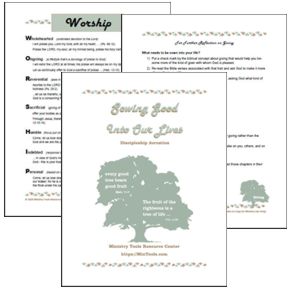
Heart Preparation is about Sowing Good into our Lives
Click on image to learn more about this resource.

Preparing our hearts is about sowing good into our lives. The good we need to sow into our lives is that which aligns with God and His Word. We’re talking about the heart qualities we need, not just what we do.

The good man brings good things out of the good stored up in his heart, and the evil man brings evil things out of the evil stored up in his heart. For out of the overflow of his heart his mouth speaks. (Lk. 6:45)

Heart preparation is also about guarding our heart so it stays focused on the Lord. It’s about watching over or protecting our hearts, being careful we don’t sow into our lives those destructive, ungodly influences that block or hinder us from focusing on Him. We’re talking about being vigilant as well as diligent and intentional about what we sow into our hearts. We must always remember that we reap what we sow.

Above all else, guard your heart, for it is the wellspring of life. (Prov. 4:23)

God looks for people whose heart is right with Him (1 Sam. 16:7; Prov. 21:2). It’s what He values, so we should too.

Share:

Where’s the Power in the Church?

Share:

We tend to think of resurrection power as an Easter phenomenon. Yet, Jesus and His death and resurrection are always at the center of the Christian faith. Resurrection power in the Church forms the foundation upon which God established the Church.

God Wants Us to Know His Power — Resurrection Power

Resurrection Power in the ChurchWe’re assured that God wants His people to know resurrection power when we look at the Apostle Paul’s prayer for the church at Ephesus (Eph. 1:18-20). He prayed that they would know:

  1. the hope to which He called them
  2. the riches of His glorious inheritance in His holy people
  3. His incomparably great power for us who believe

Of interest, note that only the third statement receives additional commentary. The power is “incomparably great” because …

That power is the same as the mighty strength he exerted when he raised Christ from the dead … (Eph. 1:19-20)

Also of significance to note is that the statement about His power is the only one known upon the condition of belief. We find this elsewhere, like in the following verses:

You, who through faith are shielded by God’s power until the coming of the salvation that is ready to be revealed in the last time. In this you greatly rejoice, though now for a little while you may have had to suffer grief in all kinds of trials. (1 Pet. 1:5-6)

If we’re going to know and appropriate resurrection power to our lives today we need to believe, to have faith. Perhaps instead of asking ‘Where’s the power in the Church today?’, we should be asking ‘Where’s the faith in the Church today?’.

  • Do we really believe God is who He says He is? Or, do we pick and choose what feels comfortable or is politically correct?
  • Do we really believe God can do what He says He has done? Or, do we view certain biblical accounts as mere stories, or fables, with lessons behind them?

If we perceive the object of our faith as weak, can we really expect to know His incomparably great power? And, we’ll likely find it hard to endure the hardship that often precedes the display of His power. Remember, Jesus first suffered and died before being resurrected. To say we want resurrection power in our lives and in our churches, we must complete the statement — “I want to know Christ and the power of His resurrection and the fellowship of sharing in His suffering …” (Phil. 3:10-11)

Not sure you have that kind of faith? Start with the words of a father hoping Jesus might help his son (Mk. 9:22-24).

The boy’s father said to Jesus, “But if you can do anything, take pity on us and help us.”

“If you can”? said Jesus. “Everything is possible for one who believes.”

Immediately the boy’s father exclaimed, “I do believe; help me overcome my unbelief!”

Share:

We Need to Think Outside of the Box

Share:

Boxed In? Think Outside of the BoxTo think outside of the box, we first need to know what the box is when it comes to the Church and ministry. Perhaps we can say the sides of the box form the parameters we’ve built around us … maybe our policies, traditions, denominational nuances, comfort level, etc.

The parameters may not be wrong in and of themselves, but the programs and strategies we’ve held on to may not work today. We need to think outside of the box. For the Church to not only survive but thrive, we need to constantly challenge what we do, asking if there’s another better way to accomplish ministry that best fits our current situation.

How far outside of the box can we go?

We first need to get down to the essence of who we are and what we’re to do as the Church. That means stripping away man-made conditions about it until we truly get down to the biblical mandates. What must stay the same is what’s actually commanded in Scripture. All the other parameters (sides of our boxes), can potentially be broken down, exposing who God truly designed us to be.

As an example, God commands us to not neglect meeting together (Heb. 10:25). But, Scripture does not tell us where, when, and how long we must meet. But, it does tell us why … so we can encourage one another. The essence of this command is that we meet to encourage one another — that’s what we must stay true to. When we strip away everything else, and start thinking outside of the box, we should find that there are so many, many ways to make that happen. The box we created undoubtedly is not the only way.

If we’re going to thrive as a Church, we must stop viewing what we do now against how we’ve always done it. To think outside of the box, we no longer use the box as the lens through which we look but rather God’s Word. That’s the foundation on which we build our new structures.

Is there biblical precedence for thinking outside of the box?

We do have precedence for thinking outside of the box with Jesus.

Jesus lived in a world steeped in tradition where the phrase “But we’ve always done it this way” would have been the way of life. He enters the scene in a most nontraditional way … a virgin birth, born in a manger. The methodology used in His teaching, healings, and miracles varied. He did not serve people the same way each time but rather tailored what He did to the moment. He raised women to a higher plateau than common for that day. Some of the activities of Jesus and His disciples went so much against status quo that it disturbed, even angered, the religious leaders. After being killed on the cross, He came to life proving that He could conquer death and sin. Who had ever done that before?

If Jesus, in a world where the pace of change was not near as rapid as today, thought outside of the box and took the risk, why shouldn’t we? Make no mistake, Jesus lined up His earthly activity with the will of the Father (Jn. 5:17-23). He knew why He came and lived accordingly.

Likewise, we too must align with God’s Word and His character in whatever risks we take. We must get to the essence … God’s purposes, design, and mission … and live accordingly. As we think outside the box, let’s envelope all we do in prayer, stay consistent with God’s Word, and follow the leading of His Spirit. When we do, we’ll find a fluidity and ability to adapt, not rigid walls that box us in.

Share:

3 Points to Remember in an Age of Digital Church Life

Share:

Still Member of One Another in an Age of Digital Church Life

Whether all ministry happens digitally, or just part, we need to remember some key elements to church life that will help us stay connected as members of one another in the Body of Christ.

In an Age of Digital Church Life Remember These 3 Points

What can you do to further enhance these key elements in all you do, however you do it? You’ll find some thoughts to consider and also some links that take you to other websites to provide additional input.

1) Relationships still matter.

Technology must never take the place of human connections. When Hebrews 10:25 warns about “not giving up meeting together” it’s about more than physically meeting, although that’s very important. It’s about being present in each other’s lives, “encouraging one another – and all the more as you see the Day approaching” in ways that can truly be considered fellowship.

  • When using a digital platform, consider how you can still foster relationships.

For More:

2) Engagement still matters.

We know people learn and grow as they participate in the process. Simply watching a worship service provides minimal or no interaction or engagement.

  • When using a digital platform, consider how you can incorporate participation within it but also how you can follow-up to enhance engagement.

For More:

3) Communication still matters.

We want people to continue to feel like they’re a part of the Body. That means we need to communicate with them. We must not, however, assume everyone is getting digital communication.

  • When using a digital platform, consider how you can communicate with everyone by reaching out in multiple ways, even by making phone calls or through postal mail.

For More:

Share:

Ministry God’s Way

Share:

Serving God’s way means we

align with Him,
use His means,
and do it for His glory.

God provides the power and equipping resources to effectively serve Him through His Word, His Son, and His Spirit. When we look to God as both our Source and Sustenance in ministry, we accomplish all we do under God’s leading and power rather than leaning on our own understanding and efforts.

Key Elements of Doing Ministry God’s Way

Key Elements to Doing Ministry God's Way

The Ministry God’s Way Discipleship Tool Download begins with an overview of what it means to do ministry God’s way and how that makes serving about Him and not us, resulting in eternal results. The resource also includes three pages on each of the following elements, two pages answering some questions relevant to that element and the third page a Bible study about it. (Clicking on the links below will take you to blog articles about the elements.)

Ministry Alignment: Lining Up Ministry with God’s Character & Ways
Ministry Effectiveness: Measuring Ministry according to God’s Standards
Ministry Empowerment: Doing Ministry Through God’s Wisdom, Grace, & Power
Ministry Focus: Putting the Attention on God, Not Ourselves
Ministry Methodology: Trusting God, Not Our Programs & Strategies
Ministry Objectives: Aiming at What Matters to God
Ministry Perseverance: Being Sustained & Strengthened by God to Keep Serving
Ministry Qualities: Being God’s Servant
Ministry Recruitment: Getting the Person of God’s Choosing
Ministry Teamwork: Serving according to God’s Design
Ministry Training: Equipping God’s People
Share:

If not a Cookie-Cutter Approach, Then What?

Share:

The problem with applying a one-size-fits all, cookie-cutter approach to all people, ministries, and churches, is the tendency for it to:

lessen effectiveness
minimize unity

That doesn’t mean we can never use the same approach but we first need to take time to pray about it and assess what’s best. If we do apply the same solution to varying situations, it’s because it’s right, not because it’s convenient or easy.

Getting Beyond a Cookie Cutter Approach

Diversity So No Cookie Cutter ApproachWe need to understand and distinguish between what should be applied to all people, ministries, and churches, and what needs to be tailored to each situation.

We can, and should, learn from others, but before simply copying what they’re doing, we need to determine …

1) if it truly is an approach that fits our situation either in part or in whole.

Just because it worked for some, doesn’t mean it will be effective for us.

2) if it is God’s will for us.

Just because He used it elsewhere doesn’t mean it’s right for us.

To lead to the greatest benefit, we need to tailor what we do to our particular people, ministries, and church. That could at times mean using a pre-packaged curriculum and strategies or tools developed by someone else. At other times we might adapt those resources to better fit our situation. But, it could also mean developing something new or unique.

Share: