Why Don’t We Provide Ministry Training for Everyone?

Share:

Train Everyone Because Nobody Has Arrived
We all have something to learn. None of us have arrived … in our personal walks or in our ministries. So, shouldn’t we be providing ministry training for everyone?

“Not that I have already obtained this, or have already been made perfect, but I press on to take hold of that for which Christ Jesus took hold of me.”  –the Apostle Paul (Phil. 3:12)

It doesn’t matter the . . .

position (how high or how low),

tasks (how minor or how major),

experience (how long or how short),

training (how formal or how informal),

. . . we all need to keep learning and growing.

Reasons We Fail to Provide Ministry Training for Everyone in All Types of Ministries

Perhaps we resist training everyone because of past reactions.  People don’t seem interested.  They don’t attend.  They don’t need one more thing to do.

Not interested? Perhaps they aren’t finding it relevant and therefore lack a reason to be interested.  When we use a one-size-fits-all approach, meeting the needs of ministry workers is hit or miss.

Don’t attend? Perhaps the time doesn’t suit.  Perhaps they find it hard to sit through a meeting.  When we fail to provide alternative means of training, gaining their participation is an uphill battle.

Too busy? Perhaps the real issue is that they don’t view it as a priority.  We tend to find the time to do what we view as important.  When we make training simply about doing a better job, getting people on board might be all the harder if they feel they are doing a good enough job.  When we make serving more about lining up with the Almighty God and working in cooperation with Him, people just may find themselves thinking twice about equipping.

The Minimum Training We Should Provide

At minimum, we should be giving everyone in ministry a big picture perspective of the area of ministry in which they are engaged.  What does God want to do through that kind of ministry?  How can we line up with Him and work in cooperation with Him?

The Ministry Manuals published by Ministry Tools Resource Center can help you with that.  They are available individually for twelve different ministry areas or as a download bundle deal.

If you haven’t been training everyone for ministry, think and pray about it.  If it seems a bit overwhelming, begin by determining some first steps that to take toward that objective.

Share:

Saving Money in Today’s Economy

Share:

I don’t know about you but in today’s economy I look for ways to save money both for the ministry and personally.

Save Money Buying Used Books

One of the things I do is to buy used books when it is not for a gift. Getting used books can also be a good way to build your church library. Pastors and teachers might need books for research purposes.  Often you can find books in new, like new, or very good conditions that can well suit your purpose. Here’s a place I look:

amazon

Generally you will find that  more recently published used books will be a higher cost.  In that case, if the price seems close to the retail cost, I might buy a new book at ChristianBook, ChurchSource,or Amazon.com.  I do some comparison shopping, remembering to figure in shipping costs from the different sites. (The ministry even makes money as an affiliate of the above sites as a commission is received for all sales that come through the links on this site.)

If we stop and think about what we do personally,  in our churches and ministries, there are undoubtedly many other ways to save in today’s economy.

Share:

An Umbrella for Classroom Discipline

Share:

I’ve done a lot of teacher training seminars through the years and learned that a very large number of teachers in children’s ministry rate classroom discipline issues as their number one frustration. Many of these teachers want a step by step play book for “fixing” the problems which I have not been able to provide. Instead, I have handed them an umbrella for classroom discipline. — No, not the kind that keeps them from getting wet. An analogy.

An Analogy, Using an Umbrella, for Classroom Discipline

  1. Teachers need a big picture perspective or philosophy under which all discipline should come.  This is like the canopy of the umbrella.  Without this material over the framework, or spokes, their efforts will not protect or provide shelter.  All that is done needs to come under the umbrella of God’s Word.  The Effectively Handling Classroom Discipline Workbook provides this kind of perspective.
  1. Under that canopy are spokes, the framework on which the material hangs.  These are principles that can apply to all discipline situations.  Again, the workbook will help you work through these principles but the Handbook on the Basics of Classroom Discipline can also help with that.
  1. The umbrella with its canopy and framework won’t help unless you personally grab hold of it.  This is where the handle comes in — the specific application to your situation.  One reason I can’t provide steps to handling discipline problems is that there are so many variables.  For example, two children can engage in the same behavior but for different reasons making the application specific to that situation.

Classroom Discipline Issues

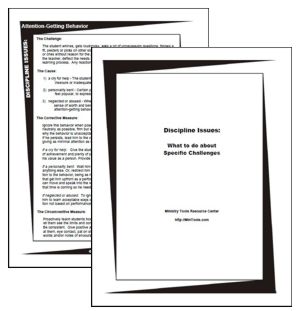
The Discipline Issues: What to Do About Specific Challenges resource provides help with 56 different discipline issues. You’ll find a page for each challenge listing possible causes with resultant suggestions for each issue.

Here are some examples:

  • Attention-Getting Behavior with 3 possible causes
  • Bringing Toys & Objects from Home with 3 possible causes
  • Constantly or Excessively Moving Children with 3 possible causes
  • Crying When Children Dropped off with 3 possible causes
  • Talking Incessantly/Inappropriately with 3 possible causes
  • Teasing & Bullying with 6 possible causes
  • When Staff Kids Misbehave with 4 possible causes

As you keep God’s big picture perspective in mind and apply the principles in ways appropriate to your situation and student needs, “rainy days” won’t have to get you drenched with frustration and despair.  If you line up what you do with God and His Word, you can depend on God for the long-range results and short-term coverage.

NOTE: All of the above mentioned resources are available in the Classroom Discipline Bundle.

Share:

Practical Use of Spiritual Gifts

Share:

I recently received an e-mail from someone whose Sunday School class was learning about spiritual gifts but wanted to help people see how to use their spiritual gifts within their church body — the practical use of spiritual gifts. I wrote,

I really believe there is no substitute for taking the time to tailor it to your particular church setting.  You need to look at your particular ministries, the tasks required to do those ministries, and then determine which gifts are needed to accomplish those tasks.  To do that you must be able to define the different spiritual gifts and then discern what gifts are used in the different ministry areas.

Ides to Show the Practical Use of Spiritual Gifts in the Church

Spiritual Gifts Curriculum Gets PracticalIn reflecting on practical ways to help people see how to use their spiritual gifts within their church body, I thought about the Everybody Has a Part Curriculum, which is part of the MAX Pak.  It concludes with a lesson suggesting  that you end with what is often called a ministry fair.

In a ministry fair you typically set up displays or booths for each of the major ministry areas of the church, with the ministry head on hand to answer questions. Students walk around to gain more information on the different ministries, talk one-on-one with the leaders, set up times to observe the ministry in action, etc.

In addition to possibly having a ministry fair, here are other ideas that have been effective in some churches:

  • Make up a booklet of your church’s ministries and list the gifts that are most used within those ministries.  Get as practical as you can in laying out ministry descriptions and the process for getting involved in those ministries.
  • Have the ministry leaders from the different areas prepare for a session to share how people with the various gifts can be used in their ministries.  You could ask them to take ‘x’ amount of minutes to share with the whole group or you could have people go to only the one(s) that best fit their gifts.
  • Plan for testimonials from people with the different gifts to share how God has used them specifically because of their giftedness.
  • Set up one-on-one consultations with class members to discuss possibilities.

Essential to doing any of the above is that we know what spiritual gifts are most useful in the different ministry areas. If you aren’t sure, be sure to check out the Ministry Handbook: Spiritual Gifts in Use. That resource suggests spiritual gifts typically used in 16 broad ministry areas under which most ministries in your church should fall. It also points to gifting vital to 27 specific tasks that might need to be done within any of those areas.  (The ideas in this post are also listed in the handbook.)

Share:

What God Uses to Build His Kingdom

Share:

We know, according to 1 Corinthians 1:20-31, that God uses people to build His kingdom who we wouldn’t normally think of as influential.  What I am also amazed at is how God uses what we do in ways we would never expect and beyond what we would imagine.  Let me give a personal example of what God uses.

Example of How What God Uses to Build His Kingdom is Often the Unexpected

Recently I tried to help a friend who was struggling with maintaining a healthy perspective to grab hold of some pertinent truths foundational to her struggles.  I wrote out a 40 day challenge for her.  She found it so helpful that only part way through the challenge, she told her sister living in a different state about it who also wanted to take the challenge.  Her sister in turn gave the challenge to others including a professional counselor.  The counselor has requested permission and proper documentation to use it in a speaking engagement to pass on to others.

Who knew??  What started out as simply helping a friend is being used by God to help more people than I ever imagined.   I have now reformatted it, made it into a PDF, and put it up on the MinTools.com site as a tool for others who might also benefit from it.

40 Day Challenge to Maintain PerspectiveDownload a free copy of Foundational Pillars of Truth for Maintaining a Healthy Perspective for yourself.  (Print and fold it in half keeping the printing on the outside.) Or, order the Foundational Pillars of Truth Discussion Guide that uses this resource.

Click here to pass it on to a friend.

Share: