Measuring Maximum Effectiveness

Share:

Is your church or ministry reaching maximum effectiveness? Your answer to that question depends on how you define and measure effectiveness.

How Some Churches & Ministries Measure Maximum Effectiveness

  • If based on the number of members and/or attendees, some churches might seem like they’ve arrived.
  • If evaluated in terms of efficient administrative organization, some churches might seem effective.
  • If measured for excellent media and technological prowess, some churches might appear to have it all.
  • If gauged by the number of programs offered, some churches might feel pretty good about themselves.
  • If determined by the size of the pastoral staff, some churches might surpass others.

How God Measures Maximum Effectiveness
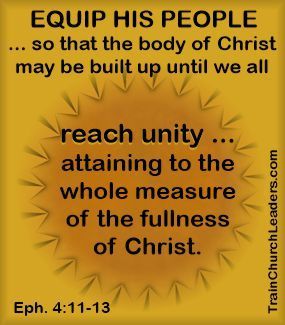
Measure of EffectivenessCertainly God values numeric growth, efficiency, and excellence. And, our programs and pastoral staff can be used by Him to accomplish what He wants us to do. Yet, if we read Ephesians 4:12-13, we learn that we haven’t arrived until . . .

  • we all reach unity in the faith and in the knowledge of the Son of God
  • and become mature
  • attaining to the whole measure of the fullness of Christ.

Ephesians 4:15-16 continues to speak about growing up “into him who is the Head, that is, Christ. From him the whole body, joined and held together by every supporting ligament grows and builds itself up in love, as each part does its work.”

Questions to Ask to Determine if We are Reaching Maximum Effectiveness

Instead of asking how many members, staff, or programs we have, or to what level of efficiency or excellence we have obtained, let’s first ask questions that line up with God’s standard of measurement as found in Ephesians 4:12-13.

  • How well are we getting along in our church?
  • How well do we handle disagreements and differences?
  • Where are people in their walk with God?
  • To what extent are we discipling people to become fully devoted followers of Jesus Christ?
  • How much are we looking to Christ as the Head of the Church?
  • How Christ-like are we?
  • How important is Christ-like character to us?

Once we can satisfactorily answer these questions, then we might find answers to the other types of questions we often ask to measure effectiveness more useful.

But, it’s also important to ask how God intends for us to reach His standard of maximum effectiveness.

Share:

Bible Truths for Coming Alongside of One Another

Share:

Coming Alongside of One AnotherAs noted in the post, Can anybody be a lay counselor?, we’re all called to come alongside of one another. God’s Word provides truths for us to remember that will guide us in the process.

In addition to all the one another commands in the New Testament, we can also find many other applicable truths to apply when coming alongside of one another like the following.

Remember these Truths from the Bible When Coming Alongside of One Another

  • Plans fail for lack of counsel, but with many advisers they succeed. (Prov. 15:22)

We are called to come along side of one another to help each other succeed in their ways, even more specifically to walk according to God’s ways. Let’s remember, however, that the ultimate counselor in a person’s life is the Spirit of God (Jn. 14:16, 26). While God will use us in one another’s lives, we should never presume to be the “fixer”, taking on a role not intended for us.

  • The fear of the LORD is the beginning of wisdom, and knowledge of the Holy One is understanding. (Prov. 9:10)

If we’re truly going to make a difference in people’s lives, we need to steer them toward God and His ways. Let’s remember the ultimate Source of wisdom, God Himself. While other sources, like the field of psychology, might offer some help, we need to run it all through the grid of Scripture.

  • And we urge you, brothers, warn those who are idle, encourage the timid, help the weak, be patient with everyone. (1 Thess. 5:14)

In coming alongside of one another, we must guard against using a one size fits all approach. What helped one person may not be the solution for the next. People encountering the same issue might need a different approach due to background, personality, level of spiritual growth, etc. We might even need to approach the same person one way one time and another the next. Let’s remember to meet people where they are.

  • Not that I have already obtained all this, or have already arrived at my goal, but I press on to take hold of that for which Christ Jesus took hold of me. (Phil. 3:12)

Coming alongside of others can be discouraging if you lack realistic expectations. No one is perfect or will ever fully arrive. We are all a work in progress. We serve others with humility when we remember that about ourselves. We extend grace when we remember this truth about others.

Share:

Spiritual Gifts Used in People Helping Ministries

Share:

Training Category: People Helping Ministry

All believers are called to come alongside of other people to help in time of need. Check out: Reasons to Help

Therefore, as we have opportunity, let us do good to all people, especially to those who belong to the family of believers. (Gal. 6:10)

And do not forget to do good and to share with others, for with such sacrifices God is pleased. (Heb. 13:16)

Yet, there will be those who, by virtue of their spiritual gifting, should focus their time, energy, and resources into helping ministries above and beyond that of other believers.

There are different kinds of gifts, but the same Spirit. There are different kinds of service, but the same Lord. There are different kinds of working but the same God works all of them in all men. (1 Cor. 12:4-6)

Spiritual Gifts Those Involved in People Helping Ministries Might Have:

Click on links below to learn more about the various ways to help people using the different spiritual gifts.

Exhortation:

Mercy:

Service:

Giving:

Hospitality:

As people with these spiritual gifts come along side of others to help in practical ways, showing the compassion and love of Christ to those in need, they must realize that sometimes in addition to “deeds” of kindness, what people need is for someone to simply “be” there with them. People helpers would therefore do well to sharpen their listening skills regardless of what role they take in helping others.

Some people may not have the primary people helping spiritual gifts but may nonetheless have a passion toward these areas or toward people in need. They could fulfill leadership or administrative roles within these ministries. They could be teaching and training others to do the work. They could be praying for the ministry. These believers may not be in regular contact with the people in need but still hold integral roles in this kind of ministry.

People Helping Ministry Manual

The People Helping Ministry Manual includes the above content plus a simple spiritual gifts test that assesses only the gifts primarily used in a people helping ministry … the five spiritual gifts mentioned above. You’ll also find definitions for each of these gifts with possible uses in this kind of ministry.

Share:

Fellowship Defined

Share:

Fellowship is sharing in our common life in Christ.

For More on what we share in common: True Body Life Results in Fellowship

We engage in fellowship by relating to one another in oneness of heart through various means of serving each other in love.

If you have any encouragement from being united with Christ, if any comfort from his love, if any fellowship with the Spirit, if any tenderness and compassion, then make my joy complete by being like-minded, having the same love, being one in spirit and purpose. Do nothing out of selfish ambition or vain conceit, but in humility consider others better than yourselves. Each of you should look not only to your own interests, but also to the interests of others. Your attitude should be the same as that of Christ Jesus: Who, being in very nature God, did not consider equality with God something to be grasped, but made himself nothing, taking the very nature of a servant, being made in human likeness. (Philippians 2:1-7)

Consequently, to define Christian fellowship in the Church we must acknowledge that …

Fellowship is not:

  • standing around talking with a cup of coffee in your hand
  • a one way street wherein one believer gives to or helps another

Fellowship is:

  • the mutual, reciprocal sharing of our life in Christ
  • the fulfillment of the one another commands of Scripture

For more on the reciprocal nature of fellowship, it’s important to understand the nature of the One Another Commands of Scripture.

Body Life Ministry ManualThe Body Life Ministry Manual contains this information in addition to the content in the Body Life Training section of the site. You’ll also find a complete list of the one another commands and an acrostic using the word FELLOWSHIP that pulls together how the one another commands tie into fellowship.

Share:

Guidelines for Developing a Prayer Ministry in Your Church

Share:

Prayer Ministry ManualIf you’ve come here for a 1-2-3 step plan to develop a prayer ministry in your church, you might be disappointed. We can provide general guidance on factors that will make for a more effective prayer ministry but the specifics depend on your church. Where you begin depends on a number of factors. (The link above will take you to the Prayer Ministry training section on the site. To get that content plus more in document form, click on the image cover.)

Questions to Get You Started on a Prayer Ministry Tailored to Your Church

Where do people stand in terms of the value and need for prayer?

You may need to provide some initial instruction or training about prayer to lay the groundwork if people don’t have that sense. Use Sunday School classes, small groups, and sermons to teach about prayer. Don’t forget about the more informal training that comes from providing an example, testimonies of how God answers prayers, little blurbs in bulletins, newsletter, social media feeds, etc. You might suggest helpful resources about praying like books or articles. — To build a culture of prayer in a church takes a consistent, regular emphasis on prayer as well as actually turning to God in prayer at every turn.

If your church already seems to have a culture of prayer, then it may just be a matter of putting a structure in place that works for them. Questions that follow will help you think through a plan tailored to your church.

How many people are truly interested in being a part of a prayer team?

While you probably desire a big turnout, you may need to start with 2-3 people, while laying the groundwork in others. Rather than let that get you discouraged, remember God’s promise that where two or three are gathered in His name, He is there (Matt. 18:20). The excitement of meeting with God in those who come could be a contagion for others to join.

What are the logistics you need to put in place before you begin such a ministry?

While it is often good to connect meeting to pray to a time people are already at church, like before or at the end of a service, rather than making them come out special, it does present some challenges. You need to think that through in order to remove obstacles people might have in attending. For example, depending on the time your worship service ends, you may run into the lunch hour. Depending on the people who stay, you may have childcare issues. The more you think through and plan for these obstacles, the better you will be able to meet with people’s excuses. If you don’t work through these issues ahead of time and people come but get discouraged, you may find it harder to get them out in the future.

How will you structure the meeting?

In some churches a rigid, formal approach may not work. In other churches a more spontaneous approach may not work. Think of the traditions of your church. While you do want to stretch people, taking them beyond where they are in their prayer life, you don’t want to frustrate them or scare them away. Begin where people are and slowly take them beyond. Regardless of the structure, make it worth their while to be there. Make the real focus on meeting with God.

What will you pray about? How will you determine what to pray about?

Perhaps there are specifics you sense this meeting should focus on, growing out of the needs at your church. If you are going to have a pre-planned agenda, be clear with people about the purpose of the prayer time. If people come thinking you are going to pray for their personal needs and you never get around to it, they may soon stop attending. If you are going to open it for personal requests, guard against spending the majority of time taking requests with little time left for praying.

Think through these questions with your church in mind. While you can learn from what others do, begin with where your people are and go from there.

Share:

Prayer a Lifestyle? Praying Part of Your Church Culture?

Share:

Training Category: Prayer Ministry

To pray without ceasing (1 Thess. 5:17) is to make prayer a lifestyle or permanent practice in your life, a part of your church culture. To pray without ceasing is to pray at all times and for all things.

Pray without Ceasing - Lifestyle of Prayer

Setting aside times devoted to concentrated, undistracted prayer in our individual lives and as a church is very important. But, we also need to go through our daily lives attentive to God, consistently asking God His opinion and desires and always giving Him thanks.

To pray without ceasing is what has been called “practicing the presence of God” — always conscious of His presence, turning to Him as a constant companion, making no topic off limits with Him. Keep in mind that we do not need to pray for His presence in our lives. We have His promise that He is already there.

Effectiveness in Prayer Ministry Requires that it be a Permanent Practice

In calling people to prayer, we need to be careful that we are not making prayer come across as a passing fad or following the latest church movement. Prayer needs to be seen as the norm, as the expected response in any and all situations. When prayer is a pattern, we do not just come together for prayer in times of need or crisis. As seen in the example of the early church (Acts 2:42), we will be devoted to prayer wherein we promote a prayer environment and not merely a prayer meeting.

Ways to Model a Lifestyle of Prayer, to Make Praying a Part of Your Church Culture

  • In conversations, ask the person if you can pray with them right then about what was just shared. Soon you may see other pockets of prayer around the church as people follow your example.
  • When someone e-mails you with a prayer request, let them know that you will be praying for them as you send back your reply. You may even type out your prayer or part of it in the e-mail.
  • As you hear or watch the news, silently pray for the current events right then and there or ask those in the room to join with you in prayer.
  • In your sermons or teaching, refer to times when God led you to stop and pray as illustrations when appropriate. People may grab hold of that idea for their own lives.

In addition to this content, the Prayer Ministry Manual looks at what happens when prayer is more a matter of lifestyle, or a pattern, than a sporadic effort. You will also find an assessment using an acrostic of the word “devoted” as we need to be devoted to prayer if it is going to become a permanent practice.

For More on what will help you develop and maintain an effective Prayer Ministry, read the following:

For More About Praying: Resources for Prayer Ministry

Share: