Difficult Times for the Church, Societally

Share:

Difficult Times for the Church SocietallyThe church finds itself in some difficult times . . .

doctrinally
morally
societally
financially

We stand at a crossroad. Will we despair and compromise or will we persevere and stay true?

Challenges the Church Faces Due to Our Society:

We live in a world where we’re supposed to be politically correct and pluralistic (accepting of all beliefs) or face scrutiny, skepticism, and accusations of intolerance.

We live in a world where people want some semblance of spirituality but are not so sure they want what the church offers  … too narrow, too out of touch.

Options for Dealing with Societal Difficulties:

  1. Ignore and further alienate ourselves from the real world.
  2. Combat those who oppose us.
  3. Compromise by watering down truth to make the church more appealing to the masses.
  4. Wisely make the most of every opportunity in ways that stay true to God and His Word.

The fourth option is the most biblical:

My prayer is not that you take them out of the world but that you protect them from the evil one. They are not of the world, even as I am not of it. Sanctify them by the truth; your word is truth. As you sent me into the world, I have sent them into the world.  (Jn. 17:15-18)

Do not conform any longer to the pattern of this world, but be transformed by the renewing of your mind. Then you will be able to test and approve what God’s will is–his good, pleasing and perfect will.  (Rom. 12:2)

Be very careful, then, how you live — not as unwise but as wise, making the most of every opportunity, because the days are evil. (Eph. 5:15-16)

Church Leaders:  Remember the real essence of the church.  Remember God’s desire to present the Bride spotless (Eph. 5:25-27).  It’s your responsibility to line up with God’s purposes and design in all you do, not to appeal to the masses and to lift Jesus up, not ourselves.

All Church Members:  We need to remember that we will stand before the Lord one day, accountable to Him for what we say and do (Rom. 14:12; Heb. 4:13).  His judgment is what matters, not what society deems proper, not what pleases people but rather what the Lord says matters, what pleases Him.
Share:

Difficult Times for the Church, Morally

Share:

Difficult Time for the Church MorallyThe church finds itself in some difficult times . . .

doctrinally
morally
societally
financially

We stand at a crossroad. Will we despair and compromise or will we persevere and stay true?

The Church experiences a morality deficit.

  • Pastors and ministry leaders who have lied, cheated, or fallen into illicit relationships
  • Teachers and ministry leaders allowed to teach and lead even though their lives do not line up with God’s ways
  • Church members who are living more by the standards of the world than God’s Word

Thankfully, the above does not characterize every local church but does for far too many churches.

This deficit leads to difficulties for the Church.

How are we going to be a testimony for Jesus if we don’t live differently than those who do not know Him?

Compromise, integrity breaks, immoral deeds from leadership to church members —

Is it any wonder our society is headed down such a destructive path?  The church, as salt and light in this world, is supposed to function as a moral compass in this world.

Is it any wonder people who might want spiritual life, want little to do with the church itself?  The church, as salt and light in this world, is supposed to attract people, not repel them.

God offers the Church the means of a moral deliverance:

As Romans 7 states, we will have that struggle between the old human nature and doing that which lines up with our new nature.  If we keep getting back to Jesus and the Gospel truth, we will find the help we need to live holy lives.  We must regularly find ourselves at the foot of the cross, grabbing hold of the resurrection power available to us, and relying on the Spirit as our Promised Helper.

What a wretched man I am! Who will rescue me from this body of death? Thanks be to God — through Jesus Christ our Lord! (Rom. 7:24-25)

Church Leaders: Be that example you are called to be.  God clearly specifies qualifications for people in ministry in passages such as 1 Timothy 3, Titus 1, and 1 Peter 5.

“Now the overseer must be above reproach.” (1 Tim. 3:2)  “Deacons, likewise, are to be men worthy of respect.” (1 Tim. 3:8)

All Church Members: Learn what it is to walk in the Spirit.  Live in accordance with the new life you have been granted in Christ.

Live by the Spirit, and you will not gratify the desires of the sinful nature. (Gal. 5:16)

Resources to Help with Your Walk with God

Share:

Difficult Times for the Church, Doctrinally

Share:

Difficult Times for the Church DoctrinallyThe church finds itself in some difficult times . . .

doctrinally
morally
societally
financially

We stand at a crossroad. Will we despair and compromise or will we persevere and stay true?

What seems to be happening doctrinally in the Church:

The doctrinal difficulties we face have consequence. Here’s what can be seen happening:

  1. creeping in of the world’s relative and pluralistic view of truth as opposed to absolute truth

— and so we lack a foundation and have no moral compass

  1. drifting away from apologetics (why we believe what we believe)

— and so it’s easier to be swayed to humanistic thinking and mystical views of spirituality

  1. lessening use of the meat of God’s Word in sermons, teaching, etc.

— and so people have a shallow understanding of truth that does little to affect the way they live

Thankfully, the above does not represent every local church but does for far too many churches.

The end result of these doctrinal shifts and our hope in light of these difficulties:

When the above creep into our churches we start seeing more and more …

  • Bible illiterate people in our churches.
  • non-victorious people in our churches.

But, there’s hope for the Church if we get back to what the Word says:

Then you will know the truth, and the truth will set you free. (Jn. 8:32)

Sanctify them by the truth; your word is truth. (Jn. 17:17)

saved through the sanctifying work of the Spirit and through belief in the truth. (2 Thess. 2:13)

If we want to see people released from bondage and growing more and more Christ-like, then we must present to them the unadulterated Truth of God’s Word.

Church Leaders:  We need to unashamedly and unapologetically stand on the Word of God, to align with Truth.  We need to be ready to give an answer but remember that it is to be seasoned with grace, gentleness, respect, and love.

… prepare God’s people … until we all reach unity in the faith and in the knowledge of the Son of God and become mature, attaining to the whole measure of the fullness of Christ. Then we will no longer be infants, tossed back and forth by the waves, and blown here and there by every wind of teaching and by the cunning and craftiness of men in their deceitful scheming. Instead, speaking the truth in love, we will in all things grow up into him who is the Head, that is, Christ. (Eph 4:12-15)

But in your hearts set apart Christ as Lord. Always be prepared to give an answer to everyone who asks you to give the reason for the hope that you have. But do this with gentleness and respect.  (1 Pet. 3:15)

All Church Members:  We need to return to our roots, to value the authority and life-changing ability of God’s Word (2 Tim. 3:16-17).  Doctrine has application to life and is what will keep you rooted and growing in the Lord.  That is why Truth is an integral part of our spiritual armor, that which holds everything together — “Stand firm then, with the belt of truth buckled around your waist” (Eph. 6:14).  If you struggle with the role of God’s Word, read through the following posts:

origin of the Bible
authority of the Bible
uniqueness of the Bible
accuracy of the Bible
sacredness of the Bible

Let’s remember:  Failure to hold on to Truth only leads to trouble.  —

The wrath of God is being revealed from heaven against all the godlessness and wickedness of men who suppress the truth by their wickedness, (Rom. 1:18)  They exchanged the truth of God for a lie, and worshiped and served created things rather than the Creator–who is forever praised. Amen.  Because of this, God gave them over to shameful lusts.  … Furthermore, since they did not think it worthwhile to retain the knowledge of God, he gave them over to a depraved mind, to do what ought not to be done.  (Rom. 1:25-26a, 28)

Bible Study & Reading Resources
Apologetics Resources

Share:

Difficult Times for the Church

Share:

Difficult Times for the ChurchThe church finds itself in some difficult times . . .

doctrinally
morally
societally
financially

What Will We Do as a Church in Difficult Times?

We stand at a crossroad.  Will we despair and compromise or will we persevere and stay true?

Rather than despair, let’s look at these difficult times as an opportunity to remind ourselves that effectiveness in ministry does not depend on worldly wisdom or human resources.

I am the vine; you are the branches. If a man remains in me and I in him, he will bear much fruit; apart from me you can do nothing. (Jn. 15:5)

His divine power has given us everything we need for life and godliness through our knowledge of him who called us by his own glory and goodness. (2 Pet. 1:3)

Rather than compromise, let’s look at these difficult times as an opportunity to examine ourselves.  Are we living for self and more concerned about what society thinks or are we living for God and more concerned about His glory?

No one can serve two masters. Either he will hate the one and love the other, or he will be devoted to the one and despise the other. (Matt. 6:24)

But I am afraid that just as Eve was deceived by the serpent’s cunning, your minds may somehow be led astray from your sincere and pure devotion to Christ.  (2 Cor. 11:3)

Church Leaders:  You are responsible for shepherding the flock (1 Pet. 5:2-3).  Review a shepherd’s ministry description.  God expects you to not only feed the flock but also to protect and guide them.

All Church Members: You can be doing all the right things but still be missing it if “you have forsaken your first love.  Remember the height from which you have fallen! Repent and do the things you did at first. If you do not repent, I will come to you and remove your lampstand from its place.” (Rev. 2:3-5)

The next four posts will take a brief look at each of the above listed difficulties in which we find ourselves.

Share:

Putting Yourself in Someone Else’s Shoes – How?

Share:

Empathize by Rejoicing and Mourning with Others
In a previous post we looked at why we should empathize with others, concluding that it is both biblical and pragmatic to do so.

Knowing we should do something doesn’t mean we will do it.

How to Better Empathize with Others

We need to intentionally take the following measures to be more empathetic, to truly mourn with those who mourn and rejoice with those who rejoice (Rom. 12:15).

Praying

  • Ask God to build within you a heart of love and compassion that cares about other people’s feelings and opinions.
  • Ask God for wisdom and discernment.  Don’t rely on your own instincts about people.

Observing

  • Actually look at people in their eyes.
  • Take note of people’s facial expressions, gestures, and overall demeanor … not just their words.
  • Pay attention to what is happening in their lives.

Listening

  • Let the other person talk and pay careful attention to what is being said.
  • Do not be quick to jump in with advice or to share your experience.
  • Work at developing your listening skills.

Asking

  • Guard against assuming that you know what a person is thinking or feeling.
  • Use clarifying questions when talking with someone to make sure you truly understand.
Share:

Putting Yourself in Someone Else’s Shoes – Why?

Share:

Recently I put up a two page document on Role Playing as a Bible Teaching Method in the MinTools.com store.  Having students role play a situation helps them develop problem solving skills but also empathy.  They must “put themselves in someone else’s shoes.”

Exercising empathy would help with much church conflict. 

When we look at a situation from only our own perspective or experience base, we risk assigning wrong motives or misinterpreting the feelings, actions, or reactions of others.

When we seek to put ourselves in their shoes, we gain an understanding that often helps us be more patient and supportive of others.

Scriptural Basis for Empathy:

The word “empathy” is not used in the Bible but verses do point to our need for it as we relate to one another.

  1. God Himself empathizes with the people He created.
As a father has compassion on his children, so the LORD has compassion on those who fear him; for he knows how we are formed, he remembers that we are dust. (Ps. 103:13-14)
O LORD, you have searched me and you know me.  You know when I sit and when I rise; you perceive my thoughts from afar. You discern my going out and my lying down; you are familiar with all my ways. (Ps. 139:1-3)
  1. Jesus modeled empathy when he lived on this earth among people and continues to empathize.  Many verses point to His compassion which is an essential part of empathy, leading Him to do something about what He perceived.
When he saw the crowds, he had compassion on them … (Matt. 9:36)
When Jesus landed and saw a large crowd, he had compassion on them and healed their sick.  (Matt. 14:14)
When Jesus saw her weeping, and the Jews who had come along with her also weeping, he was deeply moved in spirit and troubled. … Jesus wept.  (Jn. 11:33, 35)
For you know the grace of our Lord Jesus Christ, that though he was rich, yet for your sakes he became poor, so that you through his poverty might become rich.   (2 Cor. 8:9)
For we do not have a high priest who is unable to sympathize with our weaknesses, but we have one who has been tempted in every way, just as we are–yet was without sin. (Heb. 4:15)
  1. Empathy is a part of walking in love as God loves.
Be imitators of God, therefore, as dearly loved children and live a life of love, just as Christ loved us … (Eph. 5:1-2)
So in everything, do to others what you would have them do to you, for this sums up the Law and the Prophets.  (Matt. 7:12)
Love your neighbor as yourself. (Matt. 22:39)
  1. Body Life demands we empathize with one another.
Empathize by Rejoicing and Mourning with Others
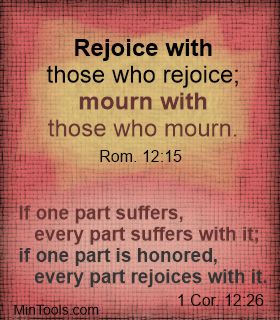
Rejoice with those who rejoice; mourn with those who mourn. (Rom. 12:15)
… so that there should be no division in the body, but that its parts should have equal concern for each other.  If one part suffers, every part suffers with it; if one part is honored, every part rejoices with it. (1 Cor. 12:25-26)
Carry each other’s burdens, and in this way you will fulfill the law of Christ. (Gal. 6:2)
Be kind and compassionate to one another, forgiving each other, just as in Christ God forgave you. (Eph. 4:32)
being like-minded, having the same love, being one in spirit and purpose.  Do nothing out of selfish ambition or vain conceit, but in humility consider others better than yourselves. Each of you should look not only to your own interests, but also to the interests of others.  (Phil. 2:2-4)
Finally, all of you, live in harmony with one another; be sympathetic, love as brothers, be compassionate and humble.  (1 Pet. 3:8)
  1. Effectively reaching out to others requires us to put ourselves in their shoes.
Remember those in prison as if you were their fellow prisoners, and those who are mistreated as if you yourselves were suffering. (Heb. 13:3)
I have become all things to all men so that by all possible means I might save some. (1 Cor. 9:22) … We must conclude that Paul did not literally become all things in every situation but that he identified with them which requires empathy.

An upcoming post will look at how to empathize.

Share: