Train Small Group Leaders

Share:

Due to the potential of life change that can come through small groups, it’s always been important to have leaders who are trained, not only to facilitate discussion, but also to shepherd members of their group. Take some time to examine what you’re doing to train small group leaders in your church. What kind of training do you provide? How encompassing is your support and encouragement?

Train Small Group Leaders to Meet the Challenges of the Days in Which We Live

Small groups form for various reasons and so training always needs to be specific to the focus and primary agenda for their meeting. But, in addition, training needs to prepare small group leaders for challenges relevant to the days in which we live.

  1. Since a question for small groups may no longer be about the “place” where they should meet but rather the online “platform” they should use, additional training may be required.

Some groups may meet online temporarily with others meeting that way for the long haul. Some may use a combination of online and in-person. Small group leaders need to be effectively trained to not only know how to use technology but also how to use it in ways that are safe and productive for their small group.

You’ll first need to determine the best platform for your small group needs (based on number of participants, length of meeting time, cost, group member’s ability to access it, etc.). Some common platforms include:

Church Online Platform
FaceTime
Google Meet (was Google Duo)
Google Chat (was Google Hangouts)
GoToMeeting
Microsoft Teams
Skype
Zoom

Also be sure to train small group leaders about the differences of leading a group online versus in-person. Here are some articles on other sites that can be of help:

  1. Though support groups used to be the main type of group for helping people work through addictions and mental health issues, more and more people are experiencing anxiety and depression today. Almost any type of group will consist of people with these kinds of needs more and more. Are your small group leaders prepared?

Small group leaders need to be trained on how to respond both within the group meeting and one-on-one. How can they and the group be a support system to one another? When is it time to guide the person in finding help outside of the group?

As relates to the days in which we live, perhaps providing leaders with coping skills suggestions to pass on would be helpful. Also remember that leaders too need support and comfort. Here are some articles on other sites that may be of help:

Maybe a study on dealing with anxiety and depression would be beneficial. The following links will take you to one of our affiliate stores:

If meeting online, people may find it easy to hide their feelings behind the screen. Small group leaders need to learn how to observe, connect, and engage with people in ways that get below the surface.

Share:

Joining God Where He is Working

Share:

Years ago my church worked through Experiencing God by Henry & Richard Blackaby and Claude King. We used it in our home fellowship groups, taught on it in Sunday School and from the pulpit, and encouraged people to do the workbook on their own. Through all that investment into this book, the one idea that keeps coming back to me the most is: “Watch to see where God is working and join Him.”

Biblical Basis for Joining God Where He is Working

Blackaby and King used John 5:17, 19-20 as the Scriptural basis for this concept. The idea is that because God is always working, we just have to discern where and join Him.

In his defense Jesus said to them, “My Father is always at his work to this very day, and I too am working.” (Jn. 5:17)

Jesus gave them this answer: “Very truly I tell you, the Son can do nothing by himself; he can do only what he sees his Father doing, because whatever the Father does the Son also does. For the Father loves the Son and shows him all he does. Yes, and he will show him even greater works than these, so that you will be amazed.” (Jn. 5:19-20)

Personal Reflections on John 5:17, 19-20

In reflecting on these verses, I come to the following conclusions:

  1. Sometimes joining God where He’s working may mean flying in the face of tradition. But, it will never contradict the character and ways of God as described in His Word.

It’s important to understand why Jesus spoke these words. He said them “in His defense” of having healed an invalid on the Sabbath. The Jewish leaders claimed Jesus violated the law. But, it wasn’t “the” law He violated, it was “their” law.

  1. Joining God requires getting ourselves out of the way. Personal agendas and human efforts will not be the way to get there. They will just cloud our vision from seeing where God is working.

Even Jesus didn’t follow His own agenda but rather aligned with the Father. If the Son could “do nothing by himself”, how could we ever possibly make true ministry happen on our own?

Personal Example of Seeing Where God Was Working and Joining Him

Foundational Pillars of Truth because of Joining God Where He is WorkingIn a much earlier post I wrote about how God used a 40 Day Challenge I developed to help a friend. I continued to see or learn of God working through that tool in the lives of many more people. I asked God what more He wanted me to do as it was obvious this was one of those situations where God was at work. The result of praying about it? — Foundational Pillars of Truth for Maintaining a Healthy Perspective Discussion Guide to be used in conjunction with the 40 Day Challenge, a tool God has used to help many.

Since God is always working in and through our individual lives, ministries, churches, and in the world, we’ll always have some way we can join Him to accomplish His purposes and mission. Do we have the spiritual eyes to see and the yielded heart to follow?

Share:

Communicating The Same Message Using Different Means

Share:

Part of thinking outside of the box is coming up with different means of communicating the same message. Just because we’ve always done it a certain way, doesn’t mean we must continue communicating that way. Read through the Bible and you’ll find that even God has communicated His message in different ways at different times.

Why We Might Need to Change to Different Means of Communicating

If we don’t grasp good reasons for changing our methodology, we will probably struggle with using different means of communicating. Here are a few broad reasons:

external conditions

We may need to do something different due to the times in which we live. The cultural setting in which we find ourselves may require a different approach. Even a change in ministry staff, with a different set of spiritual gifting, may require a break from the way ministry used to happen. If we don’t adapt, people may get frustrated and stop listening altogether.

changing needs and interests

People don’t stay at the same place. They progress through different levels in both their physical age and spiritual development which brings a new set of needs and interests. If we don’t progress with them, we may soon find our ministry having minimal impact in people’s lives.

realities about the human condition

When something becomes common place, people can become inoculated to it. Boredom can set in. The message heard in the same way starts to fall on deaf ears. If we don’t do something different, at least on occasion, we may find it hard to get and keep people’s attention.

Objective for Using Different Means in Communicating the Same Message

Adapting in Communicating to Reach All
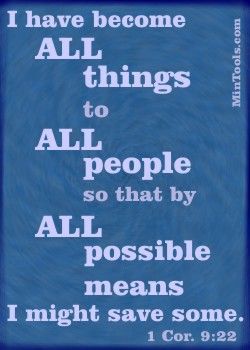
We’re not talking about changing just for the sake of changing. Our objective in adapting must always be to truly reach and impact lives. — “I have become all things to all people so that by all possible means I might save some.” (1 Cor. 9:22)

Share:

Ministry God’s Way

Share:

Serving God’s way means we

align with Him,
use His means,
and do it for His glory.

God provides the power and equipping resources to effectively serve Him through His Word, His Son, and His Spirit. When we look to God as both our Source and Sustenance in ministry, we accomplish all we do under God’s leading and power rather than leaning on our own understanding and efforts.

Key Elements of Doing Ministry God’s Way

Key Elements to Doing Ministry God's Way

The Ministry God’s Way Discipleship Tool Download begins with an overview of what it means to do ministry God’s way and how that makes serving about Him and not us, resulting in eternal results. The resource also includes three pages on each of the following elements, two pages answering some questions relevant to that element and the third page a Bible study about it. (Clicking on the links below will take you to blog articles about the elements.)

Ministry Alignment: Lining Up Ministry with God’s Character & Ways
Ministry Effectiveness: Measuring Ministry according to God’s Standards
Ministry Empowerment: Doing Ministry Through God’s Wisdom, Grace, & Power
Ministry Focus: Putting the Attention on God, Not Ourselves
Ministry Methodology: Trusting God, Not Our Programs & Strategies
Ministry Objectives: Aiming at What Matters to God
Ministry Perseverance: Being Sustained & Strengthened by God to Keep Serving
Ministry Qualities: Being God’s Servant
Ministry Recruitment: Getting the Person of God’s Choosing
Ministry Teamwork: Serving according to God’s Design
Ministry Training: Equipping God’s People
Share:

A Changing Church Still Fulfills God’s Mission

Share:

Though the Church is changing, not everything changes. In addition to continuing to fulfill God’s purposes and live within His design for the Church, we’re also still on the same mission — Jesus’ mission to “go and make disciples” (Matt. 28:18-20).

This mission doesn’t end when life gets difficult or changes. We have the promise of Jesus’ presence “to the very end of the age” so we always have the power needed to 1) reach out to those who feel hopeless and need the Lord, and 2) help those who do hope in the Lord to deepen their faith so they don’t lose heart but rather live in the fullness of life and joy Jesus came to bring us (Jn. 10:10).

Thoughts for a Changing Church Fulfilling God’s Mission to Make Disciples

As a Church, we must make the most of every opportunity to reach out to those around us (Eph. 5:16; Col. 4:5) as we go and make disciples of all peoples. That means we may need to learn new ways to present the Gospel and truth of God’s Word. We must learn to adapt as the Apostle Paul expressed in 1 Corinthians 9:19-23. He said, “I have become all things to all people so that by all possible means I might save some.” To keep that mindset from turning into compromising, always remember these truths:

  • Discipleship will continue to be founded upon the truth of God’s Word which does not change.

faith comes from hearing the message, and the message is heard through the word about Christ. (Rom. 10:17)

Then you will know the truth, and the truth will set you free. (Jn. 8:32)

  • The best discipleship practices will continue to grow out of relationships.

Read through the New Testament Gospel books and note all the time Jesus spent with His disciples. So, even in a digital age, relationships matter. Perhaps there will be times more of our discipling efforts will happen digitally. Nonetheless, even then we need to build into it times for questions, feedback, debriefing, and praying together. Where possible, it would be good to plan for at least one initial in-person contact to help lay the relational foundation.

For Additional Help on Fulfilling God’s Mission to Make Disciples:

Share:

Use Your Spiritual Gifts to Spur Others on to Serve

Share:

Use Spiritual Gifts to Spur One Another on to ServeWhether within the walls or outside of the church building, God intends for us to serve. And, He also instructs us to encourage, or prod, each other to serve.

And let us consider how we may spur one another on toward love and good deeds. (Heb. 10:24)

We are still the Church, whether meeting together or not. We’re members of one another who benefit from each other’s use of their spiritual gifts.

Now to each one the manifestation of the Spirit is given for the common good. (1 Cor. 12:7)

If one part suffers, every part suffers with it; if one part is honored, every part rejoices with it. Now you are the body of Christ, and each one of you is a part of it. (1 Cor. 12:26-27)

It only stands to reason that we would “spur one another on toward love and good deeds” in accordance with the gift(s) God has given us.

Examples of Using our Spiritual Gifts to Spur Others on to Serve

Since the last couple of posts have looked at the seven gifts in Romans 12, we’ll continue using those spiritual gifts for examples.

1) prophecy

People with the spiritual gift of prophecy will tend to be the ones to give warning to God’s people not to be slack or idle (1 Thess. 5:14), pointing them to exhortations in God’s Word like Romans 12:11. – “Never be lacking in zeal, but keep your spiritual fervor, serving the Lord.”

2) service

By doing tasks that need to be done, people with the spiritual gift of service can free others up to devote their time in serving more in accordance with how God gifted them.

3) teaching

Someone with the spiritual gift of teaching could provide training for new or different ways of serving to better equip people for ministry. Or, taking a step back, they may begin with teaching about spiritual gifting and God’s design for the Body.

4) exhortation

People with the spiritual gift of exhortation will tend to “encourage the disheartened” (1 Thess. 5:14) who need to see their potential and believe God truly does have purpose for them no matter what the circumstances might be.

5) giving

Serving can require money or other kinds of resources people don’t have so someone with the spiritual gift of giving can bless them with the finances or supplies needed to do the work.

6) leadership

Many people want to serve but don’t know how to begin. Someone with the spiritual gift of leadership can help them see the possibilities and work with them to set goals for getting started.

7) mercy

People with the spiritual gift of mercy want to “help the weak” (1 Thess. 5:14). They can provide the added support someone with some sort of disability, sickness, or age-related issue, need to be able to serve.

This is the kind of impact we can have on each other, to spur each other on in serving, whether inside or outside of the church building walls.

Not sure which gift(s) you might have? – Online Spiritual Gifts Test

Share: