Ways to Use Spiritual Gifts Outside of Church Walls

Share:

Stewards of Spiritual Gifts Even Outside Church Building

Being a faithful steward of the spiritual gifts God has given, begins with using them. Determining how to use them in what have long been ministries within the Church tends to be more obvious than using them in ways we’re not accustomed to, like outside the walls of the church building.

Determining How to Use Your Spiritual Gifts Outside of Church Walls

Since Romans 12 was referenced in the previous post, take time to consider how the seven gifts listed in that passage might be used to either serve the Church remotely or to serve the community. Below you’ll find the main issue to think about in looking for a way to serve. The possibilities could depend on your specific situation, passions of your heart, available resources, and the like. Take time to pray about how God would have you use the spiritual gifts He’s given you.

1) prophecy

Think of platforms that can be used to speak up about what’s biblically right, to help people know what God, in accordance with His Word, expects of them.

2) service

Think of tasks that need to be accomplished, no matter how menial they might seem.

3) teaching

Think of platforms for a more logical, systematic approach to communicating God’s Word.

4) exhortation

Think of ways to come alongside of people with words that build them up.

5) giving

Think of people or ministries in need of financial assistance or other resources.

6) leadership

Think of ministry that needs to be accomplished that can use some oversight to establish goals and develop a vision for accomplishing those goals.

7) mercy

Think of those who are the vulnerable in our churches or society (i.e., elderly, disabled, poor, sick) with needs to be met.

Get a few specific ideas of how each of the above gifts might be used outside of the church walls in the Ministry Handbook: Spiritual Gifts in Use. That resource expands the list of gift to include gifts found in other passages of Scripture. The majority of the handbook looks at gifting for 16 broad ministry areas under which most of your church ministries typically fall as well as 27 specific tasks that may need to be accomplished in most of those ministry areas.

Not sure which gift(s) you might have? – Online Spiritual Gifts Test

Share:

Spiritual Gifts Used Outside Church Building Walls?

Share:

Often we think of spiritual gifts in terms of ministry within the Church. But,

1) There are ways to serve the Church remotely.
2) There are ways to serve the community.

No Biblical Qualifications Limiting the Use of Spiritual Gifts to Inside or Outside the Church Building Walls

Look at the qualifications for using spiritual gifts in Romans 12:6-8.
Stewards of Spiritual Gifts Even Outside Church Building

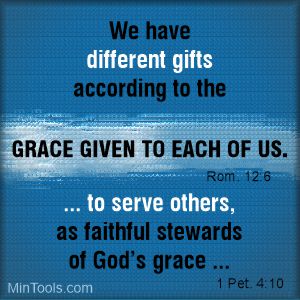
We have different gifts, according to the grace given to each of us. If your gift is prophesying, then prophesy in accordance with your faith; if it is serving, then serve; if it is teaching, then teach; if it is to encourage, then give encouragement; if it is giving, then give generously; if it is to lead, do it diligently; if it is to show mercy, do it cheerfully.

Notice the absence of “where” the gifts can be used.

The emphasis, instead, is on using your gifts:

  • if it is serving then serve
  • if it is teaching then teach
  • if it is to encourage, then give encouragement …

And, we find qualifications on the way you use your gifts:

  • If your gift is prophesying, then prophesy in accordance with your faith;
  • if it is giving, then give generously;
  • if it is to lead, do it diligently;
  • if it is to show mercy, do it cheerfully.

The key? — Use your spiritual gift(s) and do so with the right heart attitude.

Each of you should use whatever gift you have received to serve others, as faithful stewards of God’s grace in its various forms. (1 Pet. 4:10)

You’ll find this content in the Ministry Handbook: Spiritual Gifts in Use which primarily deals with which spiritual gifts fit 16 broad ministry areas under which most of your church ministries would fall as well as 27 specific tasks that may need to be accomplish in most of those ministry areas.

You may also be interest in:


Share:

Christian Nurture a Priority?

Share:

Christian Nurture a Priority to Growth
When we love someone, we want to get to know all we can about that person. Certainly the same would be true of our relationship with the Lord. The more we love Him, the more we should want to get to know Him.

And, we should want that for others in their relationship with Him as well. Hence, teaching ministry becomes a priority in the Church for nurturing His people in ways that lead them to not only know about the Lord but to more intimately know Him.

3 Biblical Reasons Christian Nurture Should be a Priority

  1. Teaching was a major part of Jesus’ earthly ministry. (Matt. 9:35; Jn. 17:6-8, 14, 17, 20)
  1. The Apostles continued teaching people after Jesus ascended. (Acts 2:42; 5:42)
  1. Jesus commanded us to teach others as part of His Great Commission to go and disciple all nations. (Matt. 28:19-20)

Whether Christian nurture takes place in the home or in the various teaching ministries of the Church, may this be our prayer:

We continually ask God to fill you with the knowledge of his will through all the wisdom and understanding that the Spirit gives so that you may live a life worthy of the Lord and please him in every way: bearing fruit in every good work, growing in the knowledge of God … (Col. 1:9-10)

You’ll find these points in the Church Purpose Manual along with other help on Christian nurture as a practical outworking of our love for God.

Resources to Help in Different Venues Where Nurturing Takes Place:

Share:

Effective Bible Teaching Takes Time

Share:

Training Category: Teaching Ministry
Effective Bible Teaching Takes Time Management

We want the results of effective Bible teaching but are we willing to make the investment?

No matter how we look at it, effectiveness will take time and effort.

The Kind of Commitment Needed for Effective Bible Teaching Takes Time

We already looked at how effective Bible teaching takes a commitment based on …

  • being the kind of teacher who makes a difference.

Certainly the nurturing of our own walk with God will take time.

  • relying on the work of the Holy Spirit.

Relying on the Spirit involves trusting God to work in and through us but it also requires making a prayer investment which takes time.

Effective Bible Teaching Takes an Investment of Time & Effort

It’s hard to imagine doing “your best to present yourself to God as one approved, a worker who does not need to be ashamed and who correctly handles the word of truth” (2 Tim. 2:15) without spending time doing the following:

  • structuring lessons that make a difference — lesson planning
  • planning methods that best communicate the content and fit group factors — teaching methods
  • incorporating variety, attention-getting, relevance, and involvement — creativity
  • discerning and meeting students’ needs, developmental abilities, and learning styles — student-oriented

Though effective Bible teaching takes time, the results are so worth the investment.

Help for Bible Teachers: Time Management for Teachers Worksheet

Share:

Effective Bible Teaching Takes Commitment

Share:

Training Category: Teaching Ministry

Whether a parent, preacher, or Bible teacher, we should want our teaching of God’s Word to make a difference in people’s lives. But, are we willing to make the commitment?

While such a commitment will take time (the topic of the next post), effective Bible teaching takes more than outwardly doing all the right things.

The Kind of Commitment Needed for Effective Bible Teaching

Effective Bible Teaching - Commitment Based on Who We Are

Effective Bible teaching requires that we “be” the kind of teacher who makes a difference. Who we are matters, not just what we say and do.

To be effective we need to …

focus on being over doing in our own lives and in our students’ lives,

so that what we do grows out of a good heart.

When what we say and do doesn’t match what’s in our hearts, people soon pick up on hypocrisy and even the “right” words can lose their effectiveness.

Make a tree good and its fruit will be good, or make a tree bad and its fruit will be bad, for a tree is recognized by its fruit. You brood of vipers, how can you who are evil say anything good? For the mouth speaks what the heart is full of. (Matt. 12:33-34)

You hypocrites! Isaiah was right when he prophesied about you: “These people honor me with their lips, but their hearts are far from me. They worship me in vain; their teachings are merely human rules.” (Matt. 15:7-9)

Effective Bible Teaching Therefore Takes a Divinely Empowered Commitment

Think about it: Who builds within us the kind of inner qualities, or spiritual fruit, we need to be effective? — To “be” the kind of teacher who makes a difference takes the work of the Holy Spirit (Gal. 5:22-23).

Effective Bible teachers therefore acknowledge their need for God’s wisdom and power and submit to and rely on His Spirit. They realize that they can’t be effective on their own. It takes a divinely empowered commitment.

Share:

Bible Verses on Ministry Objectives of Greatest Commandments

Share:

Ministry Commandments Aimed at What Matters Most to God, the Greatest Commandments

In a previous post about ministry objectives, six objectives were listed.

The post drew these objectives out of Matthew 22:37-39 where Jesus identified love for God and love for people as the greatest commandments under which all else comes.

Bible verses that back up ministry objectives based on the Greatest Commandments:

Below you’ll find the first two principles with related Bible verses. The remaining principles along with Scripture for them are listed in the Ministry God’s Way Discipleship Tool.

  1. Keep God first in ministry, not the ministry itself or the people we serve.

But seek first his kingdom and his righteousness, and all these things will be given to you as well. (Matt 6:33)

You shall have no other gods before me. (Ex. 20:3)

It is better to take refuge in the LORD than to trust in humans. (Ps. 118:8)

  1. Make ministry about loving God and others, not mere activity.

Love the Lord your God with all … Love your neighbor as yourself … All the Law and the Prophets hang on these two commandments. (Matt. 22:37-40)

If I speak in the tongues of men or of angels, but do not have love, I am only a resounding gong or a clanging cymbal. If I have the gift of prophecy and can fathom all mysteries and all knowledge, and if I have a faith that can move mountains, but do not have love, I am nothing. If I give all I possess to the poor and give over my body to hardship that I may boast, but do not have love, I gain nothing. (1 Cor. 13:1-3)


Share: