The Christian walk with God the Father, made possible due to Jesus’ death on the cross, is a love relationship resulting in Christ-like character and ways.
3 Tips for Cultivating a Passion for Prayer in Others
Teach and preach in a way that people are presented with God as the great God He is, that helps people to understand His ways, and that gives them a good foundation of His Word. In so doing, you will help develop faith, perspective, and discernment that will grow their passion to meet with Him in prayer. A passion for prayer stems out of a passion for God.
Keep the purpose of prayer ever before the people. Take great care that prayer doesn’t become routine or ritualistic.
Vary the approach. Even Jesus warned against vain repetition (Matt. 6:7). Ephesians 6:18 says we should pray with “all kinds of prayers and requests.” Be careful not to get into a rut. Keep your approach fresh so you don’t become dull or desensitized in praying.
For More on what will help you develop and maintain an effective Prayer Ministry, read the following:
Perhaps you have become convinced of the value of studying Bible characters. You may have even taken time to learn how to do character studies. Since the Bible mentions a lot of people in both the Old and New Testaments, you might not know where to begin. While you could start at the beginning of the Bible and move forward, you might find it less overwhelming to limit your study based on the following possibilities.
Bible Character Studies Based on Like Traits or Certain Slants
Click image to learn more about this devotional.
For example, you might study all Bible characters who are said to have walked with God. The Walk the Walk As Those Who Have Gone Before Devotional Guide can assist you in this study. You will learn from the lives of Enoch, Noah, Abraham, Isaac, David Jotham, Hezekiah, and Josiah.
Tip: You can find Bible characters by putting a keyword in a concordance and looking within the context of those verses for people being described as such.
Bible Character Studies Based on Your Gender
If you are a woman, you might want to learn from women like Eve, Hannah, Miriam, Sarah, Hagar, Rebekah, Leah, Rahab, Abigail, Esther, Ruth, Naomi, Anna, Mary Mother of Jesus, Mary Magdalene, Mary of Bethany, Martha, Samaritan Woman, Lydia, Priscilla, etc. – Click on the following to check out the resources in one of our affiliate stores:
If you are a man, you might want to learn from men like Adam, Cain, Abel, Noah, Abraham, Isaac, Jacob, Moses, Joshua, Samuel, Jonah, Gideon, Samson, David, other Kings in the Old Testament, Elijah, Elisha, Ezra, Nehemiah, Job, Daniel, John the Baptist, Jesus’ Twelve Disciples, Stephen, Paul, etc.
Tip: While studying characters of like gender can be helpful, do not limit yourself to only studying people based on that factor. We gain balance and different perspectives in our lives as we learn from those different from us.
Studying Biblical Characters Based on Relationships, Marital Status, or Other Circumstances
Reading about people with similar life struggles, needs, and responsibilities can help us learn how to navigate life and relationships.
Tip: Remember that not all people in the Bible lived each moment with integrity. Learn from both the good and bad in their lives.
Bible Character Studies Based on Ministry
The pages of Scripture contain many examples of people who served God in various capacities. We can learn from their leading, teaching, evangelizing, and a number of other ministries.
Stuck in the rut of reoccurring sins, bad habits, unhealthy attitudes? You want to change but can’t seem to overcome the dysfunction in your life. If this doesn’t describe you, perhaps it describes some of the people you serve.
You might rehearse God’s commands, maybe even memorize pertinent Scripture. Yet, change still alludes you.
(Click to enlarge image in Pinterest & repin.)
Certainly turn to God’s Word because “All Scripture is God-breathed and is useful for teaching, rebuking, correcting and training in righteousness” (2 Tim. 3:16). Memorizing Bible verses follows the example of the psalmist who said, “I have hidden your word in my heart that I might not sin against you.” (Ps. 119:11) — So, why do you, or those you serve, remain the same?
What Do Those Who are Stuck But Want to Change Need?
Changed lives doesn’t come merely by knowing what the Bible says or memorizing it. We start there. We need to get to know the God of the Bible … not just about Him, but to really know Him to the point where we truly rely on Him.
Here’s the flow:
1) The more you get into the Word, the more you will get to know the God of the Bible.
2) The more you get to know the God of the Bible, the more you will trust what He says to be right and true and for your good.
3) The more you trust the God of the Bible to be true, the more you will accept His grace as sufficient not only for eternal salvation but also for following His ways and overcoming in the here and now.
My grace is sufficient for you, for my power is made perfect in weakness. (2 Cor. 12:9)
For the grace of God has appeared that offers salvation to all people. It teaches us to say “No” to ungodliness and worldly passions, and to live self-controlled, upright and godly lives in this present age … (Titus 2:11-12)
4) When you accept His grace as sufficient, THEN you are ready for His power to work in you to make changes where needed and live in ways that demonstrate accountability to and alignment with Him.
Helping Others Get Unstuck
In light of the flow described above, we can help others change, by doing the following:
Make sure our teaching and other ministries aren’t just Bible-based, or Bible-centered, but also focused on helping people get to know the God of the Bible. Without that foundation, there’s little hope for sustained change.
Help people make the leap from what they know about God to how this knowledge applies to their lives. What are the implications of having a Holy God? … of a Gracious God? … of an Almighty God?
Pray that people know Him more and more and trust Him more and more.
For this reason, since the day we heard about you, we have not stopped praying for you. We continually ask God to fill you with the knowledge of his will through all the wisdom and understanding that the Spirit gives, so that you may live a life worthy of the Lord and please him in every way: bearing fruit in every good work, growing in the knowledge of God, being strengthened with all power according to his glorious might … (Col. 1:9-11)
God referred to King David of the Old Testament as someone who walked before Him “faithfully with integrity of heart and uprightness” (1 Kings 9:4) and as a man after His own heart through whose lineage He would send Jesus (Acts 13:22-23). God said of Him, “he will do everything I want him to do” (Acts 13:22). David experienced many trials and hardships yet remained strong. When he sinned, he repented and accepted the consequences from God’s hand. Where did David find such fortitude? — From his view of, approach to, and obedience of God’s Word.
Fortitude in Our Personal Walk Requires an Adequate View of God’s Word
(Click image to enlarge in Pinterest & repin.)
Look at David’s view of Scripture as written in Psalm 19:7-11. Pay particular attention to the emboldened words.
The law of the LORD is perfect, refreshing the soul. The statutes of the LORD are trustworthy, making wise the simple. The precepts of the LORD are right, giving joy to the heart. The commands of the LORD are radiant, giving light to the eyes. The fear of the LORD is pure, enduring forever. The decrees of the LORD are firm, and all of them are righteous. They are more precious than gold, than much pure gold; they are sweeter than honey, than honey from the honeycomb. By them your servant is warned; in keeping them there is great reward.
We find similar sentiments about God’s Word in Psalm 119, though it isn’t clear if David authored that Psalm. The longest chapter in the Bible, this Psalm focuses in on how we can find not only guidance but strength through His Word to overcome anything that may come against us.
I have hidden your word in my heart that I might not sin against you. (Ps. 119:11)
Your word is a lamp to my feet and a light for my path. (Ps. 119:105)
You are my refuge and my shield; I have put my hope in your word. (Ps. 119:114)
Direct my footsteps according to your word; let no sin rule over me. (Ps. 119:133)
Great peace have those who love your law, and nothing can make them stumble. (Ps. 119:165)
Let me live that I may praise you, and may your laws sustain me. (Ps. 119:175)
The psalmist viewed Scripture as his standard for living but also his source of strength to live in alignment. If we don’t have an adequate view of God’s Word and the powerful benefit it brings (2 Tim. 3:16-17), we’re not going to approach it in ways that most profit us.
How We Approach God’s Word Can Determine how much Fortification we Derive from It
The Word isn’t going to benefit us if we don’t turn toward it, which often requires sacrificing other pursuits. And so, the psalmist prayed,
Turn my heart toward your statutes and not toward selfish gain. (Ps. 119:36)
Turn my eyes away from worthless things; preserve my life according to your word. (Ps. 119:37)
The Word isn’t going to help if we don’t remember it. We must keep it ever before us.
Oh, how I love your law! I meditate on it all day long. (Ps. 119:97)
Your commands are always with me and make me wiser than my enemies. (Ps. 119:98)
Fortitude Sustained by Obeying God’s Word
Yes, faith does come from hearing the Word (Rom. 10:17) but faith without works is dead (James 1:22-25; 2:17-20). We will quickly wane in our faith if we don’t apply what we learn to life. We might gain immediate comfort or encouragement from a mere reading of the Word but the real reward comes in obeying it. David acknowledged this reality when writing about the law of the Lord. He said, “By them your servant is warned; in keeping them there is great reward” (Ps. 19:11). We read this same truth in the New Testament:
Anyone who listens to the word but does not do what it says is like someone who looks at his face in a mirror and, after looking at himself, goes away and immediately forgets what he looks like. But whoever looks intently into the perfect law that gives freedom, and continues in it – not forgetting what they have heard, but doing it – they will be blessed in what they do. (James 1:23-25)
And, what a difference it makes when obedience to the Word comes out of love for the Word, not mere duty. Notice what the author of Psalm 119 wrote:
May I wholeheartedly follow your decrees, that I may not be put to shame. (Ps. 119:80)
Your statutes are wonderful; therefore I obey them. (Ps. 119:129)
I obey your statutes, for I love them greatly. (Ps. 119:167)
Point to Remember: If you want a stronger walk with God, then you must spend time with Him in His Word.
The Word itself is that which fortifies us. We meditate on His Word. Nothing ever can, or should, be a substitute for God’s Word.
God does use other tools to strengthen us in our walk with Him. We can learn from others. But, nothing should ever supplant time spent in the Word. If using devotionals or study guides, let’s choose ones that center on the Word, that not only refer to the Bible, but actually get us reading or studying it.
Overestimate the Following And Prayerlessness will be More Likely
If we overestimate our own ability to deal with life, we’ll be less likely to pray at every turn.
Though we’re finite human beings, we sometimes act like we know it all and can do it all. Self-reliance leads to prayerlessness. When, however, we truly understand our own limitations and God’s great wisdom and power, that He’s the Infinite One, we’ll tend to pray more. When we understand how much we need Him, we’ll humble ourselves and turn to Him in prayer, yielding control and trusting Him.
Trust in the LORD with all your heart and lean not on your own understanding; in all your ways submit to him, and he will make your paths straight.(Prov. 3:5-6)
Jesus said, “I am the vine; you are the branches. If you remain in me and I in you, you will bear much fruit; apart from me you can do nothing.” (Jn. 15:5)
If we overestimate our own goodness, we’ll tend to pray less.
We don’t like to admit that we are fallen, depraved people. Yet, the Bible says, “There is no one righteous, not even one; there is no one who understands; there is no one who seeks God. All have turned away, they have together become worthless; there is no one who does good, not even one” (Rom. 3:10-12). We will often be motivated and guided by self-inflation which skews what we do. When we truly understand how much we need God’s grace and mercy in our lives, we’ll tend to pray more. When we truly grasp how our thoughts and ways are not as high as God’s (Isa. 55:9), we’ll realize we aren’t good enough to make proper decisions and we’ll seek God’s guidance and power.
Notice the emboldened words above. When we overestimate ourselves, we have less need for God. If we don’t need God, we won’t sense a need to pray. It’s only when we come to an end of ourselves that we turn to God in prayer. But after we regain our footing, if we aren’t careful and alert (1 Pet. 4:7), we’ll all too quickly return to our self-reliance and self-inflation, once again leading to prayerlessness.
In previous posts we’ve determined that for many prayerlessness probably isn’t due to ignorance or a perceived lack of benefits in praying. Why, then, don’t we pray more? Perhaps it’s because we fail to accurately or wholeheartedly grasp certain factors that will help us pray.
What We Might Underestimate that Leads to Prayerlessness
We might underestimate the work involved in praying.
The following Bible verses show how we need to be actively engaged when it comes to praying — alert, clear-minded, self-controlled, persevering. We can’t merely coast. We can’t be passive or lazy about praying. It’s too easy to lose focus or even fall asleep.
With this in mind, be alert and always keep on praying for all the Lord’s people. (Eph. 6:18)
Devote yourselves to prayer, being watchful and thankful. (Col. 4:2)
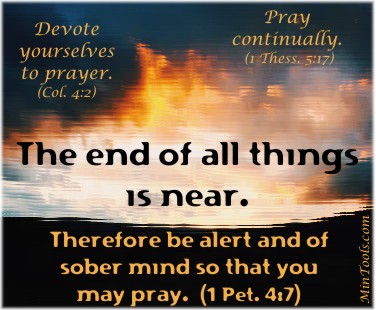
The end of all things is near. Therefore be alert and of sober mind so that you may pray. (1 Pet. 4:7)
We might underestimate the role of the Spirit in helping us pray.
We need to be consistently walking in the Spirit, depending on and yielding to His work in our lives. On our own we might lack the self-control we need to consistently pray but the fruit of the Spirit includes self-control and perseverance (Gal. 5:22-23). We might not know what to say or how to pray, but we have a Helper in the Holy Spirit.
And pray in the Spirit on all occasions with all kinds of prayers and requests. (Eph. 6:18)
In the same way, the Spirit helps us in our weakness. We do not know what we ought to pray for, but the Spirit himself intercedes for us through wordless groans. (Rom. 8:26)
We might underestimate the enemy and consequently don’t pull on God’s mighty power as needed.
God has a formidable foe who doesn’t want us praying. Satan knows the power of prayer. We must be aware of the devil’s lies and schemes to get us to doubt God hears or cares, to believe we’re too busy to pray, or that it doesn’t really matter. We must be proactive, putting on the armor God provides, resisting the devil, replacing his lies with truth.
Be alert and of sober mind. Your enemy the devil prowls around like a roaring lion looking for someone to devour. Resist him, standing firm in the faith … (1 Pet. 5:8-9)
Finally, be strong in the Lord and in his mighty power. Put on the full armor of God, so that you can take your stand against the devil’s schemes. For our struggle is not against flesh and blood, but against the rulers, against the authorities, against the powers of this dark world and against the spiritual forces of evil in the heavenly realms. … (Eph. 6:10-18)
This website uses cookies to improve your experience. By using the site, you agree to the use of cookies. AcceptRead Policy
Privacy & Cookies Policy
Privacy Overview
This website uses cookies to improve your experience while you navigate through the website. Out of these, the cookies that are categorized as necessary are stored on your browser as they are essential for the working of basic functionalities of the website. We also use third-party cookies that help us analyze and understand how you use this website. These cookies will be stored in your browser only with your consent. You also have the option to opt-out of these cookies. But opting out of some of these cookies may affect your browsing experience.
Necessary cookies are absolutely essential for the website to function properly. This category only includes cookies that ensures basic functionalities and security features of the website. These cookies do not store any personal information.
Functional cookies help to perform certain functionalities like sharing the content of the website on social media platforms, collect feedbacks, and other third-party features.
Performance cookies are used to understand and analyze the key performance indexes of the website which helps in delivering a better user experience for the visitors.
Analytical cookies are used to understand how visitors interact with the website. These cookies help provide information on metrics the number of visitors, bounce rate, traffic source, etc.
Advertisement cookies are used to provide visitors with relevant ads and marketing campaigns. These cookies track visitors across websites and collect information to provide customized ads.