Nuts & Bolts Ministries: All Ministries Valued

Share:

Training Category: Nuts & Bolts Ministries
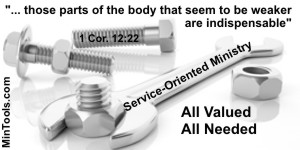
All Ministries Valued - Nuts & Bolts Ministry
According to Ephesians 4:16, everybody has a part in contributing to God’s work through the Church. And, all parts should be valued according to 1 Corinthians 12, not just those with more visible, upfront types of ministries like teachers or leaders.

It also includes the more behind-the-scenes, less visible ministries such as clerical, communications, facilities and grounds maintenance, hospitality, staff support, technical services, and other service-oriented types of ministry.

All Ministries Valued Based on God’s Assessment

If we look at verses in 1 Corinthians 12 we see the value of all ministries based on God’s intent.

But in fact God has placed the parts in the body, every one of them, just as he wanted them to be. (1 Cor. 12:18)

God knows what He is doing. He designed each one of us to serve where He deems important.

If we were to be able to do a cross section of the church at large in terms of the distribution of spiritual gifts, we would undoubtedly find a large percentage of people with the spiritual gifts of helps and service, two of the primary gifts used in these kinds of ministries. Yet, we tend to put more emphasis, or even more value, on those with the gifts of pastor, teaching, leadership, evangelism, or missionary. God, however, knew that the behind-the-scenes types of ministry would be important to holding church life together and that it would take many people to do it. Because of how they tend to hold things together, we’ll call their serving Nuts & Bolts Ministry.

The eye cannot say to the hand, “I don’t need you!” And the head cannot say to the feet, “I don’t need you!” On the contrary, those parts of the body that seem to be weaker are indispensable (1 Cor. 12:21-22)

God puts great value on the nuts and bolts kinds of ministries. According to Thayers Lexicon, the Greek word used for “indispensable” in the above verse signifies that which is necessary, what one cannot do without. Though we might put more emphasis on the upfront leadership and teaching gifts, God does not. In a very real sense, people involved in what we are calling the nuts and bolts ministries, are like the hands and feet of the church.

and the parts that we think are less honorable we treat with special honor. And the parts that are unpresentable are treated with special modesty, while our presentable parts need no special treatment. But God has put the body together, giving greater honor to the parts that lacked it, so that there should be no division in the body, but that its parts should have equal concern for each other. (1 Cor. 12:23-25)

God is the One who has made these kinds of ministries honorable. If God considers people doing these types of ministries valuable, who are we to place less value on them? Rather, we should be protecting and affirming people doing nuts and bolts kinds of ministries. We must guard against elevating certain ministries as more noble.

Not only are the contributions of those doing nuts and bolts kinds of ministry to be valued, like other ministries, they are also essential to the big picture. (Click link to read more.)

The Nuts & Bolts Ministry Manual includes the above content plus implications of it for those serving in these ways, for pastors and leaders overseeing them, and for the Body at large. It also contains a page for each of the six broad categories of ministries, listed in the second paragraph above, discussing the value of it for the Church and implications for those serving in that way, for those overseeing them, and for members of the Body benefiting from their service.


Share:

Christian Counseling: Can anybody be a lay counselor?

Share:

Training Category: People Helping Ministry

In some regards, yes, any believer fulfilling the one another commands of Scripture not only can, but will be a counselor. Undoubtedly a significant portion of professional counseling could be eliminated if the church was committed to living out the ‘one another’ commands of Scripture.

. . . admonish one another . . . bear one another’s burdens . . . build up one another . . . care for one another . . . comfort one another . . . confess faults to one another . . . encourage one another . . . spur one another on

Surely, in this kind of dynamic atmosphere, healing and change would occur. People would find the church to be a safe place, among those who accept one another.

The intent of this post, however, is not to provide a dissertation on the pros and cons of professional counseling. Nor is the objective to provide in-depth coverage of clinical counseling or abnormal psychology. The intent is to help church leaders and workers to more effectively counsel in the normal course of ministry — pastoral, lay, or peer counselors.

Spiritual Gifts in a Lay Counselor

While we can can be involved in counseling others as we live out the one another commands of Scripture, there are those who are gifted to come alongside of people in a more concerted or intentional way. People with the gift of exhortation may find themselves in this role more than those without that gift.

Qualities in a Good Counselor

warmth
genuineness
ability to empathize
ability to listen
confidentiality

People Helping Ministry Manual - Help with Christian Counseling
(Click image to learn more about this resource.)

The People Helping Ministry Manual includes a section on counseling with this content as well as some input on each of the above qualities. Other topics in that section:

Share:

Building a Christian Education Team

Share:

Training Category: Christian Education

Building a ministry team for the administration, coordination, and implementation of your Christian education programs or strategies could be one of the most important tasks apart from the discipleship process itself. If you have the right people involved in this ministry, the likelihood of seeing lives changed through the various strategies and programs will increase.

What to Look for in People When Building your Christian Education Ministry Team

Ask the following questions for each position needed to implement the various strategies in your Christian Education Ministry.  (Click on the links for more about that factor.)

Spiritual Gifts: Does this person have the special divine empowerment to do the task?

Heart Passions: Is the person’s heart drawn toward that group of people, issue, or ministry?

Personality: Does the person give enough attention to details necessary for the task? Or, does the person get along well with people if it is a people-oriented position?

Walk with God: Does the person know Jesus as Savior and Lord? Is the person committed to growing and becoming more Christ-like?

Experience: Is previous experience required? Experience can be helpful but doesn’t always have to be a requirement depending on the position and if the person is teachable and you are willing to invest into the training of the person.

Philosophy: Does the person’s philosophy of ministry sufficiently blend with the philosophy of ministry established by this ministry? How critical are any discrepancies to this person’s ability to be a team player?

Availability: Can this person devote time to adequately prepare and fulfill the tasks needed to effectively minister in this way?

Christian Education in Your Church

This content is part of the Christian Education Ministry Manual along with other information in the Christian Education training section of the site. A simple manual scoring spiritual gifts test, which you are permitted to copy, is also provided that assesses only the eight spiritual gifts most commonly used in Christian Education Ministry. In addition you will find tools for assessing people’s passions and personality temperament to help you find qualities most fitting to the various tasks / ministries to be accomplished in Christian education.

For on the Christian Education Ministry of your Church, read the following:

Share:

Family Ministry: 3 Keys

Share:

The exact structure you use for family ministry is not what really matters. You might have a well-organized, obvious family ministry or one that’s there but more behind-the-scenes. The right plan is what is tailored to your setting and resources, born out of prayer.

Whatever your strategy, though, you will be most effective when you implement these three keys:

Keys to Family Ministry
(Click to enlarge image in Pinterest & repin.)

Key #1: Consistency in Family Ministry

Training, support, and encouragement given to families must be more than an occasional shot in the arm to be most effective. People need repeated exposure to truths that apply to family life. We’re talking about on-going, practical help. What that looks like could vary based on your setting. Perhaps a combination of approaches could best facilitate consistency, possibly increasing the potential for reaching more families than one way alone wouldhdo. Here are some ideas:

  • mentoring relationships

Check out resources under the mentoring tab at: Resources for Discipleship & Shepherding Ministry

  • newsletter or e-mail providing short tips on a regular basis
  • parent support groups
  • pass on links to helpful online articles or resources
  • resource center or library stocked with books and DVDs parents and families can borrow

You can find some resources listed at these pages:

Family Ministry Resources
Biblical Parenting Resources

  • retreats
  • seminars (hosted in-house or attended elsewhere)
  • studies in Sunday School or small groups

You can find some curriculum and studies ideas under the training tab at: Biblical Parenting Resources

Key #2: Communication in Family Ministry

When Bible teachers and children and youth ministry leaders make an intentional effort to communicate with parents, the children benefit. Here’s why:

1) Teachers learn about what’s happening in their students’ lives. This increases their understanding of behavior and needs.

Teacher Training Tool: Without a Good Parent-Teacher Relationship Worksheet Download

2) Parents learn about what’s happening in the classroom and what their children are learning. This gives parents something to build upon throughout the week.

Key #3: Coordination in Family Ministry

Imagine what would happen if Bible teachers not only made an effort to increase communication with parents but if both the parents and the church used the same approach in training and disciplining children. That begins by focusing on the same goal and follows through in using similar means to get there. And, it will involve training parents, Bible teachers, and children’s and youth ministry workers accordingly.

Share:

Family Ministry: Content Matters

Share:

In a previous post I dared to suggest that family ministry is not the solution to what’s wrong with families today. We need to be careful that we aren’t merely trying to fix the symptoms of a greater problem. This is not to say that the church abandon family ministry. The key is that we get to the core and not merely address symptoms. We must be discipling and equipping people with the right emphasis. First is that they be fully devoted followers of Jesus who love the Lord with all of who they are, living in accordance with His Word and lining up all they do with His character and ways. Then, in family ministry it becomes about applying who they are in Christ to their role in the family. With this emphasis, people become more and more the parents they should be. And, they approach family life with the same focus — the heart.

In essence, then, family ministry must be rooted in the right message. Content matters.

It isn’t just about providing sermons, seminars, small group studies, etc. on all sorts of parenting skills and tactics. We need to carefully and strategically choose materials with the message that lines up with what matters to God — the heart. Reflect on these verses:

The LORD does not look at the things people look at. People look at the outward appearance, but the LORD looks at the heart. (1 Sam. 16:7)

Above all else, guard your heart, for everything you do flows from it. (Prov. 4:23)

You can find plenty of parenting help out there that focuses on behavior modification. But, is that going to equip parents to disciple their children in ways that teach them to love and revere the Lord? Is that going to teach them to honor their parents and other family members out of love for God and one another? Content matters.

Shepherding a Child's HeartCheck out the Shepherding a Children’s Heart DVD Curriculum in one of our affiliate stores.

Share:

Family Ministry: Church Solutions

Share:

Family Under Attack
Collapse of the family. Families under assault. We hear these words. We see it.

How do churches handle the state of today’s families?

I’ve seen churches at both ends of the spectrum:

1) Some say the family is broken. We must fix it.

This line of thinking could be reflected by:

  • all, or most all, programming revolving around the family
  • seeking to fill in the gaps through the church’s children’s and youth ministry

2) Others say the family is broken. We can’t fix it.

This line of thinking could be the result of:

  • a sense of hopelessness and despair about how overwhelming of a task it is; a feeling like there isn’t much we can do
  • an underlying belief that it isn’t the church’s responsibility but rather biblically it’s the parents’ responsibility to nurture the family; little effort put into reaching the family

Arriving at Biblical Church Solutions to Family Ministry

Whenever determining a biblical solution to any kind of problem, we must consider the whole of Scripture rather than building our conclusions of select passages. Here are a few points to consider:

1) We must remember that while the Church consists of families, the true Church is the coming together of individual believers from all walks of life, those who have personally put their faith in our Lord Jesus (Jn. 1:12-13; Eph. 2:11-22). Some will be parents. Some will be members of a family who attend. But, some will be single adults who never married. Some will be married couples without families. Some will be widows and widowers well past the child-rearing time of their lives. To revolve all, or most, programming around family or to regularly preach about family matters, is to potentially neglect or isolate others in the Body. We must be considerate and concerned about all (1 Cor. 12:14-27).

2) Yet, we must take into account the importance God places on family. In the beginning God determined it was not good for man to be alone so He made woman for companionship but also for procreation, to be fruitful and multiply (Gen. 1-2). God commands parents to instruct their children in the ways of the Lord, giving guidelines for healthy family dynamics, early on in the Old Testament as well as in the New Testament (Deut. 6:4-9; Eph. 5:21-6:4; Col. 3:18-21). We should also note that among the qualifications for church leadership we find listed how well they manage their families (1 Tim. 3). We must conclude that family is important to God.

3) We must also note God’s design for the Church to be equipping people to live for Him, to do their part, whether that be in their families, church, workplaces, neighborhoods, or wherever they may be. In Ephesians 4:11-12 we read that God placed gifted leaders and teachers in the church “to equip his people for works of service, so that the body of Christ may be built up.”

Implications for Family Ministry:

To apply all of these points to the dilemma about family ministry, we obviously can’t take a hands-off, give up, sort of approach. Yet, neither should we swing the pendulum so far in the opposite direction that we obsess on family. Perhaps we should be focusing on equipping believers in a way that prepares them to take on whatever responsibility they have in life. Ask these questions:

– Are we teaching people to fear the Lord?

The fear of the LORD is the beginning of wisdom, and knowledge of the Holy One is understanding. (Prov. 9:10)

…. If people aren’t getting a good sense of who God is, why should they do family His way? Isn’t His wisdom what needs to be applied to family life?

– Are we teaching people to value and apply God’s Word?

All Scripture is God-breathed and is useful for teaching, rebuking, correcting and training in righteousness, so that the servant of God may be thoroughly equipped for every good work. (2 Tim. 3:16-17)

…. If people aren’t grasping the authority and power of God’s Word, what standard will they use in parenting, in determining family life? Isn’t the Word the parenting and family life manual they need?

– Are we teaching people to love the Lord with all of who they are and to love their neighbor?

Jesus replied: ‘Love the Lord your God with all your heart and with all your soul and with all your mind.’ This is the first and greatest commandment. And the second is like it: ‘Love your neighbor as yourself.’ (Matt. 22:37-39)

…. If people aren’t learning to love, where will they get the motivation to be selfless and honoring among family? Isn’t the nurturing of family to begin in the heart of the parent according to Deuteronomy 6:5-9?

If all we do is teach people parenting skills, we are failing them. If all we do is coach families on how to get along, we are failing them. Jesus gave us the mission of going and making disciples, “teaching them to obey EVERYTHING” He commanded (Matt. 28:19-20) — the “first and greatest commandment” He identified as loving “the Lord your God with all your heart and with all your soul and with all your mind” (Matt. 22:37-38).

Perhaps if the Church sufficiently focused on this purpose and mission, rather than how to fix, or not fix, specific problems, then we’d have a church whose families are healthier. Perhaps what we are seeing are symptoms of a greater problem.

For More Help, Go To: Family Ministry Resources for Churches, Parents, Families

Share: