Biblical Ways to Fellowship with One Another

Share:

Biblical Ways to Fellowship with One Another
The Greek word used in the Bible for fellowship, koinonia, means the sharing of what we have in common (koinos). Our life in Jesus Christ brings us together as that which we share in common, superseding all of our differences. But how do we share, or participate, in that common life? There are at least four biblical ways to fellowship with one another.

Four Biblical Ways to Fellowship with One Another

If we look at Bible verses where koinonia appears, we find the process of fellowshipping with one another.

1) Celebrate together what Jesus has done for us through the Lord’s Supper, also known as Holy Communion.

Is not the cup of thanksgiving for which we give thanks a participation (koinonia) in the blood of Christ? And is not the bread that we break a participation (koinonia) in the body of Christ? (1 Cor. 10:16)

2) Contribute materially to the needs of one another.

For Macedonia and Achaia were pleased to make a contribution (koinonia) for the poor among the Lord’s people in Jerusalem. (Rom. 15:26)

For I testify that they gave as much as they were able, and even beyond their ability. Entirely on their own, they urgently pleaded with us for the privilege of sharing (koinonia) in this service to the Lord’s people. (2 Cor. 8:3-4)

3) Communicate about God’s work in each other’s lives.

that the sharing (koinonia) of your faith may become effective by the acknowledgment of every good thing which is in you in Christ Jesus. (Phil. 1:6)

4) Connect with one another in sharing the whole of our lives on a regular basis, engaging in true community.

They devoted themselves to the apostles’ teaching and to fellowship (koinonia), to the breaking of bread and to prayer. … All the believers were together and had everything in common (koinos). … (Acts 2:42-47)

All the believers were one in heart and mind. No one claimed that any of their possessions was their own, but they shared (koinos) everything they had. … (Acts 4:32-35)

You’ll find these processes of fellowshipping listed in the Church Purpose Manual which looks at fellowship as one of the ways to fulfill our purpose to love people. It also considers other ways to live our our purpose to love God and people.

For More: Fellowship Resources

Share:

Compliments to God

Share:

Compliments to God as We Ascribe to the LordA compliment is “an expression of esteem, respect, affection, or admiration” (Merriam-Webster). Hence, when we give compliments to God, we’re honoring Him for who He is and what He’s done. Biblically we might say that we are:

  • ascribing to God the glory due His name (Ps. 29:2; 96:7-8)
  • expressing His worth (Rev. 4:11; 5:11-14)
  • exalting Him, lifting Him up (Ps. 99:5, 9)

We might also use terms like praising and worshiping God. In essence, we’re telling God how great He is. We’re attributing the glory to Him, praising Him for who He is, and giving Him credit for what He’s done.

God Doesn’t Need Our Compliments

God is worthy whether we acknowledge it or not. Who He is, isn’t based on our recognition of Him. He is who He is. Our compliments, or lack of praise, doesn’t affect His significance and worth.

Through the generations there have been people who have failed to acknowledge Him as the Source (Rom. 1:20-25). Some defiantly turn their backs on Him, disbelieving He could really be great enough to do all Scripture says He did and will do. But a day will come when “every knee will bow” before Him and “every tongue will acknowledge God” (Rom. 14:11).

Compliments to God Show Our Appreciation, Thankfulness, Respect, and Admiration

We express appreciation and thankfulness when we compliment people. God has done, and will continue to do, more for us than all the people combined in our lives.

Think of His wonderful and thorough work of salvation. Who else will love us enough to come and die in our place, or be able to take on the punishment our sin deserves? Certainly such a merciful, gracious, loving, and holy God deserves our compliments.

Think of His Written Word. Who else could compose such a consistent body of truth over the span of nearly 2000 years, dynamic and sufficient to thoroughly equip and teach us, that could stand the test of time and attacks of enemies? Without doubt, we owe such a wise, all-knowing, powerful, and righteous God our compliments.

We express respect and admiration for traits in people we think are commendable. God consistently demonstrates admirable qualities because He is perfect in every way, something we could never say about ourselves or any other human being. Compliments go to Someone we can always depend on to be faithful and true in what He says and does because He can’t deny Himself. He always was and always will be who He is.

Take time today to express compliments to God not just for what He does but also for who He is. He deserves our appreciation, thankfulness, respect, and admiration!

For More About Our God: Theology Resources

Share:

In Anticipation of VBS

Share:

Are you having Vacation Bible School this year? You will have some work ahead, some prayer to invest, some workers to recruit and materials to prepare, as well as promotional efforts. Though time intensive and energy consuming, trusting God to use it should bring an excitement and joy to your soul.

Vacation Bible School Ministry Manual
The following poem of anticipation is included in the Vacation Bible School Ministry Manual. This resource looks at seven steps that will lead to a more impactful VBS, to make what you read below a reality.

‘Twas the Morn Before VBS : Anticipating VBS

‘Twas the morn before VBS and all through the church,
not a car was a stirring, not a person in search.
The tent was hung by the building with care,
in hopes that lots of children soon would be there.
The classrooms were empty; the sanctuary was bare,
not even one person to sit on a chair.
The directors were busy with last minute details,
while visions of blessing their mind couldn’t curtail.
Yes, visions of laughter from children at play,
enjoying recreation every day.
Fun games for all from the littlest to the oldest,
with challenges to see who’d be the boldest.
Our vision didn’t end there, so much more we would share
as we’d welcome each person to a special affair.
There were visions of craft time for each one to make,
a reminder of that lesson’s truth they could take.
There’d be singing and offerings to a mission we’d claim
all for a demonstration of God’s love to proclaim.
One vision would outshine all the others we’d sown,
and that was to make our Lord Jesus Christ known.
They’d learn how God loves them and wants them to be,
a member of His big family.
A new life He’ll give them, one full and free,
one able to reach out and love as does He.
These visions were dancing around in our heads,
and that long winter’s nap … well …
All of the sudden there arose such a clatter,
we didn’t have time to see what was the matter.
Then what to our wondering eyes to appear,
people registered for VBS this year.
The moral of this story is so plain and so true,
God will work through VBS, but that we already knew.

© 2022 Ministry Tools Resource Center, MinTools.com (permission to print for ministry use with copyright info included but not on another website)

Need help preparing for your VBS?

Share:

Pointers on How to Pray

Share:

Often people want steps on “how to” do various tasks or a pattern for how to do it. The same holds true with prayer. Though Jesus did give a pattern for how we might pray in what’s been called “The Lord’s Prayer” (Lk. 11:1-4), He put more emphasis on what goes on inside than the actual words or action of praying.

Pointers Jesus Gave on How to Pray

Throughout the Gospels Jesus spoke about prayer as an attitude of the heart. He modeled prayer that focused more on God than His own needs.

1) Be authentic when you pray.

And when you pray, do not be like the hypocrites, for they love to pray standing in the synagogues and on the street corners to be seen by others. Truly I tell you, they have received their reward in full. But when you pray, go into your room, close the door and pray to your Father, who is unseen. Then your Father, who sees what is done in secret, will reward you. And when you pray, do not keep on babbling like pagans, for they think they will be heard because of their many words. Do not be like them, for your Father knows what you need before you ask him. (Matt. 6:5-8)

2) Be eternally minded in prayer.

Jesus prayed, Father, if you are willing, take this cup from me; yet not my will, but yours be done. (Lk. 22:40-46)

My prayer is not for them alone. I pray also for those who will believe in me through their message, that all of them may be one, Father, just as you are in me and I am in you. May they also be in us so that the world may believe that you have sent me. … I in them and you in me—so that they may be brought to complete unity. Then the world will know that you sent me and have loved them even as you have loved me. (Jn. 17:20-23)

3) Be full of faith when you pray.

If you believe, you will receive whatever you ask for in prayer. (Matt. 21:22)

Therefore I tell you, whatever you ask for in prayer, believe that you have received it, and it will be yours. (Mk. 11:24)

4) Be persistent in praying.

Then Jesus told his disciples a parable to show them that they should always pray and not give up. … (Lk. 18:1-8)

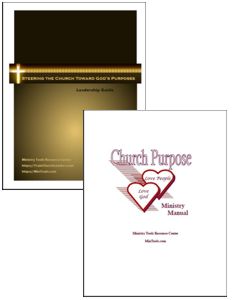
Church Purpose Ministry Manual with Pointers on How to PrayYou’ll find these pointers Jesus gave on how to pray from the Gospels, plus six more points about how to pray found elsewhere in Scripture, listed in the Church Purpose Ministry Manual which looks at prayer as one of the ways we fulfill our purpose to love God.

Share:

Saint Patrick’s Day Is …

Share:

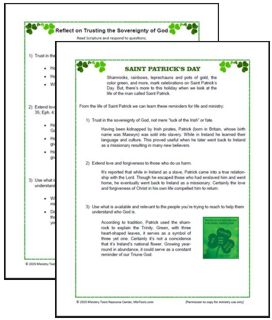
Shamrocks, rainbows, leprechauns and pots of gold, the color green, and more, mark celebrations on Saint Patrick’s Day. But, there’s more to this holiday when we look at the life of the man called Saint Patrick.

St. Patrick’s Day is a time for us to be reminded to trust in the sovereignty of God.

We see this in the life of Patrick (birth name was Maewyn) who was kidnapped by Irish pirates and sold into slavery. It’s reported that he came into a true relationship with the Lord while a slave in Ireland. Though he escaped and went back home to Britain, he eventually returned to Ireland as a missionary, already having learned their language and culture. God used his time there to prepare him for ministry.

Holiday Reflections for Saint Patrick's Day
The Holiday Reflections Discipleship Guides resource includes Saint Patrick’s Day, one of 14 different holidays. It pulls out three important truths about we can learn about the sovereignty of God through the account of Saint Patrick’s life. It provides Scripture and questions for reflection.

Also go to: St. Patrick’s Day Ministry Resources

Share:

Keeping Issues from Blocking Church Growth & Health

Share:

We want to see our churches grow and become spiritually healthy. Yet, church leaders must deal with many issues that can prevent or stunt reaching those objectives. We can, and should, learn as much as we can about the obstacles but keeping issues from blocking church growth and health requires aligning with God’s overall purposes for the Church.

Objective to Grow & Become Spiritually Healthy

First spend some time reflecting on your desire for church growth and health. Ask God to help you understand your part in it and how to handle blockages to that growth. Here are some articles and books that can help you grasp a better understanding of this objective:

Issues That Might Be Blocking the Realization of These Objectives

Obstacles of both a physical and spiritual nature can sometimes block church growth and health. This post won’t provide solutions but rather point to other resources for you to read, reflect on, and pray about.

  1. Physical concerns like safety and legal issues can get in the way of spiritual growth and health if not dealt with effectively. They could become distractions and even cause people to become disillusioned with the church. Perhaps the following resources can help you with these kinds of issues:
  1. Sometimes people stray from God and His ways. Similar to the account of Achan in the Old Testament whose disobedience to God affected the whole camp (Josh. 7), so will sin left unchecked in the Church lessen its light and saltiness in the world (Matt. 5:13-16). If the people in the church act and react no better than everyone else, what’s the benefit of becoming part of it? Church leaders can find help thinking about their role in these situation in the following resources:
  1. When conflict festers in a church, it tends to derail real ministry and can even lead to division. Jesus clearly stated that a house “divided against itself will not stand” (Matt. 12:25). Leaders can become so consumed with putting out relational fires that they have little left to steer the church toward health and growth. If we can’t reconcile with one another and find ourselves wrapped up in political power plays, how are we any different than the world around us?

Keeping These Issues from Blocking Church Growth & Health Requires Aligning with God’s Purposes

We must always remember what Jesus identified as the Greatest Commandments — to love Him with all of who we are which spills over into loving others (Matt. 22:37-40). Jesus also said, “By this everyone will know that you are my disciples, if you love one another” (Jn. 13:34-35). Church life will at times get messy as a diverse group of people come together as one living in a world full of trouble (Jn. 16:33). But, if we keep bringing each other back into alignment with God’s overriding purposes, we will overcome and continue to grow and mature in Him. To keep from letting issues destroy and divide rather than build up and propel us, we need to “Above all, love each other deeply, because love covers over a multitude of sins” (1 Pet. 4:8). Use the resources below to work through how to continue on this pursuit:

Keeping Issues from Blocking Church Growth & Health Requires Aligning with God’s Purposes

More Help for Leaders: Leadership Resources

Share: